Get It Growing: Ask a Master Gardener
Published 3:30 am Wednesday, April 1, 2026
Q: We want to grow apples and sweet cherries. The helper at the nursery said we needed to get two of each type of tree. I don’t think our family can eat that much fruit. Are they just trying to make a buck?
A: Sounds like the nursery people know what they are talking about!
Almost all fruit trees require pollination to set fruit. Pollination occurs when pollen is transferred from the another (male part of the tree’s flower) to the stigma (female part of the flower).
Once on the stigma, the pollen (which contains sperm) produces a pollen tube. Sperm travel down the pollen tube to the ovary of the flower and fertilize its eggs, producing seeds.
The seeds then produce hormones that cause the fruit’s flesh to grow, attracting animals that eat the tree’s fruit and disperse the tree’s seeds, continuing the plant’s lineage.
So why do you need more than one tree, if the tree’s flowers have both male and female parts?
Some fruit trees can pollinate themselves, meaning pollen from their own flowers (or from other trees of the same variety) can fertilize their own eggs and produce fruit. These fruit trees are called self-fertile or self-fruitful.
Some fruit trees, however, require cross-pollination (pollination by a different variety of the same fruit tree type) to successfully produce fruit. Their own pollen cannot fertilize their own eggs. These trees are called self-unfruitful.
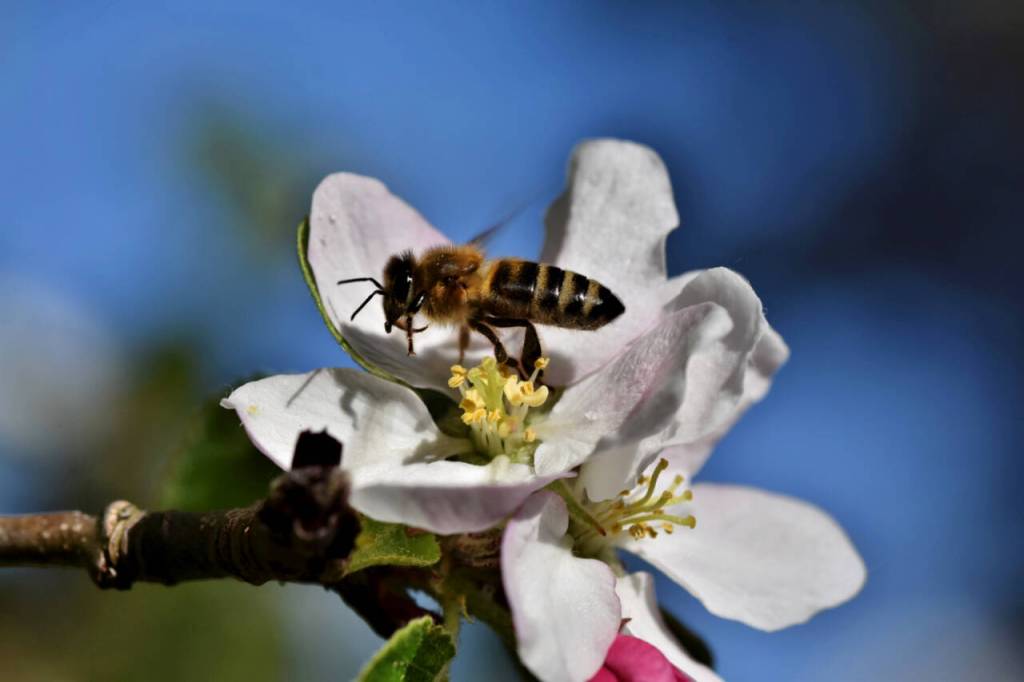
Cross-pollination usually requires a pollinator such as an insect, most commonly a bee, or other small creature to move between flowers on different trees. The pollinators are primarily collecting nectar but are also unknowingly transferring pollen from one flower to another.
Plants attract pollinators by producing showy flowers, tasty nectar, or an attractive scent, all of which use the plant’s energy. So, what’s in it for the plant?
Cross-pollination results in increased genetic diversity of the plant’s offspring. Increased genetic diversity increases offspring adaptability to changing environmental conditions, pathogens, and other stressors. Cross-pollination also prevents the accumulation of harmful mutations that are associated with inbreeding. Both end results improve the survival of that plant’s lineage — the reason why plants produce fruit in the first place.
Not all varieties of the same type of fruit can cross-pollinate each other. The varieties must bloom at the same time and be genetically compatible. Varieties that are too closely related are often unable to cross-pollinate each other.
Furthermore, a few varieties of fruit trees don’t produce any viable pollen; the plants cannot pollinate themselves nor any other trees. Examples include Gravenstein, Jonagold, and Winesap apples. If you plant one of these fruit tree varieties, a third variety is needed to ensure that there is fertile pollen available for all three trees.
Even with the presence of a compatible cross-pollinating tree, fruit tree pollination is not always assured.
Cross-pollinating trees need to be in close proximity — no more than 100 feet apart — to ensure that insects and other pollinating creatures move between them.
Cool temperatures and wind during bloom can reduce bee activity and the resulting cross-pollination.
The presence of flowers that are more attractive to the pollinators (e.g., those that produce more nectar) can decrease pollinator visits to fruit trees.
The use of insecticides can hurt pollinating insects and reduce their ability to act as pollinators.
Bottom line: For both apple and sweet cherry trees you will need at least two varieties of each.
Do your homework. Determine which varieties are compatible. Plant and care for the trees to facilitate cross-pollination and avoid the use of insecticides to protect the pollinators in your garden.
Have gardening questions?
Clallam County Master Gardeners will hold Garden Clinics from 10-11:30 a.m. on the second Saturday of every month through September at the Fifth Street Community Garden at 328 E. Fifth St. in Port Angeles. Master Gardeners will be available to answer gardening questions, give vegetable gardening advice, and show visitors around the garden. Stop by on April 11 and see what should be happening in Clallam County vegetables gardens at this time of year.
___________________
Pollination requirements of common fruit trees
Self-fruitful* (can pollinate their own flowers)
- Apricots
- Citrus
- European plums (Prunus domestica)
- Nectarines
- Peaches
- Pears
- Sour cherries
Self-unfruitful (require cross-pollination by a different variety of the same type of fruit)
- Apples (with a few exceptions)
- Chinese/Japanese plums (Prunus salicina and their hybrids)
- Filberts/hazelnuts
- Sweet cherries (with a few exceptions)
*Many fruit trees that are considered self-fruitful produce a bigger harvest of a higher quality with cross-pollination.
___________________
Jeanette Stehr-Green is a WSU-certified Clallam County Master Gardener.