Get It Growing: Heather vs. heath: Why not both?
Published 4:30 am Wednesday, October 8, 2025
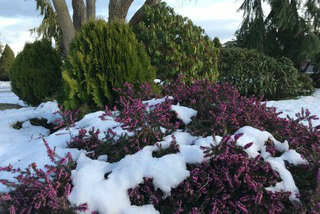
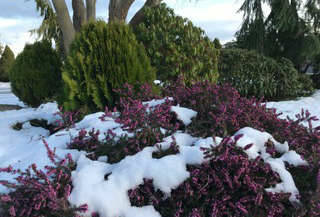

Plants of the heather family (Ericaceae) represent one of the most useful components of gardens in the Pacific Northwest. Not only are they evergreen and supremely adapted to the climate and soils that occur on the Olympic Peninsula, they can provide color in every season of the year.
While most people think of all plants in this family as being heathers, there are two major sub-groups: the true heathers, belonging to the genus Calluna, and the heaths, belonging to the genus Erica. While very similar and often confused, each sub-group has its own botanical characteristics.
There is a clever mnemonic to help distinguish the plants: ”Heathers have feathers, heath have teeth.” The leaves of the heather are small and scale-like and the way they overlap gives the branches a soft feathery look. In contrast, the leaves of the heath are needle-like with pointed tips, which gives it a prickly appearance.
Heath and heather plants are available in a wide range of flower colors, including white and various shades and intensities of pink, red, and purple. In addition to flowers, their evergreen foliage provides year-round interest, with varieties featuring shades of green, gold, bronze, and even chartreuse.
Heathers, native to northwestern Europe, are typically taller and spread sideways at a slower rate than the heaths, which are typically lower growing. Generally, heather is hardier than heath and will usually bloom sometime in the summer and into late fall, sometimes twice.
Heaths have an extensive native range from as far south as South Africa and north as Alaska, also including Ireland, Spain, and mainland Europe.
Heath is generally more compact and spreads outwards at a faster rate than heathers. It outshines its close cousin, heather, with over 700 species and countless varieties, some reaching 10- to 20-feet tall and earning the name ‘tree heathers’ for their spectacular size. Heath also is more often found blooming in winter, making it an interesting choice for many gardens.
Both heath and heather grow best in acidic soils but will tolerate most conditions, provided the soil is not high in lime. On the Olympic Peninsula, the ideal planting seasons are spring and fall. If planted in spring, regular watering is important throughout the summer dry periods, especially during the first year after planting. If you wait to plant until fall, the plants can take full advantage of the approaching rainy season to establish strong roots.
Young plants should be planted with the foliage almost touching the soil surface, with mulch drawn back from the main stem. Plants should be spaced at 12- to 18-inches apart, in groups if possible, to allow for side spreading and filling out in the flower beds. Heather and heath planted alone are lovely, but they often make more of a statement if planted in groupings.
Both of these plants are very low maintenance, requiring very little fertilizer and only needing a slight haircut after they are finished blooming. Which to choose? Why not plant both? Heather and heath can be a beautiful, low-maintenance addition to the garden.
____________________
Susan Kalmar is a WSU Clallam County Master Gardener



Best of Olympic Peninsula