Harnessing the wind
Published 4:48 pm Tuesday, September 16, 2014
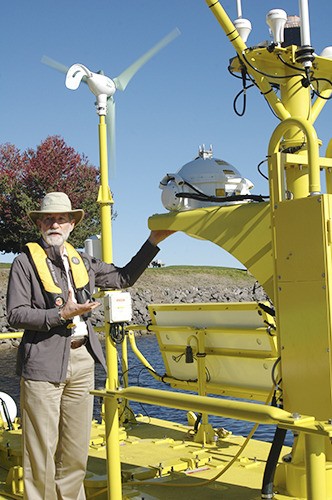
The United States has yet to generate energy from the estimated multi-megawatts of unharnessed energy offshore winds withhold, but that may soon change.
More than a year’s worth of collaboration from many researchers from varying facets of the scientific community have come together to mark a milestone in offshore wind energy research. Scientists with Pacific Northwest National Laboratory (PNNL) plan to commission two buoys outfitted with state-of-the-art technology by the end of the week.
The buoys will undergo about a month of tests in Sequim Bay and near Dungeness Spit to ensure the oceanographic and meteorological equipment aboard the buoys functions before being deployed into the open ocean, said William Shaw, atmospheric chemistry and meteorology scientist for PNNL.
“These two buoys represent a significant new investment by the Department of Energy to advance the development of offshore wind energy,” Shaw said.
Each 20,000-pound buoy, fully equipped, costs $1.3 million. Officials with the Department of Energy “understood” the need for additional information on offshore wind energy and recognized PNNL’s Marine Sciences Laboratory in Sequim as an ideal place to commission the research given the facility’s staff and unique location with ready access to the water, Shaw said.
Although the staff at the Marine Sciences Laboratory accounts for only about 85 of PNNL’s nearly 4,000 employees, Charles Brandt, Marine Sciences Laboratory manager, said the structure of the lab and researchers are prepared for such projects and pull from the large pool of scientists within PNNL to create a multidimensional team.
The PNNL research team also has worked with additional national agencies, such as the National Oceanic and Atmospheric Administration and the U.S. Fish and Wildlife Service to study the potential negative impacts offshore wind turbines may have on marine mammals and birds, but Shaw said they don’t expect any adverse impacts. Though, any impacts, such as noise would be mitigated as much as possible.
Motivation
“Our real motivation behind this research is to reduce the uncertainty of the amount of offshore wind energy available,” Shaw said.
Once scientists have a firm prediction of the actual amount of energy blowing freely about the open ocean, the risks in such investments are reduced and therefore the costs are reduced, too.
The buoys and the advanced devices they’re equipped with will allow researchers to gather the additional information needed to better the existing computer models used to estimate the amount of offshore wind energy, Shaw said.
The lack of long-term measurements has been a barrier in offshore wind energy development and research, Shaw said. However, the buoys and equipment have the potential to fill the void in research.
Following the monthlong tests at Sequim Bay and the Dungeness Spit, the buoys are anticipated to be deployed into the open ocean the beginning of November. Once deployed, data will be collected for at least a full year in order to gather data during all seasons.
The deployments will occur at two of the Department of Energy’s offshore energy demonstration sites, Shaw said. Both buoys will be about 20 miles offshore near Coos Bay, Ore., and Virginia Beach, Va. The demonstrations are expected to be complete by 2017, Shaw said, and the implementation of offshore turbines is anticipated to shortly follow.
Roughly 5 percent of U.S. energy is produced by terrestrial wind, Shaw said, but the estimated potential for offshore wind energy is more than 54 megawatts or equivalent to the capacity of about 25 nuclear power plants.
Given the growing presence of terrestrial wind energy, it is becoming an economically competitive alternative to some of the more traditional types of energy generation (depending on location and associated energy costs), but offshore needs to be competitive too, Shaw said.
Importance of ‘lidar’
A key component of the research under way are instruments called “lidar,” which stands for “light detection and ranging,” but are best thought of as sets of lasers that can shoot into the atmosphere well above the buoy. Lidar can record the atmospheric conditions 600 feet above the sea’s surface while correcting for the motion of the buoy.
Unlike previous offshore energy research, Shaw said, these buoys and their equipment will provide the ability to collect a series of data including wind speed and direction, air and sea surface temperatures, barometric pressure, relative humidity, wave height and period, water conductivity and subsurface ocean currents.
With the combined information gathered by the buoys, PNNL scientists, like Shaw, can further their understanding of how the air and sea interact and thus further their understanding of offshore wind energy.
Previous offshore wind energy research primarily has occurred at the ocean’s surface and atmospheric conditions hundreds of feet above the surface tend to be different, Shaw said.
Because the blades on the potential offshore wind turbines can be 70 meters long, or half the length of a football field, Shaw and his team of researchers need to understand the conditions the blades may experience, despite being 600 feet in the air.
“This is a great adventure for us scientists,” Shaw said.
Rewards yet to come
Although terrestrial wind farms do produce energy and have much potential, many of the places, such as the Dakotas, that provide ideal conditions for turbines are too far from human development to be efficient, Shaw explained. However, the transmission distant of offshore wind energy can be much shorter. The energy captured from the offshore wind turbines will be transmitted to shore via cables.
Additionally, from past research, the sea breeze happens to correspond with the peak energy consumption, or “load matches,” Shaw said. With about 70 percent of the U.S. population located along the coastlines, offshore wind energy could directly impact more than half the U.S. population. And, even developed areas too far inland to receive energy directly for offshore wind would be positively impacted. Once installed, offshore wind turbines don’t produce any carbon into the atmosphere, energy generated within U.S. is energy independent and the industry would produce jobs.
“The most rewarding part is yet to come,” Shaw said. “We’ll have truly unique data.”
And with that unique data, Shaw and his colleagues can better understand offshore shore wind energy and thus take one step closer toward tapping into the enormous potential.
The data derived from the buoys throughout the course of the next couple of years will be available to the public via online.
For a video of the buoys and Shaw explaining the offshore wind energy research, visit www.youtube.com/watch?v=AIPrf2kfiYw.
About PNNL’s Marine Sciences Laboratory
The Marine Sciences Laboratory, headquartered at the Pacific Northwest National Laboratory’s Marine Research Operations located in Sequim, is the Department of Energy’s only marine research laboratory. The unique facility and its researchers deliver science and technology that is critical to the nation’s energy, environmental and security future.
Phone: 683-4151
Location: 1529 West Sequim Bay Road
On the web: marine.pnnl.gov



Best of Olympic Peninsula