
Preserving the summertime abundance from our local farms can be a daunting task, but there is no denying the satisfaction that comes from transforming a counter-top full of glowing, fresh produce into a finished product. These edibles can be neatly stored away to share with friends and enjoy for several months, even after the fields have been turned over with cover crop beginning to sprout in the cool soil.
Fermentation is an age-old method of preservation with many nutritional benefits as we consume these foods into the fall and winter months. Fermentation is really quite a simple process that can yield delicious results, with a few key ingredients.
Fresh, local and organically-sourced vegetables are important, as the vegetables provide the inoculant for successful fermentation. Purchasing from sources that use chemicals or sterilizing washes may compromise the inoculation that creates the appropriate environment for fermentation to occur.
Choosing to use vegetables freshly harvested from healthy soils is the best way to set yourself up for a successful fermentation experience. The Sequim Farmers Market, open each Saturday from 9 a.m. to 3 p.m., is a great place to start!
After sourcing your vegetables, the only other critical ingredient is salt to create the brine, which aids in maintaining the health of beneficial bacteria that are helping with the fermentation process, while discouraging the growth of bacteria that would spoil the vegetables.
You may also choose to use fragrant herbs, seeds, and spices to achieve the desired flavor you wish to achieve.
Lactic acid is the main by-product of fermentation, and this is what preserves the food to prevent it from rotting. Fermenting vegetables actually increases their available vitamin content, and makes them easier for our bodies to digest. The lactic acid promotes growth of beneficial flora in our intestines, and the fermented foods provide us with healthy enzymes and a great boost for our immune systems as we enter the fall and winter months ahead.
Cabbage conversion
Making sauerkraut is an excellent way to get started. What you will need is one head of cabbage, salt and a 1-gallon glass jar with a wide mouth and lid.
After discarding the first outer leaves of cabbage, set aside two-three clean large outer leaves and save them until the end.
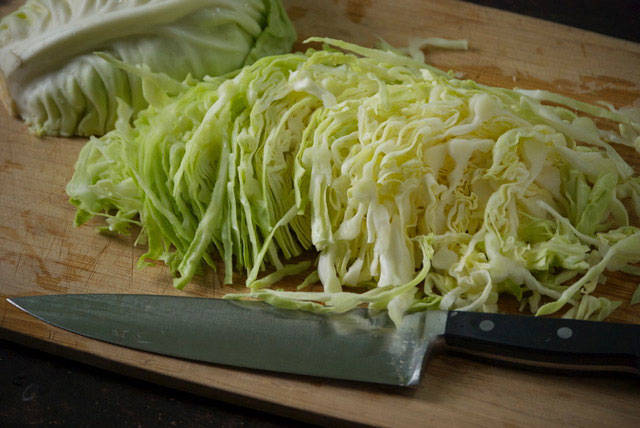
Shred the entire cabbage with a sharp knife or a food processor, and in a large bowl sprinkle it with salt: about 1/2 tablespoon for every 2 pounds of cabbage.
With clean hands, toss it until the salt is mixed evenly throughout.
Next, begin adding the cabbage mixture to your clean glass jar, adding pressure to each layer that you put in. You can use your clenched fist to push it down, or you can use a wooden kraut-pounder (beautifully functional, hand-made kraut pounders are available from Lady and the Carpenter at the Sequim Farmers Market).
You will begin to notice that the salted cabbage is releasing moisture to create a brine. Be sure to leave several inches of space at the top of the jar, as the cabbage will continue to release moisture for the next couple of days.
Once you have filled the jar, wipe off any cabbage debris that is left on the insides of the jar opening, and carefully place the large cabbage leaves that you set aside in a layer that blankets the shredded cabbage.
Now you can use a small, clean stone or jar that fits snugly inside the mouth of the large jar, and press it down firmly with the lid of the gallon jar. You should see the brine rise up over the shredded cabbage, and you can hold it in place with a single twist of the lid; don’t seal the lid tight, as gas is released during the fermentation process.
Set the jar aside in a cool, dark space such as in the pantry or the garage. Be sure that the brine is completely covering the shredded cabbage throughout the fermentation.
After a week, carefully remove the blanket of leaves to taste the shredded cabbage.
You can continue fermenting it for up to one month, depending on your taste preference. When it has a flavor that you like, you may seal the jar and store it in the refrigerator to enjoy as a probiotic condiment that is suitable for just about any meal.
In refrigeration, your sauerkraut will keep for up to one year.
At the market …
Enjoy our summer live music series with Mixed Company, performing this week from 11 a.m.-2 p.m. A special thanks to Bell & Davis Law, Brokers Group Real Estate and First Federal Savings & Loan for supporting the Sequim Farmers Market.
Elli Rose is the Sequim Farmers Market manager. Contact her at manager@sequimmarket.com or 360-582-6218, or see www. sequimmarket.com.