“Theater is important for so many things,” says Michele Canepa, one of the drama teachers at Olympic Peninsula Academy.
“It helps students by allowing them to be someone else for a time. They can be someone who isn’t struggling with anxiety, or isn’t shy… and while they are learning to do that, they have a safe place to fall and get back up again. It also helps them work as a community.”
Students at Olympic Peninsula Academy (OPA) will perform two plays at Sequim High School auditorium, 533 N. Sequim Ave, on June 3 and 4.
Students in grades 1-5 open with a 15-20 minute performance of “Dragon Trouble” at 7 p.m. on Friday and 1:30 p.m. on Saturday, with students in grades 6-12 following with “The Big Bad Musical” both afternoons, and a third performance at 7 p.m. on Saturday.
The performances are free of charge, a $5 donation is suggested.
Light snacks and refreshments will be available during intermission.
“The monies made go back into the OPA drama program for sets, costumes, scripts, etc.,” said Canepa.
COVID and cramming
Canepa and Dee Dee Nielsen have been in charge of the drama department since 2008; this will be their 13th production. Together with music director Sara Benjamin, the pair have been working intensely with students and volunteers to prepare the production.
This will be OPA’s first production since 2019; COVID-19 shut down the production students were preparing for the spring of 2020, to the lasting disappointment of those involved.
Teachers “didn’t even know until this semester” if they would have a production this year, leading to an abbreviated preparation time, Nielsen said. Students received their scripts in late March.
“We’re cramming,” said Nielsen. “We had one week to build all our sets.”
“We spent the week at the theater after rehearsals building sets, painting and working out the quirks in the sound system,” said Canepa. “The students are working hard to prepare.”
New to the stage
“Dragon Trouble,” stars 20 elementary school-aged performers, many who have never been on stage before. Familiar characters like knights, princesses, dragons and tricksters are depicted in an unusual way. It also features an uncommon character: a jackalope, a mythical jackrabbit with antlers often seen in postcards from the southwest.
At a recent after-school rehearsal the students were working on projecting, blocking and remembering their lines, appearing joyful both on and off set.
Two narrators, Bradley Mader and Ashley Elliott, stand on either side of the stage, explaining the action as it unfolds. Every child except the jackalope (played by Azlyn Blessington) has a speaking part.
Elliott said that this is the first time she’s been in a play and has learned about projecting and memorization. She said she tried out for the narrator role and “luckily” got chosen.
“It’s cool that I get to be with with my friends in this play,” Elliott said.
The Big Bad Wolf
The sixth-12th grade performance “The Big Bad Musical” centers on a trial, putting three crimes of folk story wolves together at the feet of one wolf.
It features a gifted cast of 18 new and experienced performers. Nolan Valenzuela anchors the cast and set as the kooky judge, seated back center stage, with the defendant and her attorney, played by Paloma Franco and Kailah Blake, on stage left.
Prosecutor Aiden Carlquist-Bundy or understudy Aiyana Dennis dominate stage right, while behind sit a powerful group of character actors, whose performances feature many laugh-out-loud moments.
Malachi Byrne takes front center stage periodically as a TV reporter.
“It’s a pretty good role,” he said.
Students said they like the plot line of the play and that it’s been challenging because of starting so late. They said they appreciated the chance to “become a different person” and that they enjoy being together.
Nielsen and Canepa “have taught me so much,” said Valenzuela, a ninth-grader who has been in the program since first grade, where his first role was as a knight in “Dragon Trouble.”
These young performers are rehearsing three different endings to the play. Which one will be performed will depend on each audience, because they will be the jury.
The cast has a special experience in store for Saturday night: a one-time performance imitating a blooper reel.
Traditions, challenges
Nielsen said that many siblings and some cousins are involved in the two plays. She said it is a normal thing at OPA for families to have multiple children go through the program and for people to come back after graduating to help out with productions. Her own daughter and son-in-law, graduates, are helping with production.
“OPA students work alongside family members in our performances,” Canepa said.
OPA is built around cooperation between families and school.
“Our mission is to support and encourage families of Sequim School District by providing customized educational opportunities and resources, with a commitment to flexibility and choices, regarding the educational direction of students,” Canepa said.
Singing solos on stage can be nerve-wracking, especially if it is the first time doing so before a live audience, but the performers bravely take it on, coached by Benjamin.
“We tried for years to teach [students] to project,” Nielsen said. “But we had kids that were too shy and it’s not fair to the audience to not hear them.”
Nielsen and Canepa emphasized the importance of encouraging every student to perform, regardless of personal challenges.
“We’ve had students who were deaf, autistic or with Asperger’s,” Nielsen said. “We shouldn’t let those kinds of things hold them back.”
The teachers said that at OPA they “choose plays by the cast rather than choosing the cast by the play.”

Princesses played by Josephine Bauer and Madelynn McIntyre discover destruction in “Dragon Trouble,” a play performed by 20 1st-5th graders from Olympic Peninsula Academy on June 3 and 4 at Sequim High School auditorium.

Rivers Maynard, Madelynn McIntyre, Sophia Mason and Brooklynn Glavin grapple with repairing the castle in “Dragon Trouble”, a play performed by 20 1st-5th graders from Olympic Peninsula Academy on June 3 and 4 at Sequim High School auditorium. Sequim Gazette photo by Emily Matthiessen
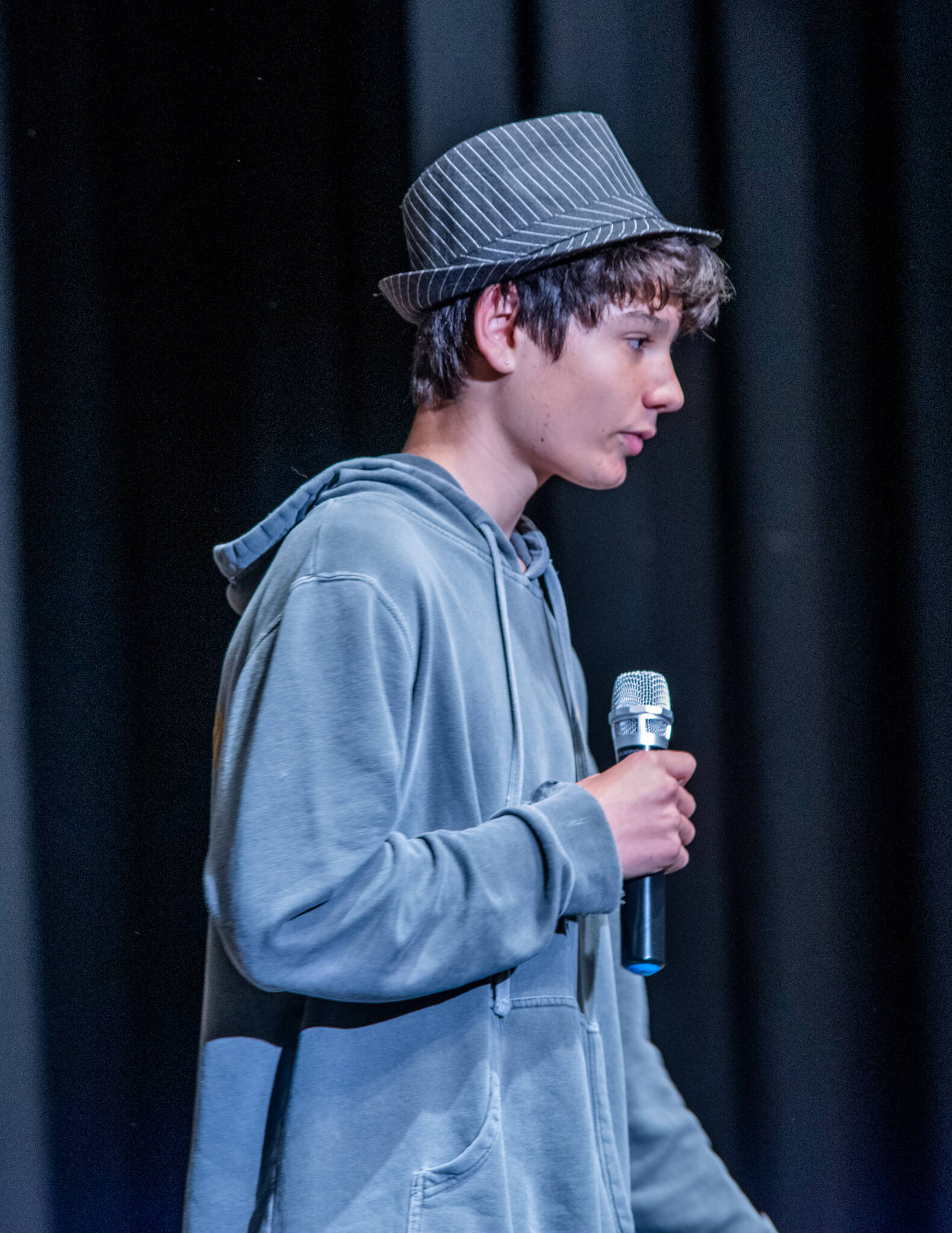
Malachi Byrne reports on the trial in “The Big Bad Musical,” a performance by the 6th-8th graders from Olympic Peninsula Academy on June 3 and 4 at Sequim High School auditorium. Sequim Gazette photo by Emily Matthiessen

The Three Little Pigs swear an oath in (names soon) Sequim Gazette photo by Emily Matthiessen

Sequim Gazette photo by Emily Matthiessen Princess Sopia Mason and dragon Bekah Abken interact in “Dragon Trouble,” a play the 1st-5th graders of Olympic Peninsula Academy are preparing to share with the public on June 3 and 4.
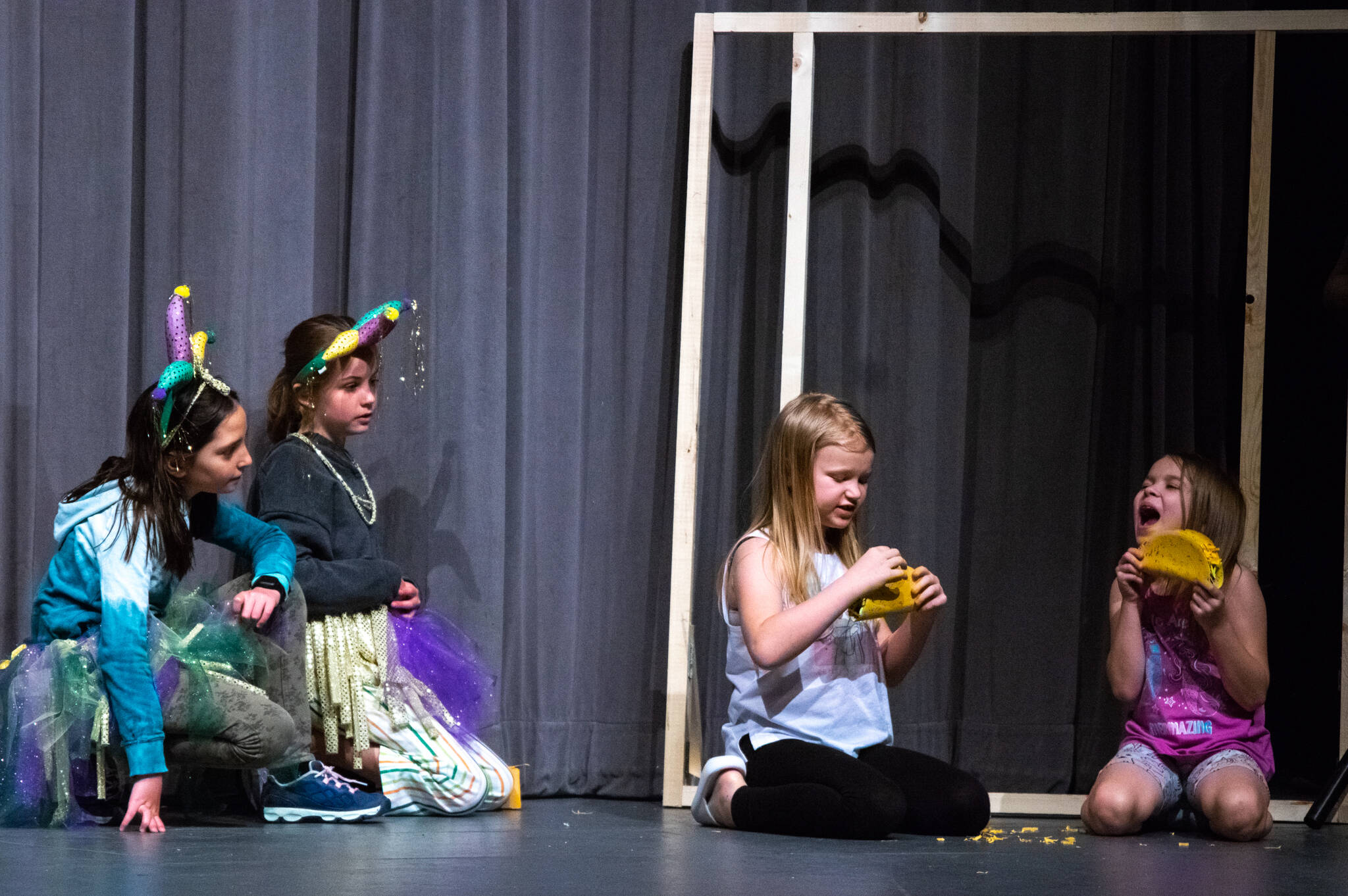
Tricksters played by Mia Buhrer and Matilda Woodbury watch the dragons played by Emma Abken and Bekah Abken eat specially prepared tacos. Sequim Gazette photo by Emily Matthiessen
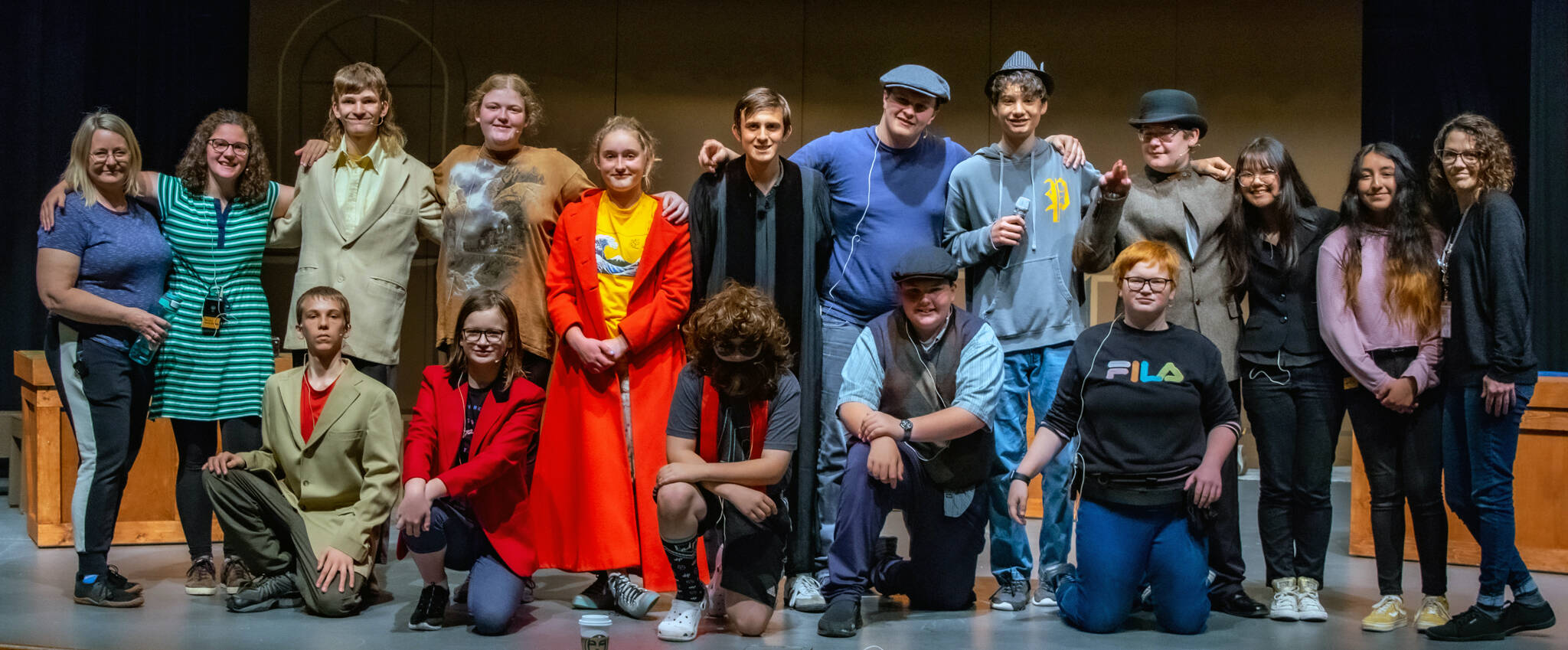
Sequim Gazette photos by Emily Matthiessen The cast of “The Big Bad Musical” pose with their two drama teachers after a successful rehearsal. From left to right in the back row: drama teacher Dee Dee Nielsen, Aiyana Dennis, Donovan Rynearson, Kaia McCarter, Sasha Yada, Nolan Valenzuela, Landon Elliott, Malachi Byrne, Louden Yates, Kailah Blake, Paloma Franco and drama teacher Michele Canepa. Front row: Mica McCarter, Katerina Abken, Sammy Mason, Dylan Simpler and Zowie Abken.