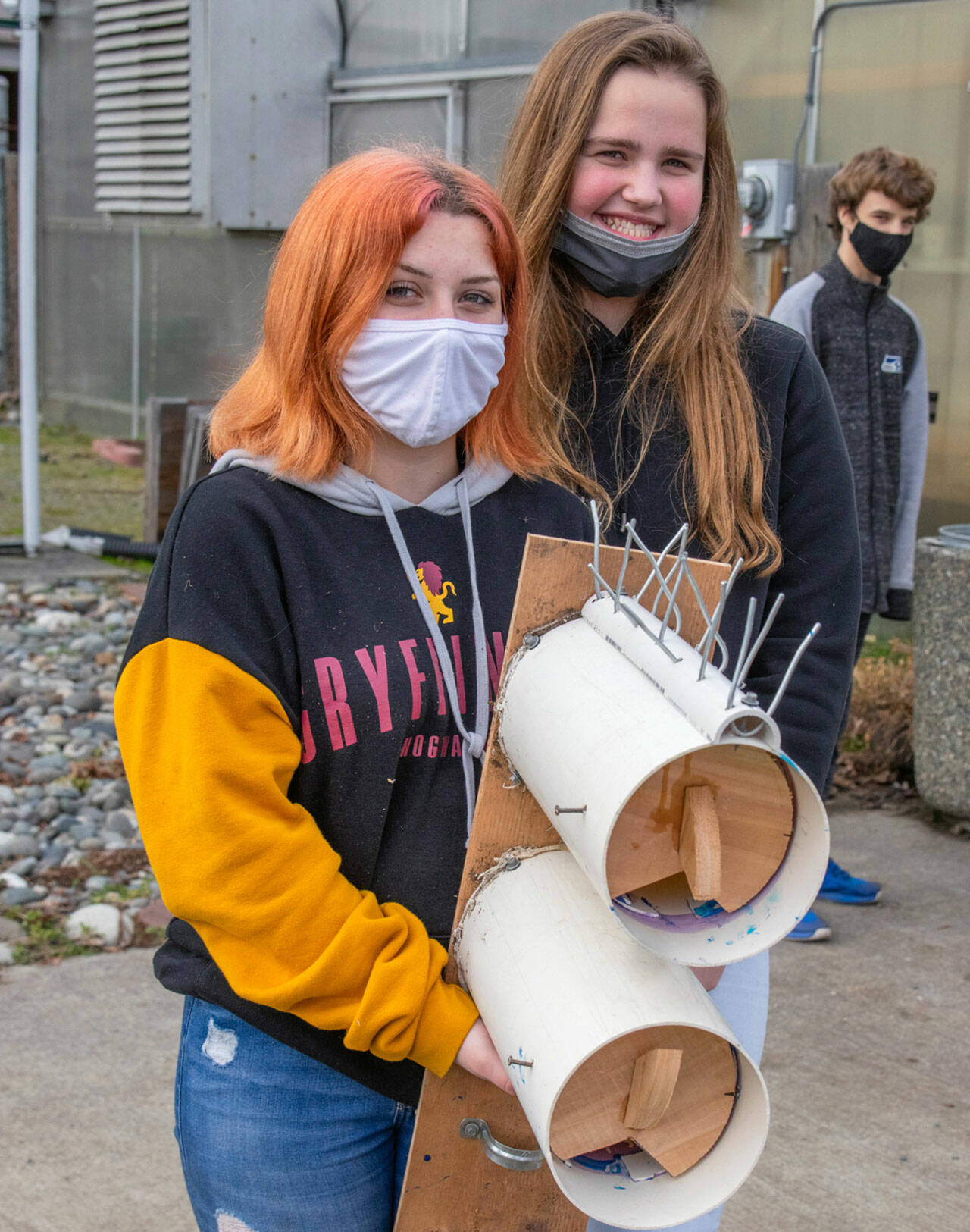
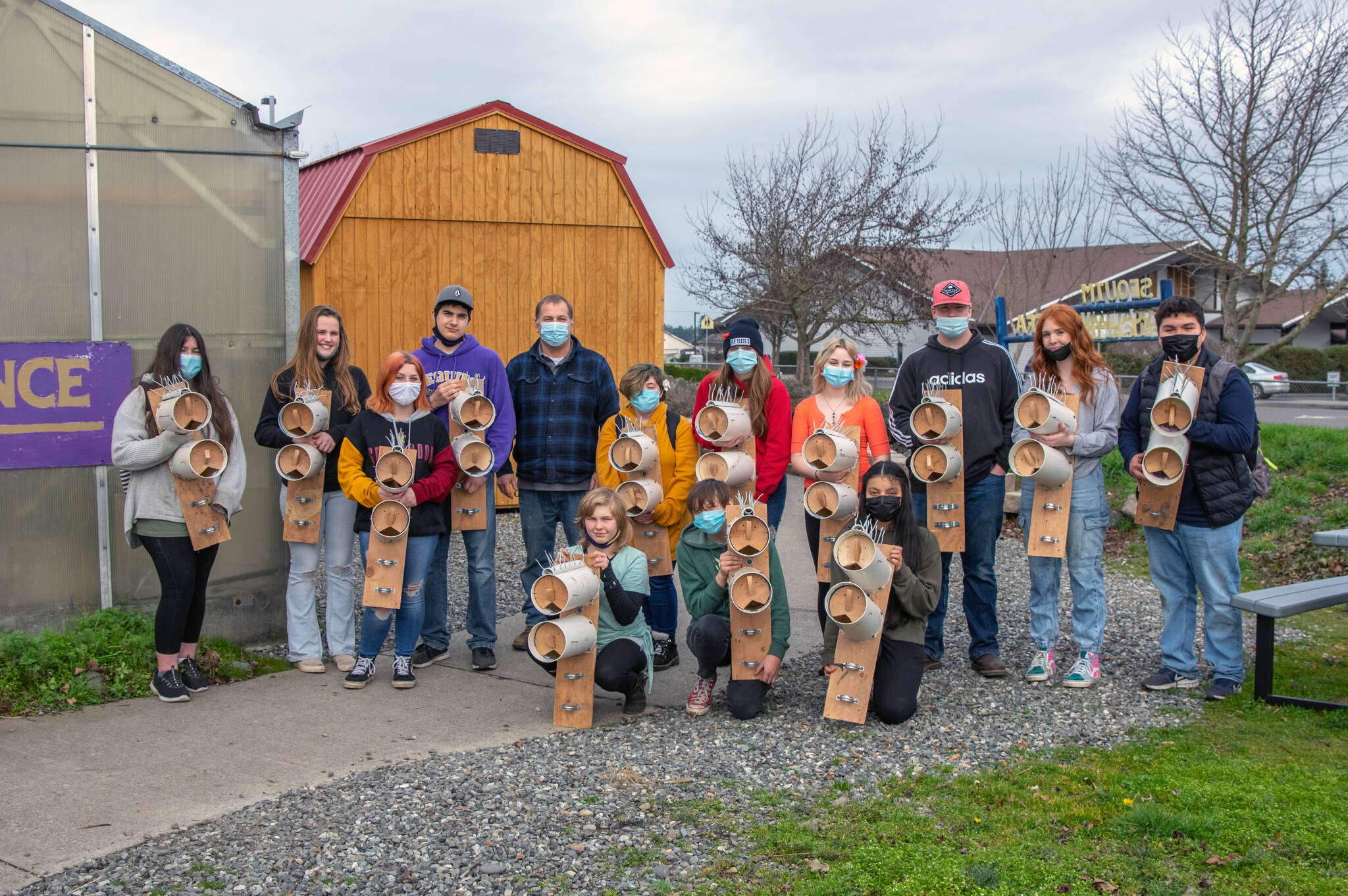
Sequim High School agriculture students recently wrapped up three weeks of building 14 purple martin nesting boxes by turning them over to the Washington Department of Fish and Wildlife for placement in suitable habitat.
“It was really fun,” student Joanna Morales said.
In all, 52 students in four different classes worked on the two-holed tubular nesting boxes, each of which have the potential to host two pairs of purple martins and their three to six eggs.
“They do a segment about fish and wildlife in the class,” agriculture science teacher Bill McFarlen said. “This was a nice way to round things up.”
He said that the students split up into stations, “I gave them job descriptions, and they took off.”
The boxes were made from 6-inch pvc pipe and 1.5-inch pvc pipe, cedar boards, wire and plywood for the back, McFarlen said.
Shelly Ament, wildlife biologist with Washington Department of Fish and Wildlife, said the design plan given to McFarlen for the students to build the boxes was given to WDFW by Ken Wiersma and Dow Lambert of the Olympic Peninsula Audubon Society (OPAS) in March of 2021.
OPAS has been working to increase purple martin nesting habitat since the 1990s, according to their website.
Ament said the box is “durable, light-weight and easy to hang.”
Student Willow Yager said, “It was difficult because the wires won’t always go in, so we had to hammer it down … If you put your mind to it, you can do anything.”
Yager explained that the wires on the top of the nesting box are so eagles can’t stand on it and get the hatchlings.
Purple martins are the largest swallow in North America and “eat 2,000 mosquitoes a day,” said McFarlen. They spend half the year in South America and half the year in North America.
According to the OPAS website, “Records of the Washington Department of Fish and Wildlife (WDFW) reveal documented nesting colonies of Purple Martins in Clallam County from the 1920s.There were small colonies under the eaves of the Sol Duc Hot Springs lodge and in the County Courthouse in Port Angeles as late as the 1930s.
“Since that time, introduction of non-native, cavity nesting birds, such as the European Starling and the House Sparrow, have taken many of the natural and human made cavities found over land sites and forced the Purple Martins to move their nests over water.”
This resulted in the decreased presence of the birds.
Ament said that Bill Montgomery, WDFW Region 6’s hunter education and volunteer coordinator, reached out to McFarlen at the school, and that he was supportive of having Sequim students take on the project to construct the boxes.
“I thought it would be a good opportunity for the kids to give back,” McFarlen said. He said this is the first time the school has taken on such a project.
Ament said that McFarlen has the materials for three-hole boxes to be completed later.
Money to purchase materials was from Watchable Wildlife funding at WDFW, Ament said; the funding is generated from the eagle license plate.
“We are very grateful to the Audubon for all the work they do,” said Ament, referencing long-term cooperation between WDFW and OPAS to increase purple martin presence in the area.
“We have a wonderful parnership with Audubon, and now with the students, too.”
To learn more about OPAS’s efforts in Clallam County, visit olympicpeninsulaaudubon.org/purple-martin-nest-box-project.
For more information about wildlife background plates that fund projects such as these and others to help to the wildlife of Washington state, visit wdfw.wa.gov/licenses/license-plates.
To read more about purple martins in the Sequim Gazette, visit sequimgazette.com/news/opas-helping-purple-martins-find-homes.