
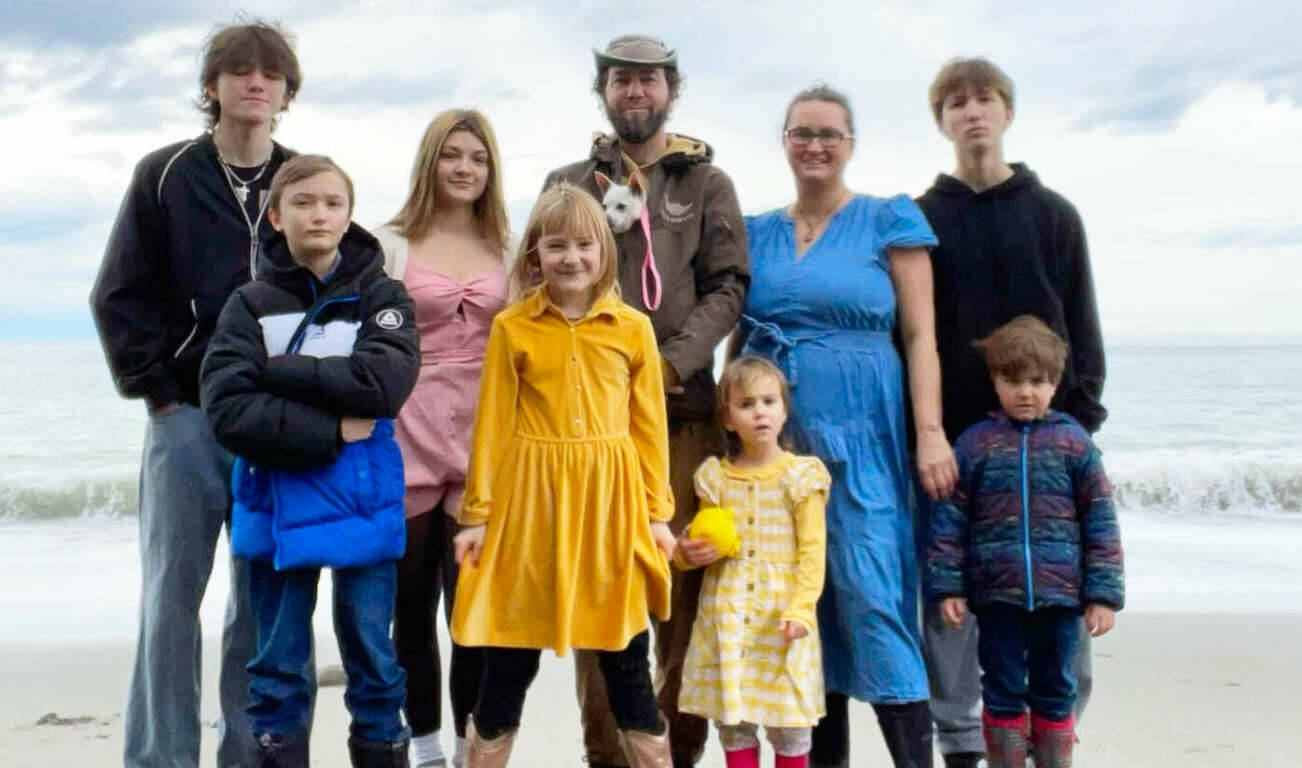
With five dependents under their roof — one of whom they adopted, two of whom came to them through kinship foster care, all three of whom bear the scars of trauma — it could be said that any help Cindy and Joshua Sylvester receive is a godsend.
In that case, Olympic Angels may be aptly named.
Founded in 2020, the nonprofit supports children and families in the foster care system. It operates under the umbrella of the national nonprofit National Angels and is one of the network’s only rural pilots.
According to Cindy, Olympic Angels has been “phenomenal,” a steady, reliable source of help for her family. They have provided pizza, grocery gift cards, laundry soap and even specialized adult diapers through the organization’s Love Box program. Background-checked volunteers pitch in with respite care, taking the children to the park or movies and supervising visits between the two younger children and their biological mother. One volunteer even offered to help Cindy with medical paperwork.
Last Christmas, when the Sylvesters wanted to prioritize a memory-making experience over gifts, the organization even provided a gift certificate to Great Wolf Lodge. Last year, and again this year, it provided the family with tickets to the Winter Ice Village outdoor ice skating rink in Port Angeles.
Olympic Angels, which started in Port Townsend, supports children and caregivers in foster and kinship care across Clallam and Jefferson counties. The organization is currently assisting two such families in Sequim, one of which is the Sylvesters, said Executive Director Tasha Fitzgerald.
The nonprofit was one of dozens of local organizations to recently receive a grant from the Albert Haller Foundation — $12,175, close to the maximum grant award of $14,000 — but it has been struggling financially as nonprofits face federal cutbacks and compete for funding.
“It’s quarter four in the nonprofit world, and I never realized how big that really is until stepping into leadership,” Fitzgerald said. “It’s been an atypical year — an incredibly competitive one.”
Fitzgerald said that one of the most striking misconceptions among the public is that there is not a significant need for foster care on the North Olympic Peninsula.
“I’m amazed — and, honestly, a bit appalled — by how many people don’t realize foster care exists here,” she said. “But it does, and the need is enormous.”
According to Fitzgerald, there is a severe shortage of licensed foster homes. She rated the need as “a 10 or 11” on a 10-point scale. When local foster homes are full, or when relatives are unable to step in, children are often sent hours away, to places such as Grays Harbor, Olympia or even Spokane, she said — adding new layers of upheaval to their lives when they have already experienced significant trauma.
“If you’ve grown up with the water, the mountains, the fog, the community here, and suddenly you’re in a totally different place… it’s another loss,” Fitzgerald said.
Kinship care — children placed with relatives or close family friends — has become increasingly common, helping lessen the strain. But kinship caregivers often receive little to no state support, despite taking in children unexpectedly and with their own households oftentimes already stretched. Olympic Angels, Fitzgerald said, works to stabilize both licensed foster families and kinship households through ongoing, community-driven assistance.
“Routine, safety, and consistent adult support — it changes everything,” Fitzgerald said.
A safe, stable home
The Sylvesters’ story is multi-layered. Although Cindy and Joshua were comfortable with their newest charges being included in a published family photo, Cindy asked that their names not be published. The family photo that accompanies this article was published by Seattle’s Child magazine when Cindy and Joshua were nominated for an Unsung Heroes award given through the state Department of Children, Youth and Families. They ultimately were chosen to receive that honor.
The Sylvesters have five biological sons, two of whom are grown and no longer live at home. A 19-year-old girl who is not related to the family but is a friend of one of the sons moved in with the Sylvesters because she was in need of a home, according to Cindy.
“H,” the nine-year-old girl that Cindy and Joshua took in and eventually adopted through the Indian Child Welfare Act (ICWA), came to them through a request from the Jamestown S’Klallam Tribe. Cindy’s family is part of the Tribe, and she works for its after-school and summer youth programs. Joshua teaches at Olympic Nature Experience. The Tribe promised to provide help with housing if the couple took the child in, and it has provided assistance in other ways as well, Cindy and Joshua said.
“H,” who is distantly related to Cindy, had been in a dozen foster homes and was about to be sent to a group home when the Sylvesters agreed to take her in. She has Oppositional Defiance Disorder (ODD) and is continuing to work through deep-seated trauma, which manifests in severe behavioral issues that include nocturnal screaming, although the night terrors are happening less frequently now.
The two youngest children are siblings and are related to Joshua and Cindy. They are a boy, “O,” who is 6, and a girl, “R,” who is 5. The children endured severe abuse and neglect, Cindy said, and “O” was airlifted to Seattle Children’s Hospital with a traumatic brain injury after he was violently thrown against a wall. The boy faces lifelong challenges due to damage to his frontal lobe, Cindy said, and he was diagnosed with failure to thrive and post-traumatic stress disorder (PTSD). She said that “H” and “R” have been diagnosed with PTSD as well.
Despite such significant challenges, “O” is “a little trooper,” Cindy said. When his impulse control issues cause him to lash out, he now sometimes apologizes without prompting. He is gaining weight and even helping Joshua in the kitchen. On a recent night, the boy cut up vegetables for a salad.
“I will set up stations in the kitchen and say, this is for onions, if you can handle it,” Joshua recounted with a laugh. The children “pull their little stools out,” he said, and he lets them stir things or add ingredients. He has taught them how to chop and slice.
The Sylvester house is “a free house,” Joshua said. The children are allowed to get themselves a drink or a snack when they want one. They participate with other members of the family in what Joshua calls “ten-minute tidies” — a time when everyone chooses an area of the home to tidy up.
When the children are upset and having difficulty with self-control, they are given the choice to participate in time-out — or a “time-in,” a time when they choose to remain present with the family and practice learning how to self-regulate.
Joshua said that he and Cindy are able to handle such a full house and so many challenges because they have a “tag team” approach. For example, he said, the kids were having a rough day on Saturday, so he piled them in the car, met up with friends, and took them foraging for mushrooms in the forest, giving Cindy a break of about five hours.
Family members and Olympic Angels — as well as others, such as the Tribe, therapist Autumn Piontek-Walsh, the staff at Greywolf Elementary, and Peninsula Behavioral Health — are part of that tag team effort, he said. Volunteers with Olympic Angels have given the children gifts and have brought the family fresh fruits and vegetables — and even a birthday cake for Cindy, he said. By taking the children on outings, they give the couple time to relax and recharge their batteries.
“I feel like Olympic Angels have been a blessing to us,” Joshua said.
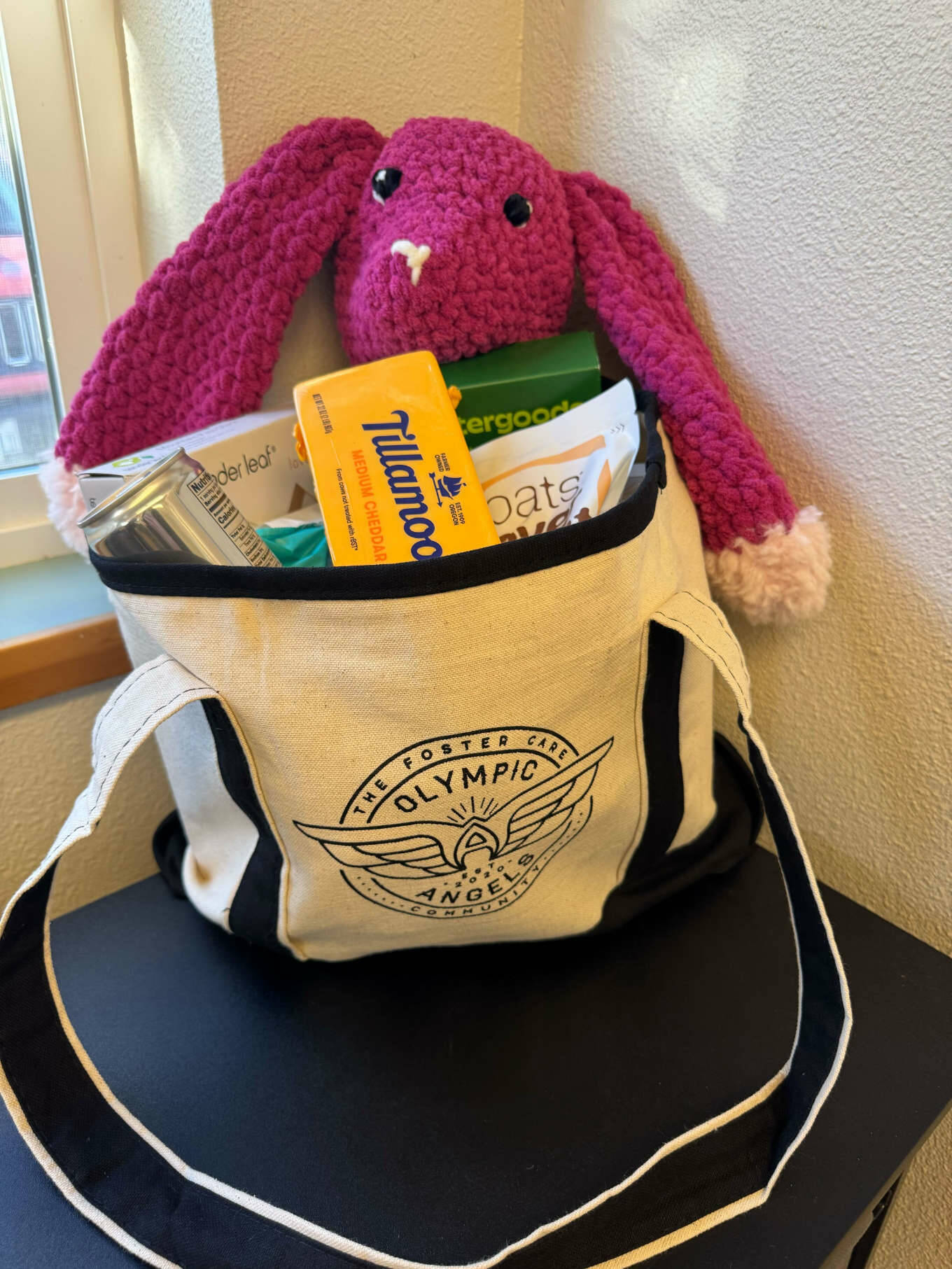
Photo courtesy Olympic Angels Through its Love Box program, volunteers with Olympic Angels provide items geared toward specific foster families.
Olympic Angels’ programs
Two hallmark programs define Olympic Angels’ work: Love Box and the Dare to Dream mentorship initiative.
With Love Box, community volunteers are paired with a foster or kinship family and deliver monthly care packages. They may also bring hot meals, help with errands, supply household needs, or simply express consistent encouragement. This is the program that has been so helpful to the Sylvesters.
“A volunteer dropping off a weekly meal might not seem like much,” Fitzgerald said. “But for caregivers juggling full-time jobs, multiple children, trauma-related behaviors, school meetings — it’s everything.”
Unlike material donations routed through the organization, Love Box support can be tailored directly to one family because volunteers adopt that family as a long-term commitment.
With Dare to Dream, youth in foster care are paired with trained mentors who help them build life skills, confidence, and stable relationships.
This matters because the stakes are high: 50 percent of youth exiting foster care experience homelessness, a statistic Fitzgerald says she thinks of every morning she sees lines forming outside the Salvation Army in Port Angeles.
“After knowing that number, you can’t look away,” she said. “Every other person in that line could have been in foster care.”
For more information about Olympic Angels, visit olympicangels.org or call 360-207-4661. Donations can be made online or mailed to: Olympic Angels, P.O. Box 654, Port Townsend, WA., 98368.
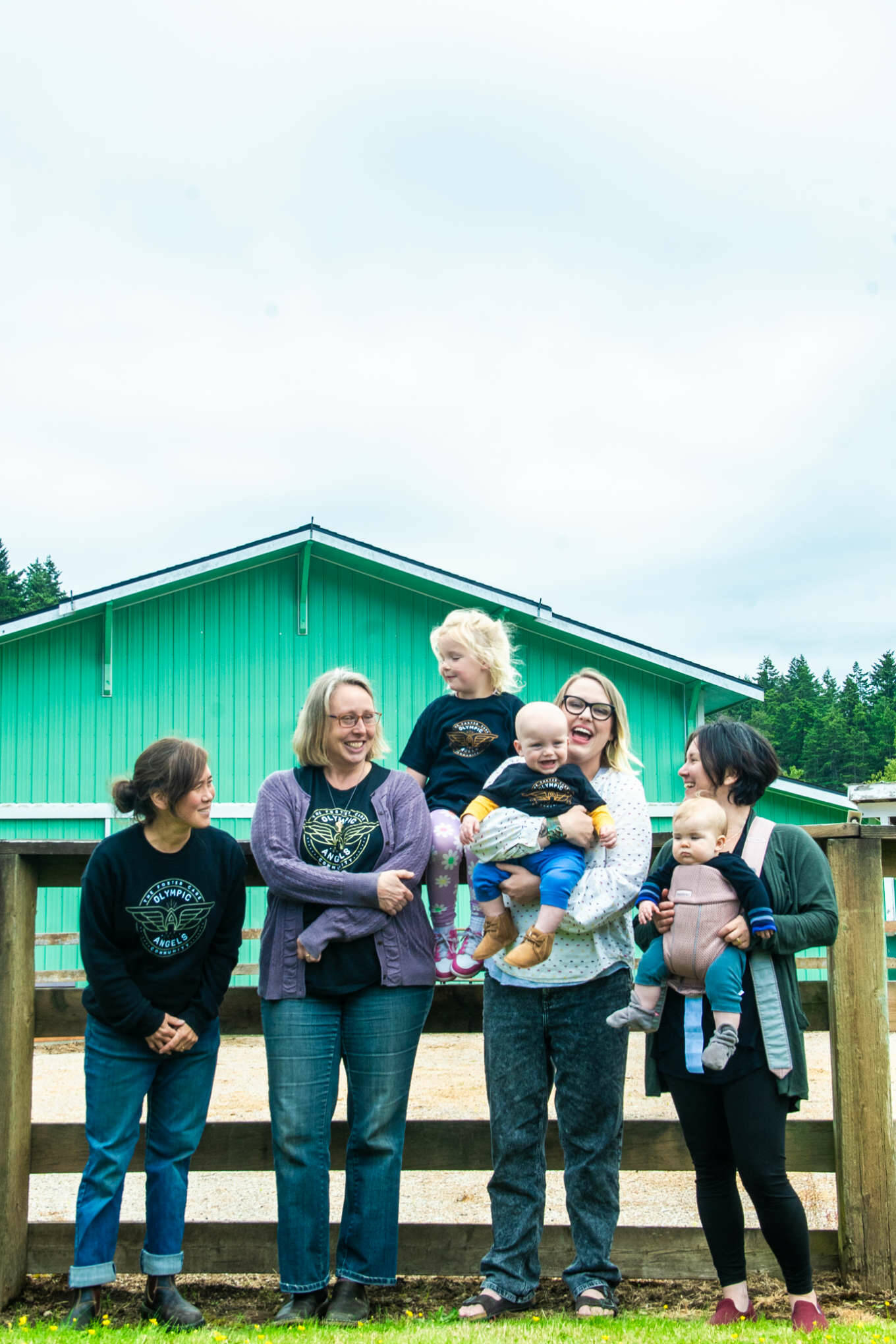
Photo courtesy by Teren Oddo/ At Olympic Angels, it’s all about family. Shown here from left to right are: Hanako Myers, case manager; Kathy Zelenka, case manager; Kylie Douglas with her daughter Stevie Douglas and baby son Killian Douglas; and board advisor Julia Guarino with her baby, Juniper.