
The demand for health care is growing, yet more than 80 positions remain unfilled at Olympic Medical Center.
Available positions widely vary from, but aren’t limited to, medical assistants, registered nurses, an accountant, housekeepers and a psychiatrist to an orthopedic surgeon.
The numbers of doctors entering the medical field aren’t keeping pace with the increasing demand, leaving a “huge” shortage in areas like primary care, according to Eric Lewis, Olympic Medical Center chief executive officer.
“There is a national shortage in health care providers and that creates a competitive situation,” Lewis said.
OMC, also known as Clallam County Public Hospital District No. 2, provides inpatient and outpatient services in Clallam County and is a designated sole community hospital and rural referral center by Medicare. An 80-bed acute-care hospital, level-three trauma designated emergency department, surgical services and labor and delivery fall under the umbrella of OMC centered in Port Angeles.
Additionally, OMC provides a variety of outpatient services such as physical therapy, laboratory, nutrition and diabetes, home health, primary care, a walk-in clinic and cancer care in both Port Angeles and Sequim.
A growing demand
As a rural medical center, OMC isn’t excused from the impacts associated with the surge of people entering the national health care system, but its more rural setting can instead cause more challenges.
“Most of our positions require advanced education, and finding, but also retaining people with advanced education is often more difficult in rural communities,” Lewis said.
The U.S. health care system is “already strained,” according to the Office of Disease Prevention and Health Promotion, yet it faced an influx of patients in 2014 after most major provisions of the Affordable Care Act were phased in, allowing “32 million Americans” access to health insurance for the first time.
The Patient Protection and Affordable Care Act, referred to as Obamacare, was signed into law by President Barack Obama in 2010. Shortly following, the Affordable Care Act and expansion of Medicaid eligibility was implemented in Washington in 2013 and it is among 25 other states to have expanded Medicaid coverage.
Locally, Lewis estimates about 5,000-6,000 more people in Clallam County have health insurance as a result of the Affordable Care Act.
Additionally, as individuals born between the years 1946-1964, categorized as “baby boomers” by the U.S. Census Bureau, reach retirement age, they’re requiring more specialized medical attention, as well as retiring from the medical field themselves.
In an effort to meet medical demands spurred by both the shifts in health care coverage and the aging population, OMC official are actively seeking more staff. Beyond simply meeting the area’s health care demands, Lewis said, OMC officials are continuously working to enhance and develop the services they provide.
To keep up with the demand, infrastructure as well as personnel are needed. Structurally, among the most recent enhancements at OMC is a 42,000-square-foot medical office building under way at the Port Angeles campus and in Sequim, OMC officials are considering a capital campaign in 2016 to expand the cancer center.
“Every building in Sequim, we’d like to make bigger,” Lewis said.
Local challenges
Deepening the widespread challenges facing health care, Clallam County has its own unique obstacles when it comes to not only recruiting people, but more importantly the right people and retaining them.
“Here the challenge is finding the right people that also want to live here,” Lewis said. “Relocating is a complex decision to make, especially if they’re married or have children.”
Because of the county’s rural setting there isn’t the diversity of jobs readily found in more urban areas, nor does the area offer the same amount of the amenities, nightlife, ease of transportation or selection of restaurants that a city can. However, Lewis noted the rural setting also has a lot of offer someone who’s interested in that kind of lifestyle.
The lack of community support to pass a proposed $49.3 million Sequim School District construction bond earlier this month is concerning to OMC officials hoping to bring in younger, skilled medical professionals as well as to those like Bill Greenwood, Clallam County Economic Development Corporation executive director.
Schools are a large part of recruiting because medical professionals “pay a lot of attention (to schools),” Lewis said.
“Doctors got where they are at because they invested in education,” he said.
The resistance to upgrade and expand the public school system goes beyond creating challenges for recruiting medical professionals to the area, but “It’s fouling up our opportunities to expand this economy,” Greenwood said. Without a growing economy it can be difficult for the spouses of professionals interested in moving to the area to find employment, Greenwood said.
“This (problem) goes beyond health care,” he said.
Despite the variety of challenges, OMC’s job listings get plenty of interest, but that doesn’t mean every applicant is right for the position, Lewis said.
“We may get a lot of interest, but we also want to hire excellent employees,” he said. “We’re more concerned with retention — that’s always something we’re working on.”
Even when OMC officials are able to fill positions with the right people, their efforts often break even with the number of professionals retiring from health care industry, Lewis explained.
Programs offered at Peninsula Community College help to combat some of the staffing and health care demands at OMC, Lewis said, but many of the positions needing filled require more education than what’s available at the college.
“We tell them where we need (staffing) … and they’re (Peninsula Community College) expanding,” he said, “But it takes time.”
Reflecting both the nationwide and local challenges to recruit and retain, the number of available positions at OMC “is definitely a little higher,” but it’s not uncommon for the center to have around 50 positions open at any given time, as it employs 1,200 people, Lewis said.
“Right now there’s way more demand than supply of trained professionals. It takes about 10-12 years to train a physician,” he said. “We’re definitely hiring, there are just some serious headwinds.”
Opportunity
Gastroenterologist Duane Webb joined Olympic Medical Center about a year and a half ago — allowing OMC to have two gastroenterologists on staff. Still, Webb’s department is shorthanded and thus he’s heading the recruitment process for another gastroenterologist.
The position has been open for about five months and has generated “some” interest, he said.
To Webb, the ideal recruits for OMC are medical professionals in the midst of their career seeking change and/or new challenges.
When recruiting for a gastroenterologist, Webb highlights the area’s rural lifestyle with fairly close proximity to Seattle or Victoria, the lack of traffic, mild weather and ample outdoor recreational opportunities — all reasons he and his wife were drawn to the area.
Still, it’s a “competitive situation” given there are a lot of jobs out there for medical grads coming out of their fellowships, Webb said.
Since working at OMC, Webb has been impressed with the way the center is flexible with the scheduling to allow for many part-time doctors not quite ready to retire to stay involved.
“This helps to fill the voids, especially in primary care,” he said.
OMC officials also work with surrounding resources and partners like Swedish Medical Center to continue to build the Rural Family Medicine Residency program where health care professionals do one year at Swedish and next two years on the peninsula.
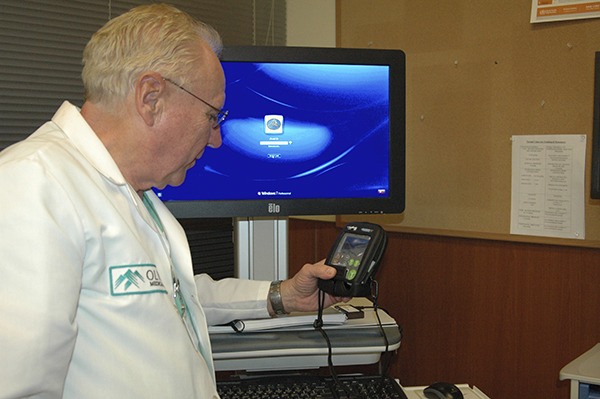
OMC as an affiliate of a larger health care network like Swedish was another plus to Webb when accepting his position at OMC and relocating from Vancouver. Additionally, before coming on with OMC, officials with the center committed to funding and supplying the equipment needed for Webb to pursue an interest of his and offer a specialized service — esophageal motility studies.
Although Webb only has had the equipment to actively do esophageal function motility studies for about one month, he’s already referred one patient to Swedish Medical Center based on the data collected. The ability for Webb to provide his patient with specialized care locally and gather his own data saved the patient three trips and a one-night stay in Seattle, he said.
“(OMC) is a great opportunity for people wanting to grow and implement new services,” Webb said. “I think there’s a huge demand here and for people that are passionate about that, then it’s exciting — that was my case.”
Reach Alana Linderoth at alinderoth@sequimgazette.com. Reach Michael Dashiell at editor@sequimgazette.com