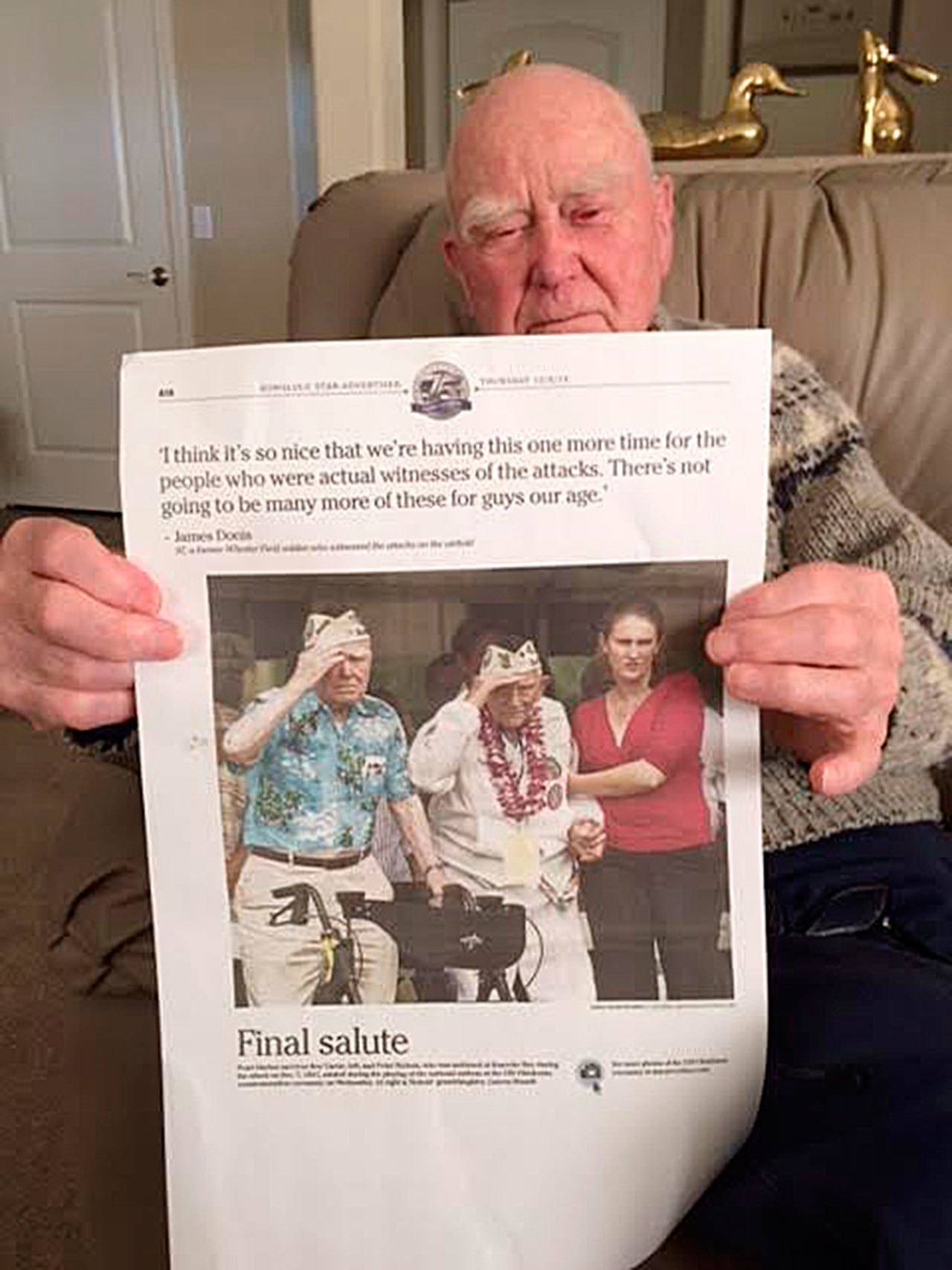
Ever wonder what it’s like to be a celebrity? Ask Roy Carter, a World War ll veteran and survivor of the Dec. 7, 1941, attack on Pearl Harbor, who recently returned to the scene marking the 75th anniversary.
Why the celebrity comparison?
“I was treated like a king,” said the personable Carter. “Everywhere I went I was saluted, patted on the shoulder and kissed. I must have got a thousand kisses.” And, he admitted, “I like kisses.”
This is not the first anniversary of the attack Carter has attended. He was at the 50th, 70th and now the 75th, which he said was much larger than the previous ones. “It was really quite a show,” he said of his seven days in Honolulu, Hawaii.
Because of his age — he will turn 97 in mid-January — Carter’s family and several friends discouraged him from attending this year’s event. But, he said, “I went anyway and I’m glad I went.”
Back to celebrity status. On the plane trip from Seattle to Honolulu, first the flight attendants welcomed, congratulated and thanked him (and probably kissed him) and then, once in the air, the captain announced his name, saying there was a special person on board, one Roy Carter, veteran and survivor of the attack.
“Everyone on the plane clapped and cheered,” he related with a slight smile crossing is face and a twinkle in his ever-so-blue eyes.
Carter is a quiet man with a subtle sense of humor and tends to shy away from the spotlight. He doesn’t consider himself a hero, though he did save a group of men on the USS Oklahoma during the attack. An admiral who spoke at the remembrance service for the USS Oklahoma— one of the eight battleships hit during the attack — mentioned two sailors by name, congratulating them for an outstanding job during the attack. One of those was Carter.
According to Carter, he “dogged down” eight men in a compartment that had a six-inch thick, spring-loaded door that became sealed once closed. One sailor, Michael Stuz, ran by the group yelling to let him by. Carter tried to stop him and send him into the water-tight compartment with the others, but he was insistent on getting to his battle station. Stuz died trying to do so, but the other eight men were cut out of the compartment some 30 hours later, all alive and well — as well as one can be after spending 30 hours in a locked space. Carter was cited for saving their lives
“I was just doing my duty,” he said in his unassuming way. But the look in his brilliant blue eyes suggested he was proud to be recognized for his bravery.
Carter, an Iowa boy, was 18 years old when he joined the Navy. After boot camp, Carter and three buddies from Company 19 were assigned to the battleship USS Oklahoma, which was stationed in Bremerton.
The USS Oklahoma, commissioned in 1916, was a ship Carter called a “technological marvel.”
“It had things prior ships did not have, a range finder and plotter to determine where the target would be when the shell got there.”
A week after Carter boarded the Oklahoma, she went into dry dock. His first job was to scrape barnacles off the side of the ship, a job he admits he didn’t care for at all.
“That was not what I called learning a trade, that or scrubbing the deck,” he said.
About six months later, there was an opening in what Carter called the R Division, which were the carpenters and ship fitters. He requested a transfer and got it.
“During battle conditions, the R Division’s job was damage control,” Carter explained. Little did they know that the R Division would have its hands full trying to keep up with damage control on Dec. 7, 1941.
Dec. 7 began as most days did for Carter and his fellow sailors aboard the USS Oklahoma, three of whom he considered close friends. It was Sunday and Senior Petty Officer 2nd class Carter was busy stowing his clothing in his locker when the loud speaker blared, “air attack, all hands man your battle stations.”
Torpedoes began hitting the Oklahoma as soon as the air attack announcement was made. “Torpedoes were hitting the Oklahoma. No one knew how many until she was righted three weeks later,” Carter said. The Navy battle damage assessment board report indicated a total of nine torpedoes hit the battleship, eight midship and one hit the rudder.
Carter was one of the lucky survivors of that infamous day. Not so much for the 429 sailors and Marines who lost their lives serving aboard the USS Oklahoma, one of the most severely damaged battleships stationed in Pearl Harbor. The Oklahoma had a complement of about 1,300, including 77 Marines.
It surprised Carter that only one other person, whom he did not know, from the USS Oklahoma was at the 75th anniversary ceremonies. But, he added, “I have no idea how many (survivors) are even living.” Only 70 survivors from all eight battleships were in attendance, although Carter guesstimated there probably were 100,000 people visiting during the anniversary.
“At the time of the Pearl Harbor attack, there were 84,000 survivors,” Carter noted. “Two years ago, there were 2,500.” Then his wry humor kicked in. “Age is like a roll of toilet paper,” he said with a straight face. “The closer it gets to the end, the faster it goes.”
When Carter and his late wife moved to Sequim, there were 32 veterans who served at Pearl Harbor living on the peninsula. “We formed a Pearl Harbor Survivors Group and had regular meetings,” Carter recalled, “Now, as far as I know, there are only three of us left.”
Carter and others who survived that day do think about the near future when there will be no more survivors to tell their stories. Carter has written quite a lengthy journal-type recollection of his life aboard the Oklahoma, the events leading up to the Dec. 7 attack, the attack itself and the death of the Oklahoma (in September of 1944, the Oklahoma, after being decommissioned and deemed unsalvageable, parted her tow line and sank on May 17, 1947, 549 miles out, bound from Pearl Harbor to San Francisco) “so my children, grandchildren and great-grandchildren will know that part of history,” Carter said.
Back to the celebrity in Honolulu. There was, of course, a parade and the 70 veterans of Pearl Harbor and other World War II veterans served as grand marshals. There was a bit of a mix-up, however. Carter and the 70 survivors were scheduled to ride in convertibles in the parade.
“I think they miscounted because they ran out of convertibles for us,” Carter chuckled. “I ended up riding in a truck,” but, he said “it was still very nice, with everyone cheering as we drove along.”
The Honolulu Star-Advisor newspaper interviewed Carter and put his photo and story on the front page of one of its dozens of editions throughout the week.
Carter and all other veterans were chauffeured to and from events of the week. The most memorable for Carter was the commemorative service for the USS Oklahoma. No tears, he said, but he did have a few moments of sadness and did meet quite a number of relatives of those who served on the battleship.
Before he left for the festivities, Carter said it would be his last trip to Pearl Harbor. Now that he’s home, he’s having second thoughts.
“I couldn’t have asked for better treatment, it was very nice,” he said. “I know I said it was my last trip, but I had such a good time, who knows, I may go again next year.”
Thank you again, Roy Carter, for your service to our country. It has been a pleasure to talk to you and write your story.