
The picture painted of the current state of affairs in the state’s hotel and restaurant industries presented by Anthony Anton, president and CEO of the Washington Hospitality Association, was sobering as he spoke in late June to those who showed up online for a session of “Coffee with Colleen,” a resource of the Clallam County Economic Development Council and its executive director, Colleen McAleer.
Anton, who has been with the Association for 30 years, had just finished a 20-city tour during which he heard from many who work in Washington’s hospitality industry. In his “Coffee with Colleen” presentation, he used phrases such as “alarm bells,” “canary in the mine shaft” and “the walls are closing in on all sides.” If things don’t turn around in the next 18 months, he warned, 650-1,500 of the state’s approximately 15,000 restaurants will likely close.
Anton explained that costs in the hotel and restaurant industries have soared, reducing profit margins. After weathering the COVID-19 pandemic, hotel and restaurant owners no longer have a financial cushion to help them navigate current-day challenges. The only viable option – raising prices – isn’t working, he said, because customers are pushing back.
For many, Anton’s concerning report on current trends might not have been surprising considering the current political and economic climate. Tariffs, rhetoric that some have found offensive, and perceived unwelcoming attitudes toward foreigners, migrants and the LGBTQ+ community have taken their toll, foretelling possible grave consequences for the economy, according to various polls and organizations that monitor such things.

Photo courtesy of Olympic Hiking Company/ An Olympic Hiking Company van transports a group of hikers to the Hoh Rain Forest.
On July 4, Forbes published an article with the headline “U.S. tourism will lose up to $29 billion as visitors plummet amid Trump policies.” The article cited a study from the World Travel & Tourism Council (WTTC) that analyzed the economic impact of tourism in 184 countries. The United States was the only country forecast to see international visitor spending decline in 2025.
But while rhetoric and policies may be partly to blame, they are not the only factors impacting tourism and increasing the vulnerability of the hotel and restaurant industries.
“Tariffs (are) part of it, but the other part you’ve got to remember is the Canadian dollar, as compared to the U.S.,” Precinct 2 Clallam County Commissioner Randy Johnson said in July when referring to fewer visits by Canadians. “If it’s 75 cents to the U.S. dollar, that just means things are that much more expensive. So, there are other factors, too…”
Marc Abshire, executive director of the Port Angeles Chamber of Commerce, said that almost 200 Canadian riders typically participate in the annual chamber-sponsored “Ride the Hurricane” event, a 40-mile round-trip cycling challenge that climbs more than 5,000 feet from Port Angeles to Hurricane Ridge. This year’s event, held Aug. 3, had fewer than 100 Canadians participating, but Abshire said that a price increase and the unfavorable exchange rate likely played a role.
“The price increase also affected the waiting list for Ride the Hurricane,” Abshire wrote in an email to the Sequim Gazette. “Normally we have around 200 on the waiting list… but this year we had only about 50 or so on the waiting list. It was a significant price increase, so we expected the waitlist would decrease in size. But we did sell out, as we have for the past 5 years.”
Tommy Farris is convinced that Clallam County, with its moderate climate, abundance of natural beauty, and popular annual events is uniquely situated to withstand tourism challenges that may be affecting other parts of the country. His Port Angeles-based Olympic Hiking Company is doing just fine, he indicated earlier this summer. Even though there are fewer Canadians booking guided hikes, business is still brisk, and he’s even adding employees.
“We’re going to be at 27 this year,” Farris said, referring to his team of full-time and part-time employees. The company books about 4,000 hikes a year, he said, including in North Cascades National Park.
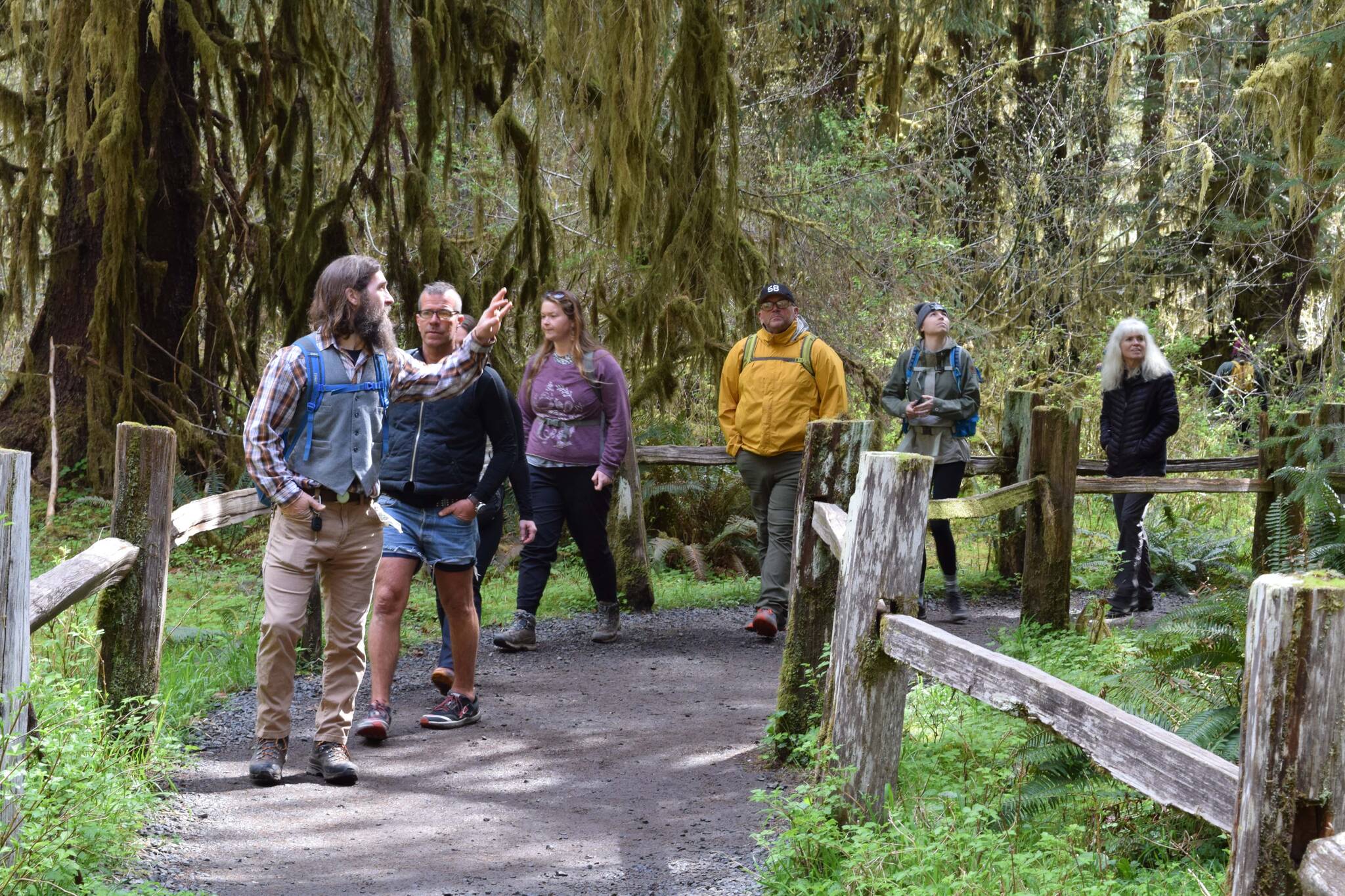
Photo courtesy of Olympic Hiking Company Oscar Hammer, a naturalist tour guide for Port Angeles-based Olympic Hiking Company, leads a group on a hiking trail in Olympic National Park. Founded by Tommy Farris, a 2008 graduate of Crescent High School, the company books about 4,000 hikes a year and provides tour guides for American Cruise Lines van excursions that include visits to Sequim.
Olympic Hiking Company’s clients come from all over. They arrive by cruise ship, by air at Sea-Tac Airport, and by vehicle. Although cruise ship passengers don’t account for a large portion of tourism dollars since they sleep and dine on the ship, some enjoy the Olympic Peninsula so much that they make a return visit, noted Abshire.
Those who arrive by vehicle for scheduled hikes often stay in area hotels or short-term rentals the night before their hike and the night after, likely filling seats in local restaurants, Farris pointed out.
“We’re based out of this amazing gateway community,” he said, noting that when it comes to lodging, his hikers don’t just stay in Port Angeles. “We see a lot of folks staying in Sequim. It’s only a 20-minute drive away; it’s closer to Sea-Tac Airport. So, we see people staying at 7 Cedars… They just want a place to stay and have a fun community to visit and explore, places to eat and shop, and, you know… it’s a team effort out here. We serve guests in Forks. We serve guests in Port Angeles. We serve guests in Sequim. Our mission is to get people here (for) at least two or three days, if not more.”
Farris’ view that the Olympic Peninsula is uniquely situated to keep its tourism industry robust is shared by both Abshire and Johnson. Both feel that tourism is as much a matter of perspective as it is about numbers.
“Forks is different from Sequim, and the county is different from Port Angeles, and on and on,” Johnson said. “We all have our so-called micro-tourism groups that are all slightly different for different reasons.”
Johnson said that lodging tax revenue for Forks has been exceeding that of Sequim, thanks to the continuing growth and success of the annual “Forever Twilight in Forks” multi-day festival.
“And, again, give credit to the marketing people out there,” he said. “’Twilight’ just continues to roll, and they’ve kind of created a venue that attracts just loads of people. Good luck ever finding a place to stay out there that time of year.”
Forks Chamber of Commerce Executive Director Lissy Andros agreed that Forks is “doing really well” when it comes to lodging tax revenues.
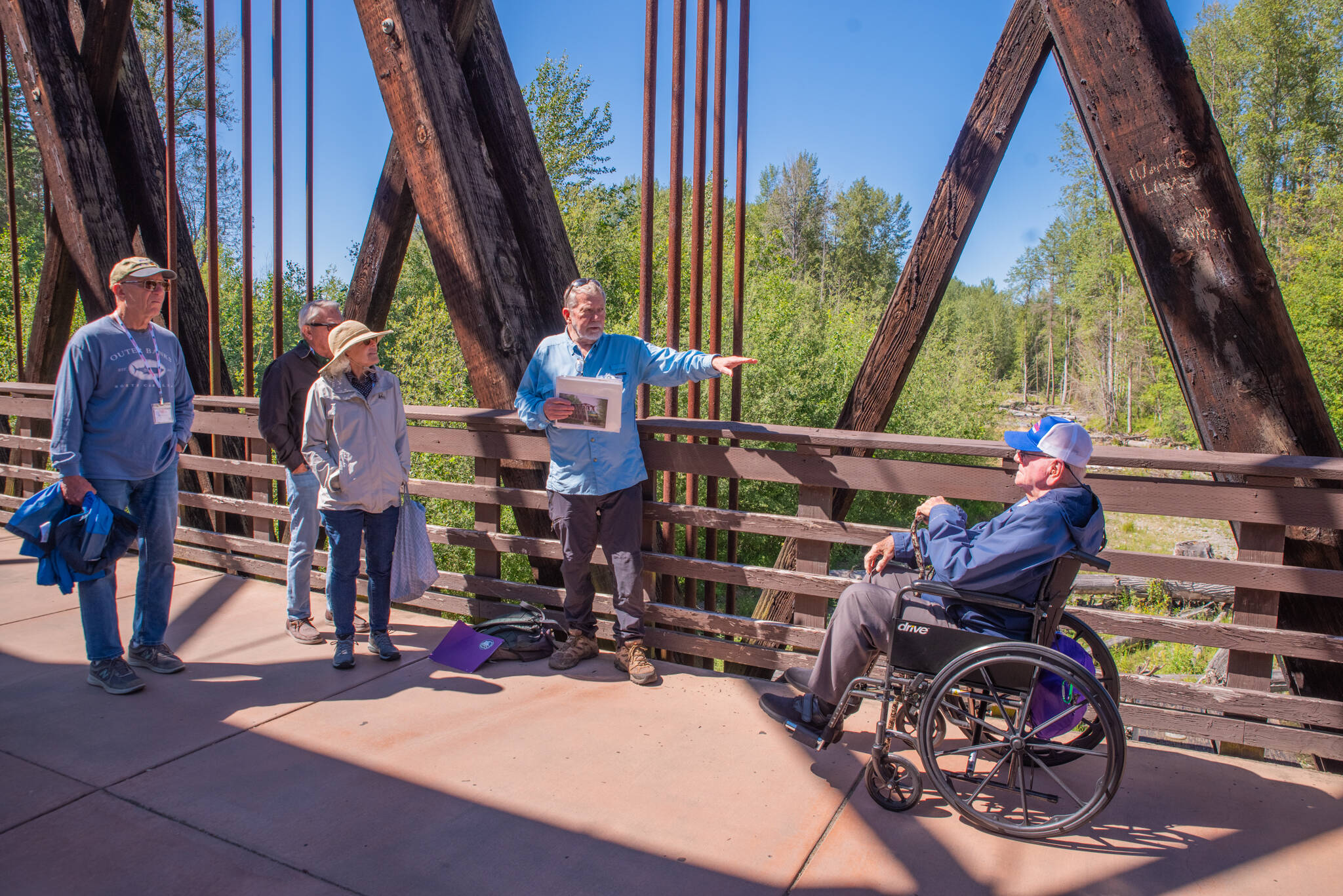
Sequim Gazette photo by Emily Matthiessen Bob Steelquist, a member of the board of the Dungeness River Nature Center and a tour guide for Olympic Hiking Company, provides details about the Dungeness River to a group of cruise ship passengers while standing on the Dungeness River Railroad Bridge.
“We are setting records with our visitor statistics,” she said in July. “We are on track to have the busiest year in history this year. We had our busiest year last year, but we’re already about 6,500 people over last year at the same time.”
In recent years, lodging tax revenues paid for a new roof for the Visitor Center, Andros said, and the money helps support not just “Forever Twilight in Forks” but other events that draw tourists, such as the Fourth of July celebration and the Piecemakers Quilt Club’s annual Fabric of the Forest Quilt Show. However, Andros said she feels that Forks’ successful tourism industry is often misconstrued as benefiting only Forks. What benefits Forks benefits the Olympic Peninsula, she pointed out.
“People say (“Twilight”) is a gift for Forks, (but) it’s a gift to our whole area,” she said. “This is not something that Forks just gets to enjoy; the whole area gets to enjoy the people that it brings here. These people are coming to Sequim, they’re going to Port Townsend, they’re going to Port Angeles. You know, they’re coming to the whole area.”
Andros said many visitors come to the Olympic Peninsula “over and over again.” The first time, they may come specifically to visit Forks, she said, but the next time might be to visit Port Angeles and Victoria, BC.
“They love the area, and it benefits all of us,” Andros said. “And even if they just stop and get gas or get a meal or whatever, all of those contribute to our community’s economics. I think it’s definitely the gift that keeps on giving for the whole area.”
Abshire said that, while he can’t speak for the rest of Washington State, the Olympic Peninsula is doing very well.
“The draw that we have just doesn’t go away,” he said. “I think, culturally, people are looking for what we have. I think people are looking for outdoor adventure, outdoor recreation. They’re looking to get away from the madding crowds. They’re looking to get away from the heat dome. There’s just a lot of things that we have here that people still care about.”
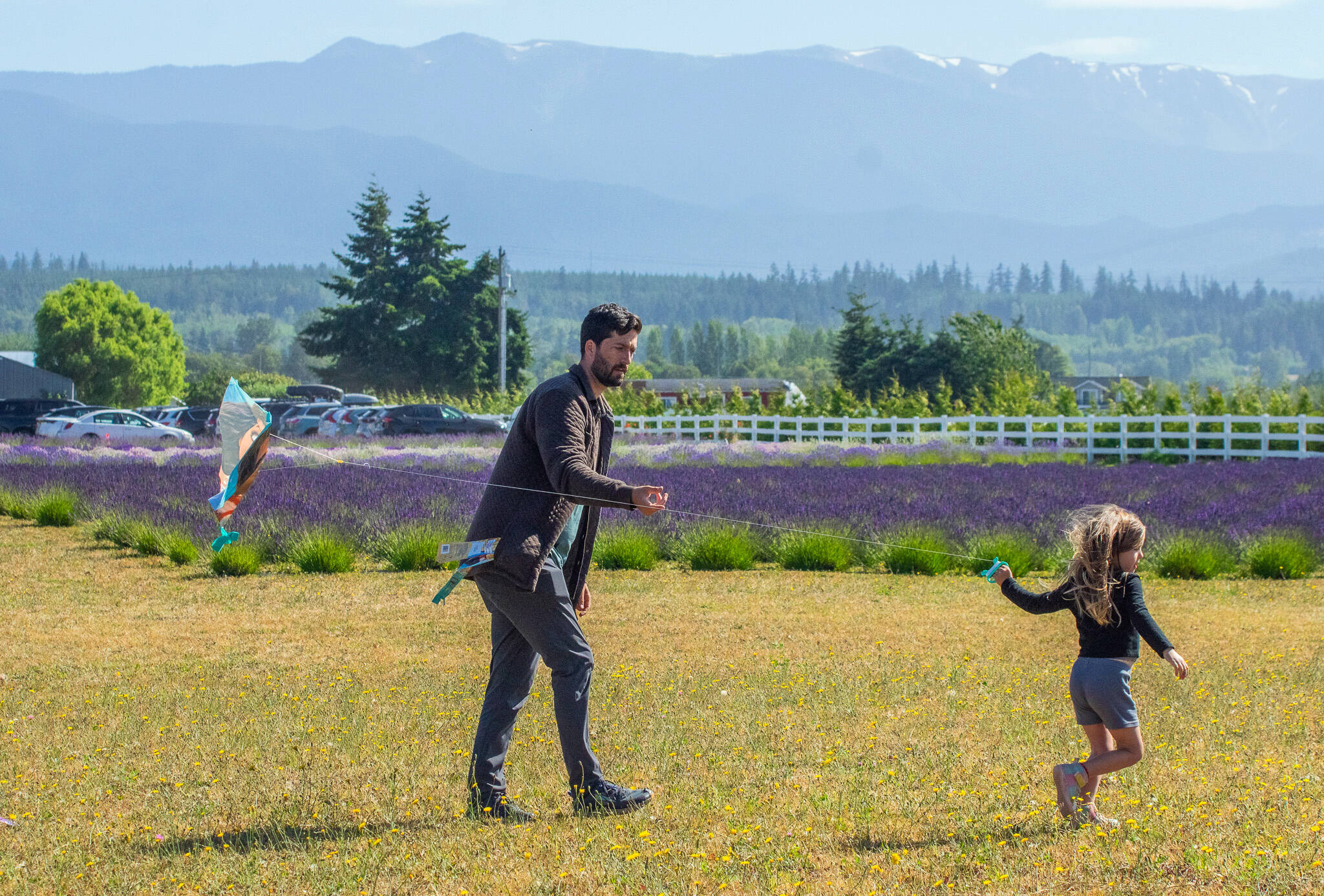
Sequim Gazette photo by Emily Matthiessen Tyler Carey and Lenara, 4, fly a kite together at Olympic Bluffs Cidery & Lavender Farm during Sequim Lavender Weekend in July. Olympic Bluffs is one of the sites visited throughout the summer by American Cruise Lines passengers through van excursions spearheaded by the Port Angeles Chamber of Commerce.
Summer events
As Forks looks forward to September, when its “Forever Twilight in Forks” multi-day event will again deposit lodging tax revenues and sales tax revenues into its coffers, there is no need to cry for Sequim. Sources report that Sequim Lavender Weekend in July and the Aug. 2 Tour de Lavender were well attended, even though, yes, there were fewer Canadians.
Lorrie Mittmann, event coordinator for Tour de Lavender, which is sponsored by the Peninsula Trails Coalition, said the participating cyclists represented an increase of about 10 percent over last year.
“We had 15 Canadian participants, down from 40-45 in previous years,” she stated in an email. “But obviously being down 30 out of 1,100 entries is just a tiny percent compared to our total, so it didn’t have an impact. Although we do hope they’ll return next year!”
Kelly Iriye, director of the Sequim Lavender Festival, stated in an email to the Sequim Gazette that this year’s attendees totaled about the same as last year, somewhere between 35,000-40,000. She said there was “definitely” an increase in traffic on Friday, the opening day of the festival.
Barbara Hanna, the city of Sequim’s communications and marketing director, said she visited nine lavender farms during Sequim Lavender Weekend and all of them seemed “busy and happy.”
“It sure seemed busy overall and all indications that I have are that the weekend was very successful,” she stated in an email to the Sequim Gazette.
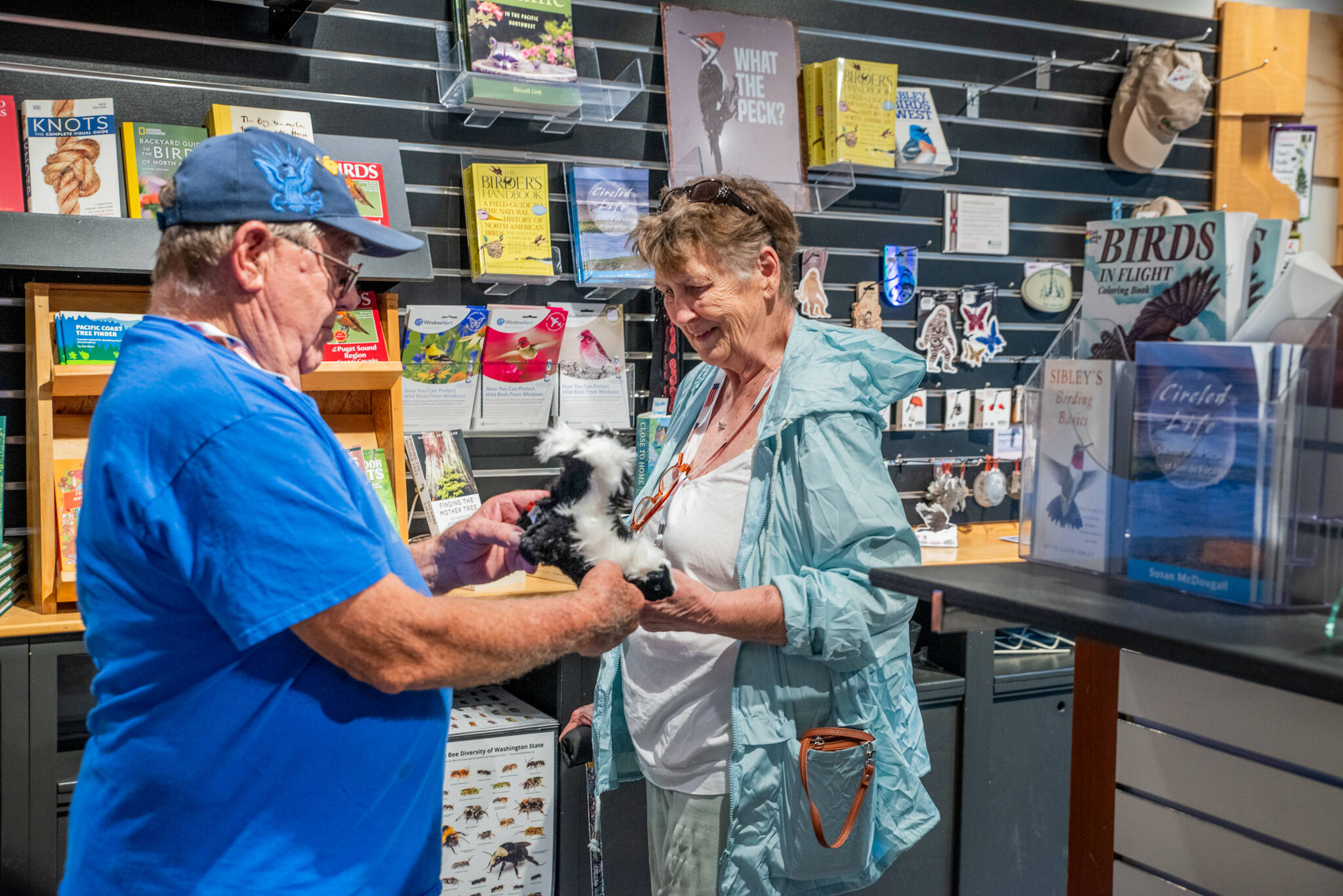
Sequim Gazette photo by Emily Matthiessen American Cruise Lines passengers Bob and Gill Waxler shop in the gift shop at the Dungeness River Nature Center.
Hard times on the menu?
While Anton may be right in sounding the alarm about the state of Washington’s restaurant industry, Michael and Candy McQuay are restaurant owners who may be in the minority. The couple own Kokopelli Grill and Hook & Line Pub near the Port Angeles Pier as well as Coyote BBQ Catering, one of the top catering companies on the Olympic Peninsula.
In an interview with the Sequim Gazette, Michael McQuay, who sits on the board of the Clallam Economic Development Council, indicated that while his and his wife’s businesses are facing the same challenges as other restaurants in the state, they are managing to stay in the black.
“My gross margins are better than they have been since 2018,” McQuay said.
He credits Margin Edge, a restaurant management software recommended to him by Neil Conklin, owner of Bella Italia.
“It’s a tremendous amount of on-boarding to make it work,” McQuay said, but “it’s absolutely working.” Food costs have dropped by 8% for both restaurants and labor costs are down by 4%, he said.
“We do a tremendous amount of revenue between both restaurants. I mean, it’s in the millions of dollars,” McQuay said. “And, so, shaving off labor and food (by) 8(%) or 9% is massive.”
Although so far this year the businesses have been down about 2%, McQuay said he expects things to level out by the end of August. At the time McQuay spoke to the Sequim Gazette, he said that he and his general manager had just helped feed 4,000 people as part of the Paddle to Elwha Canoe Journey hosted by the Lower Elwha Klallam Tribe.
McQuay noted that he is seeing fewer Canadian customers. Black Ball Ferry numbers are down, he said, echoing reporting in the Peninsula Daily News in late May about decreased Canadian visits. The article stated that, according to Black Ball Ferry CEO Rian Anderson, ferry travel from Victoria to Port Angeles had seen a 13% decrease in foot travel and a 15% decrease in vehicle traffic since February.
The other side of the coin, though, is that the McQuays are seeing more Asian customers for some reason and Abshire said the Port Angeles Visitor Center is fielding inquiries from many Europeans looking to visit.
When it’s all said and done, how will things shake out for Clallam County in terms of its summer tourism?
“All the tourism data won’t really come out until the fall, where we can kind of decipher and see what happened,” said McQuay.
Said Abshire: “I wouldn’t say that we’re going to be breaking any records this year. We very well may be down a little bit… But I don’t see it going down much at all, if at all.”
Tourism in 2024 saw a 15% increase over 2023, Abshire noted, so even if tourism takes a 15% hit this year, that would make it equal to 2023 — “which was a very good year.”
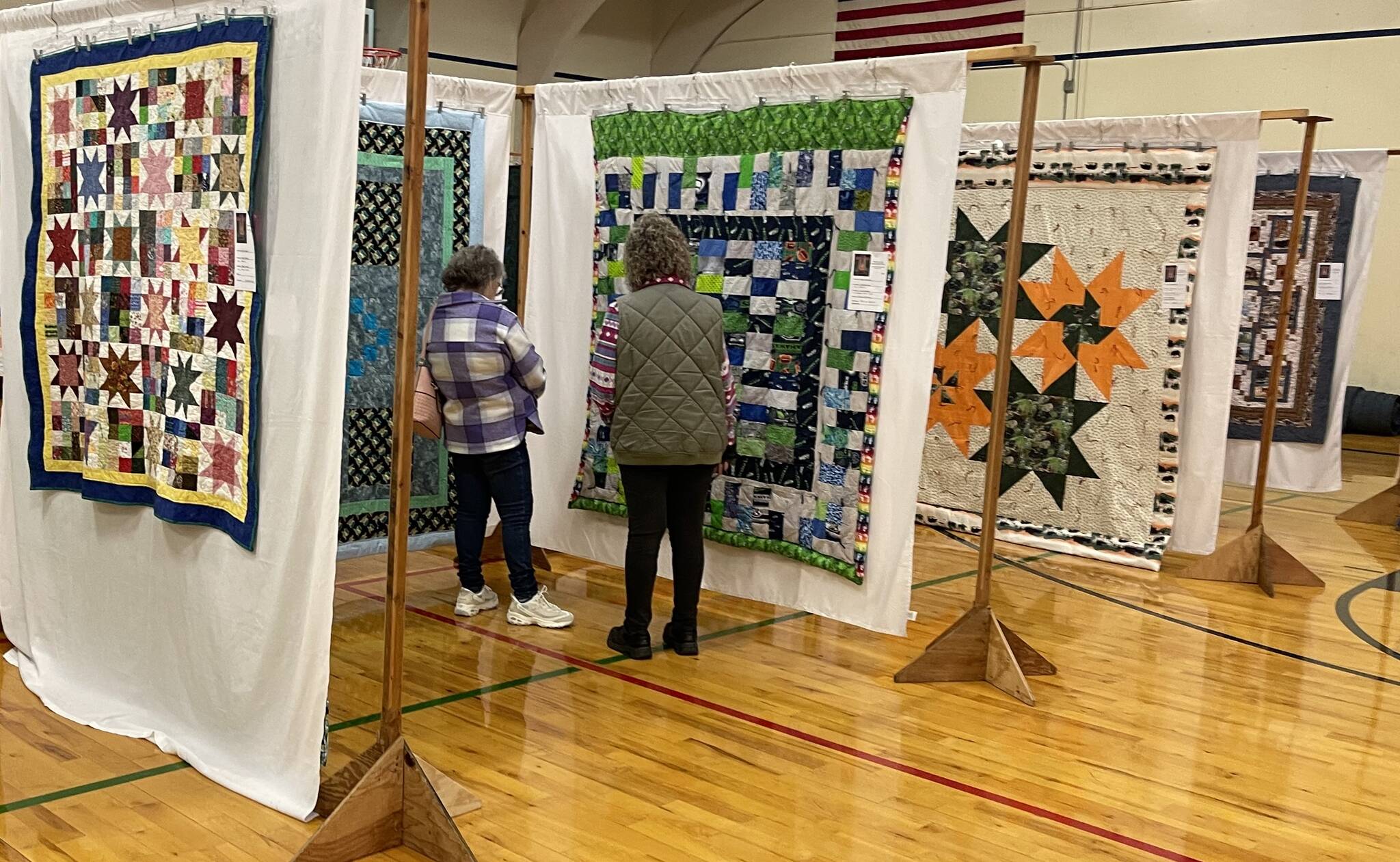
Photo by Christi Baron Although the yearly “Forever Twilight in Forks” multi-day festival is a major tourism draw for Forks, the small town’s lodging tax revenues help support other events popular to visitors, such as the Piecemaker Quilt Club’s annual Fabric of the Forest Quilt Show. Lissy Andros, executive director of the Forks Chamber of Commerce, said the Olympic Peninsula as a whole benefits from Forks’ tourism industry.
A wide reach
A 2008 graduate of Crescent High School, Farris was just 26 when he decided to invest in his passion and in the Olympic Peninsula. They are basically one and the same. Farris left behind a career in accounting and finance, bought a 12-passenger van and began offering guided tours of Olympic National Park.
Farris not only managed to keep the business going through the COVID-19 pandemic, but he also managed to grow it. He feels that the pandemic – a period when flying and traveling long distances posed health risks – caused many people who already lived in Washington to rediscover what was in their own backyard.
Since last year, the company has assisted the chamber by providing knowledgeable tour guides for van excursions for American Cruise Lines. The cruise ships dock at Port Angeles harbor throughout the summer and passengers spend a couple days visiting area locations such as Hurricane Ridge, Lake Crescent and Sequim.
Excursions include the Dungeness River Nature Center, Olympic Cellars Winery, Olympic Bluffs Cidery & Lavender Farm, and Sequim Museum & Arts. At the museum, cruise ship passengers view the mastodon exhibit and learn the story of the late Joe Rantz, a former Sequim resident and Olympic gold medalist in rowing who inspired the book “The Boys in the Boat.” The movie based on the book, produced and directed by George Clooney, was released in 2023.
One of the American Cruise Lines tour guides provided through Olympic Hiking Company is Bob Steelquist, a former journalist and National Park Service employee who has authored 13 books and serves on the board of the Dungeness River Nature Center. He said the tours provide a “homespun” and intimate experience.
“What folks take away is, this is something really authentic,” he said of what Sequim and the Olympic Peninsula have to offer. “These aren’t tourist traps.”