Get It Growing: Bulbs and corms and tubers, oh my!
Published 4:30 am Wednesday, April 8, 2026
By Jeene Hobbs
for the Sequim Gazette
Bulbs make up a large variety of plants that add beauty and diversity to your garden. They are also good for extending your blooming season as some are the first non-woody plants to bloom in spring. Another benefit of true bulbs and some corms is that they come up early in the spring when there is ample moisture, and complete their life cycle before the summer’s heat and drought.
But what really are bulbs? The term “bulb” tends to be used as a generic name for the part of a plant that stores food, water, and minerals as energy and gives new life to the plant. Another way to understand a bulb is that it stores a plant’s complete life cycle in an underground structure. However, not everything referred to as a bulb is a true bulb.
Before we get too far, let’s do a brief review of the parts of a plant. The main parts of a herbaceous plant are roots, stem, leaves, flowers, fruits, and seeds.
So where does the true bulb, corm, tuber, or tuberous root fit in that anatomy? Let’s consider each one and learn some examples of each.
True bulbs
True bulbs consist of layers of modified leaves and contain a miniature flower or sprout. An easy way to visualize a bulb is to cut open an onion from top to bottom. Notice the layers of the onion which would develop into leaves. The center of the onion would develop a flower and the roots come out of the basal plate at the bottom of the bulb.
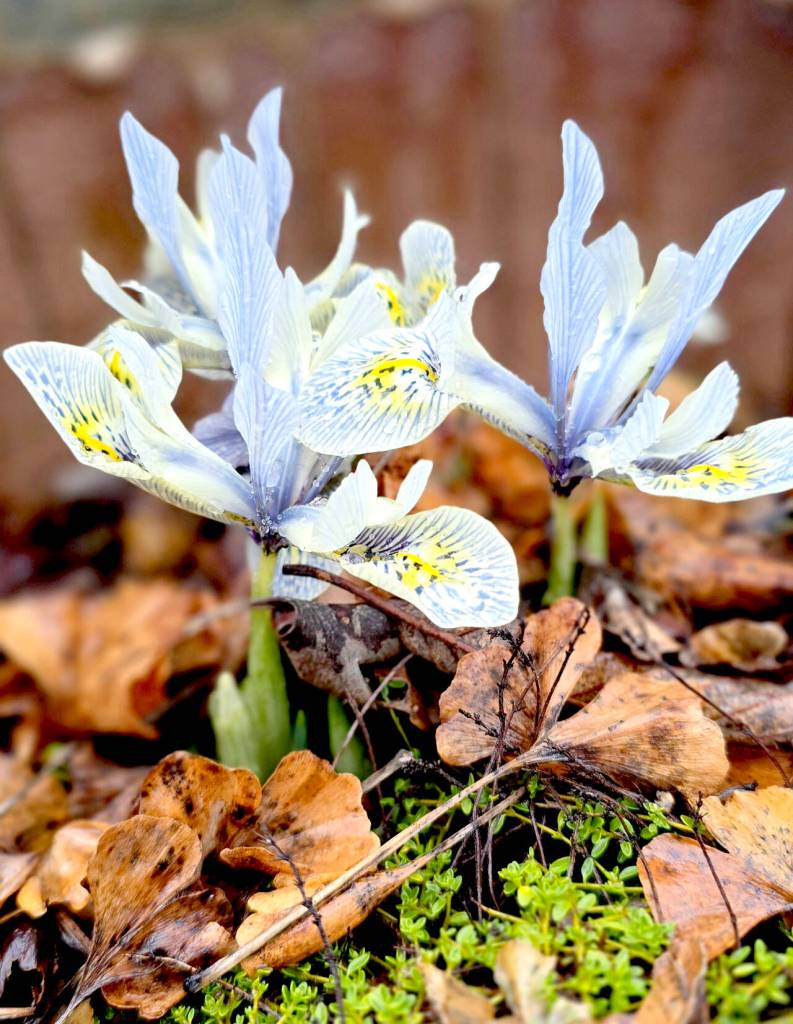
Tulips, amaryllis, daffodils, hyacinths, grape hyacinths (Muscari), Colchicum, Dutch iris, reticulated iris, and decorative alliums are examples of tunicate bulbs. They have a paper-like covering, or tunic, that protects from damage and drying. Lilies, which are also true bulbs but without the protective covering, are called imbricate bulbs.
Corms
Corms may look like true bulbs — they are both modified stems — but the tissues used to store the food are different. In true bulbs, the food reserves are stored in old leaves, while in a corm it is stored directly in a shortened vertical stem. When you cut open a corm, it will be solid as compared to the true bulb with its layers.
Corms replace themselves each year. As they begin flowering, a new corm will develop on top of the old corm at the base of the flowering stem. Corms have two sets of roots. One set from the basal plate holds the corm in place and provides water and nutrients. The other set is called contractile roots and forms at the base of the new corm. These roots contract and pull the corm deeper into the soil, adjusting it to the proper depth.
Gladiolas, crocus, and crocosmia are examples of corms that grow in our region. Other examples include oxalis, elephant ear (Alocasia), taro (Colocasia), freesia, water chestnut, and saffron crocus.
Tubers and tuberous roots
Tubers come in two types, depending on where the tuber forms. There are stem tubers, such as potatoes, cyclamen, anemone, and ranunculus. These tubers form near the surface of the soil and have multiple nodes, commonly called “eyes” that can develop into the new plant.
Tuberous roots perform the general function of roots and are also able to reproduce using buds or eyes that produce a new plant. However, tuberous roots only develop buds clustered at the crown, a modified stem base where the roots attach.
Think of dahlias with their buds near the end of the tuber. Other tuberous roots include sweet potatoes and cassava. Agapanthus, tuberous begonias, society garlic, and daylilies are additional examples.
Rhizomes
Rhizomes are horizontally growing, modified stems. They can produce both shoots and roots. Not all plants with rhizomes are spreaders, but be aware that many are. Boston fern, Venus fly trap, turmeric, ginger, calla, and horsetail are all examples of plants with rhizomes. Others include asparagus, canna lily, stinging nettle, rhubarb, and mint. Bearded iris has above ground rhizomes.
As a final note, don’t be too concerned about conflicting information. Let’s consider daylilies (Hemerocallis) and peonies. How are they categorized? Some references consider them to be “fleshy roots” while others classify the peony as a below-ground rhizome and the daylily as a tuberous root. The beloved dahlia can be referred to as a root tuber or a tuberous root.
It is the understanding of how the plant grows that will help the gardener be successful with that plant — not how it is classified.
If you want more information on bulbs and corms, you will find it in almost any book on perennials. There are a few books dedicated to bulbs such as “Tulips” by Tara Austen Weaver and “Bulbs,” a Royal Horticultural Society guide, by Rod Leeds. If you are a Facebook user, you will find pages dedicated to crocuses and colchicums, species irises, and bulbs in general.
In future articles we plan to present information on native bulbs, spring planted bulbs, and miscellaneous small bulbs to add to your garden. If you have questions about bulbs, you can email us at gigeditor@mgclallam.org. We will try and address common questions in future articles.
_______________
Jeene Hobbs is a Master Gardener from the Class of 2025. This is her second time to train and certify as a Master Gardener, previously in Benton-Franklin counties in the 1990s. Hobbs has planted bulbs in gardens in Eastern and Western Washington, South Dakota, and Nebraska.