Get It Growing: Attracting beneficial blue orchard mason bees
Published 1:30 am Wednesday, March 11, 2026
By Bev Hetrick and Shelly Deisch
Gardeners know that it is important to attract beneficial insects as pollinators. One pollinator native to our region is the hard-working blue orchard mason bee (Osmia lignaria). They are bluish black and can be mistaken for house flies, but are laden with pollen on legs, belly, and brow. Although mason bees do not make honey, they are purportedly seven times more efficient than honeybees when pollinating fruit trees.
Gentle mason bees do not sting and are delightfully fun to accommodate. Like most native bees, mason bees are solitary and nest in pre-existing holes.
To attract mason bees, all necessary habitat elements — food, water, mud, nesting holes, and safety — must be within a small area (approximately 300 yards). Mason bees use clay mud to create “masonry” cells between each laid egg in a nesting tube — hence their name.
Mason bees are cool weather operators and emerge when outside temperatures reach 50-55˚F for several days, generally in late April to early May. First, the smaller males chew out of their winter cocoons. Four or more days later the females emerge, then mating takes place. Males live for 10-15 days.
The female finds suitable nesting habitat, lays eggs, provides the eggs food, and walls off each egg. Her life span is approximately six weeks. About the time garden fruit is set and early blossoms are gone, the females will die — around June or early July.
Gardeners can enhance mason bee habitat. Mason bee plant preferences include fruit trees, blueberries, flowering shrubs, and early blooming strawberries.
Nesting
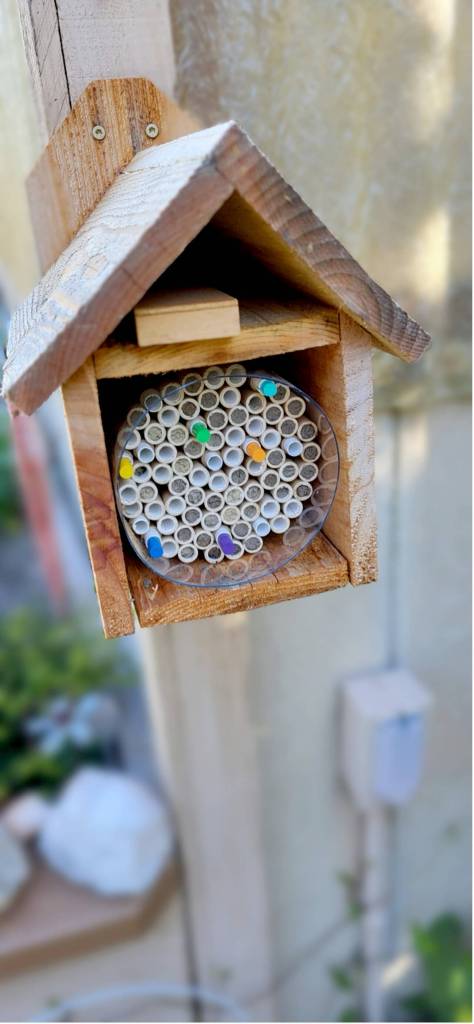
Mason bees will nest in hollow stems and between house siding. To encourage them to stay out of a home’s exterior, mason bee houses can be purchased or made. Mason bee houses can be made of simple cardboard nesting tubes with inserted paper straws (5/16” x 6”) placed inside. Check out local nurseries or online mason bee specialty shops for supplies.
We do not encourage “designer” houses with holes drilled into cute wood figures due to the difficulty in keeping them sanitized.
Inside a nesting tube, eggs hatch and transform into adults by September. A newly developed bee spins a cocoon around itself and sleeps until spring. Cocoons over-winter in native habitats, your home’s exterior, or better yet, you could store the cocoons where temperatures range between 0–40˚F, like in your refrigerator!
Mason bees are the first bees to become active in spring, making them very important to spring blooming crops.
Consider making your yard welcoming to mason bees. Now is the time to start.
For more information about hosting mason bees, check out the Washington State University website extension.wsu.edu and search “mason bee fostering.”
Presentations
“Biology and Backyard Care of Blue Orchard Mason Bees: Part I,” a free Green Thumb Education Series presentation by Shelly Deisch, will take place from 1 p.m. to 2:15 p.m. on Thursday, March 12 at the Vern Burton Memorial Community Center, 308 E. Fourth St. in Port Angeles. One door prize will be given to help kick start a gardener’s backyard mason bees. “Winter Care of Blue Orchard Mason Bee Cocoons: Part 2,” also free and also presented by Deisch, will be presented on Thursday, Oct. 8 from 1 p.m. to 2:15 p.m. at the same location. A door prize will be given to help the recipient on their way to mason bee husbandry.
________________________
Bev Hetrick and Shelly Deisch are WSU Certified Clallam County Master Gardeners. Hetrick managed mason bees at Woodcock Demonstration Garden for years, and Deisch has raised mason bees in her backyard for four years.



Best of Olympic Peninsula