The concept of lawns originated in 17th century England, where wealthy landowners surrounded their manors to show off their money and status with lawns and gardens around the property.
The practice was greatly accelerated by the invention in the 1800s of lawnmowers, not relying on a herd of sheep or an extensive staff of groundskeepers with scythes.
Everybody loves parks, sports fields, other public areas; golf courses are big businesses; teens and lawn care companies make good money mowing lawns during the summer.
Lawn grasses are now the most grown crop in America, giving a way to demonstrate one’s home-ownership ability and pride, or the lack of it. Huge amounts of resources, seed, water, fertilizer and tools are devoted to them. A large amount of time is devoted to lawn care, whether by the homeowner or hired crews.
Lawn care 101 is well-known: keep it mowed and watered, fertilize, control weeds and insects. Great detail can easily be found on soil preparation, seed selection, including over-seeding, de-thatching and/or aeration, how high to set the mower, whether to catch the clippings, etc.
Andrew May, in his Peninsula Daily News column “A Growing Concern,” has coined the acronym G.R.A.S.S., standing for “Grueling Repetitive Annual Seasonal Service.” Our Master Gardener training from a local county extension agent included ‘take up another hobby than your lawn — Western Washington grows moss, moles and annual bluegrass better than turf.’
The climate and soil here is likely different from where you grew up. The seed mixture here is different. Doing your homework or hiring expert help is important.
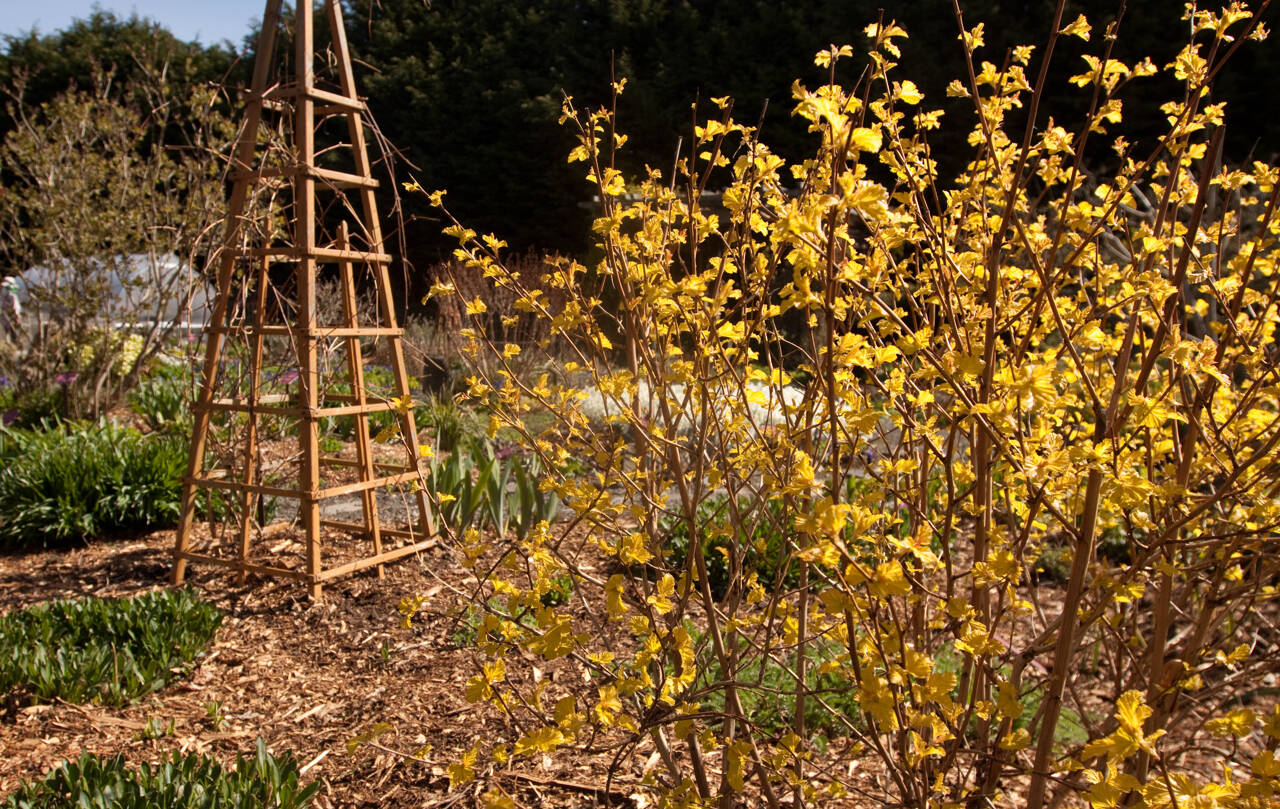
Photo by Sandy Cortez
The Woodcock Demonstration Garden, 2711 Woodcock Road, has probably one of the weediest lawns and biggest mole hills of any around. That’s because a monoculture of only grass is not desirable; rather a mixture with clover, daisies, even dandelions (shudder), and visiting insect pollinators is better.
That’s because soil amendment is critical to all gardening — in particular adding organic material such as mulch and compost. As a natural occurrence, organic material attracts the earthworms and the earthworms attract the moles. In retrospect, applying insecticide or broad-leafed herbicide to everything is fundamentally wrong. It’s bad for the rivers and bad for the planet.
Choices, choices
So consider lawn alternatives. One alternative is converting turf to planting beds for flowers, shrubs or vegetables. Grass can be killed quickly, either with chemicals or black plastic in hot weather or slowly by covering with cardboard and compost, usually over the winter. Then the new beds can be installed.
Another option is eco-lawns, ryegrass and fescue seed mixed with clover and other small flowers like daisies, alyssum, and yarrow. Best results come from seeding on bare ground, but it can also be done by over-seeding (planting seed directly into existing turf, without tearing up the turf or the soil). Eco-lawns are mowed higher, about once a month or even not mowed at all for a meadow look. They require much less water. The clover fixes atmospheric nitrogen so they don’t need fertilizing.
Another alternative to lawns is mulch. After the grass is dead, the ground is covered with landscape cloth for weed suppression then a thick layer of wood chips or bark is applied. It requires no mowing and no watering.
Finally, plain old gravel is a good lawn alternative, also needing no mowing or watering whatsoever. A thick layer of 4-5 inches is needed for coverage and weed suppression. Both mulch and gravel will need cleanup, fall removal of organic debris such as leaves, and both mulch and gravel will need weeding. They will also look better with an occasional renewal of the top dressing.
It’s important to stress that all these lawn alternatives should be kept looking neat, edged, bordered and controlled — not like an empty house or a neglected vacant lot. Many folks have a yard incorporating all of the above, a small bordered lawn adjacent to mulch, gravel pathways, and planting beds. For examples, just look at parks, arboretums, schools, or businesses.
What fun! What a creative challenge!
Bob Blackett is a Clallam County Master Gardener.
The goal is spending less time on lawn care, especially mowing and watering, and having more time for gardening, hiking, enjoying this beautiful region, or even relaxing in a hammock with a newspaper or book. The objective is more bees and butterflies. The desire is fewer poisons.
The aim is more water for our irrigation canals and agriculture. The desired results are less gasoline for lawn mowers with less air and noise pollution. Lawn diversity, or even elimination, can be a beautiful thing.
Bob Blackett is a Clallam County Master Gardener.
‘Growing Strawberries’
Make sure to join us for the upcoming Digging Deeper presentation “Growing Strawberries,” hosted by Jeanette Stehr-Green, Clallam County Master Gardener, from 10:30 a.m.-noon on Saturday, April 16. The presentation will provide a primer on growing strawberries at the Master Gardener Demonstration Garden, 2711 Woodcock Road. In addition to the scheduled educational presentation, a team of Clallam County Master Gardeners will be available at the Demonstration Garden from 10:00 a.m.-1 p.m. on April 16 to answer all gardening questions. Digging Deeper attendees are encouraged to bring samples of garden problems or pests for diagnosis by Master Gardeners who can recommend control measures. Presentations cover basic gardening topics relevant to most home gardeners. Seminars are free, but donations to help support the WSU Clallam County Extension Master Gardener program or Master Gardener Foundation of Clallam County are appreciated. See extension.wsu.edu/clallam/master-gardener-calendar.