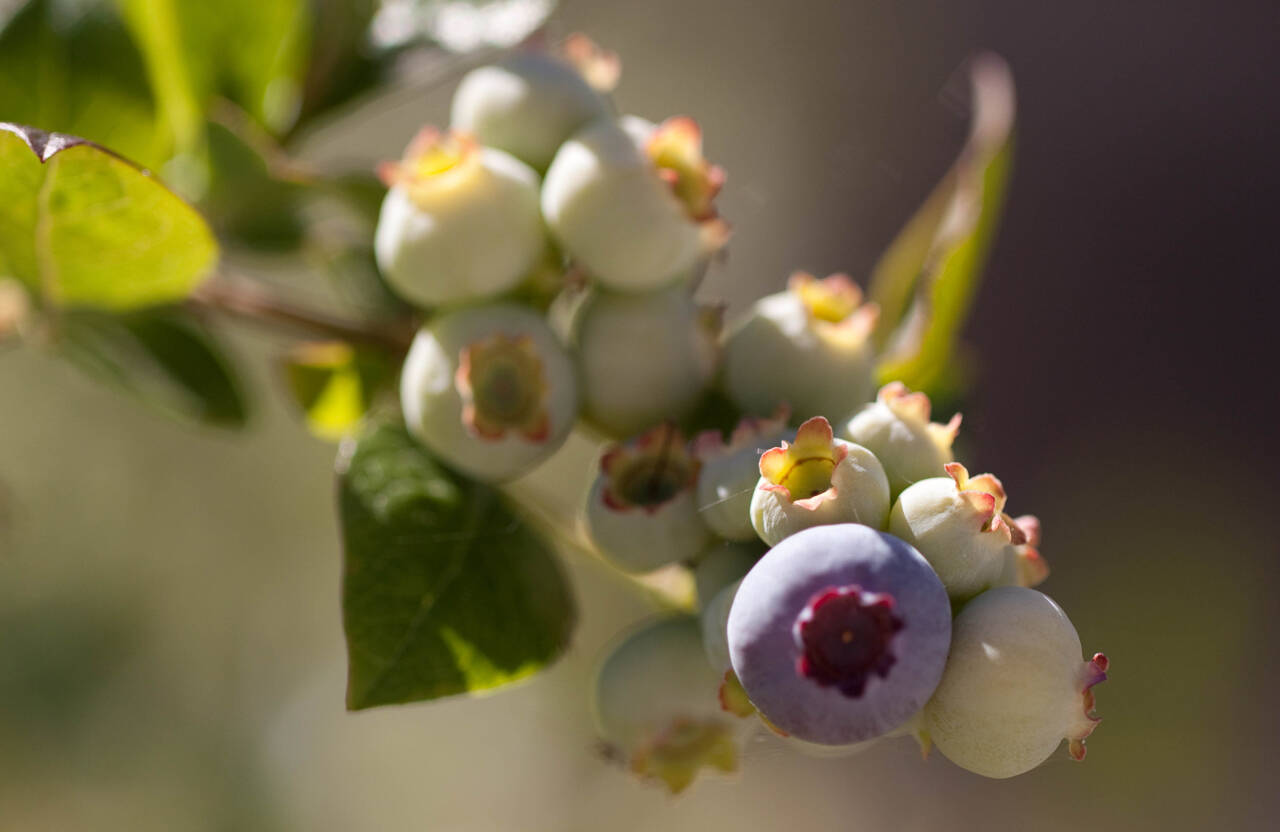
Question: Can I use coffee grounds to acidify the soil around my blueberries?
Blueberries are acid-loving plants that require a soil pH between 4.5 and 5.5 to access some nutrients (particularly iron) from the soil. If your soil has a pH above 5.5, you will need to acidify it to grow blueberries successfully.
Elemental sulfur is the most cost-effective acidifying agent for home gardeners. The amount needed depends on the starting pH of the soil, the soil texture and whether you have already planted your blueberries.
If you have not planted your blueberries: Apply 2.5 pounds of elemental sulfur (about 5 cups) per 100 square feet of soil to lower the pH by one point. Heavier soils (soils with more clay in them) require more sulfur to achieve the same acidification. Sandy soil requires less. Work the suggested amount of sulfur into the top eight inches of soil.
If you have planted your blueberries: Sulfur must be applied more sparingly so as not to burn the roots of the plants. Spread one-third cup of elemental sulfur in the drip zone of each bush. (The drip zone is the area directly below the outer circumference of the bush’s branches.) Lightly scratch the sulfur into the soil. Check the soil pH the following year. If the pH is still too high, apply the same amount of sulfur. Repeat sulfur applications in subsequent years until the desired pH is reached.
Can you use other agents to acidify the soil? Although most brewed coffee is acidic, studies suggest that coffee grounds have a pH close to neutral (6.5-6.8) and will not reliably acidify the soil. Sawdust, ammonium sulfate and sphagnum peat are weak acidifiers and only useful for making small changes in soil pH.
Aluminum sulfate, an acidifying agent used to turn bigleaf hydrangea flowers blue, is toxic to blueberries and should be avoided.
Question: What’s causing these holes on my cabbage leaves?
A number of pests feed on cabbage leaves, resulting in holes of various sizes and shapes. Two common culprits on the North Olympic Peninsula are the larvae (caterpillars) of both the cabbage looper moth and cabbage white butterfly.
Larvae of the cabbage looper moth (Trichoplusia ni) are light green with distinct stripes along each side. They grow up to 1.5 inches long and are distinguished from other caterpillars by their inchworm-like locomotion. Cabbage looper larvae feed readily on cruciferous crops (e.g., broccoli, Brussels sprouts, cabbage, cauliflower, kale and kohlrabi) but also on a host of unrelated crops and ornamentals.
The imported cabbage worm is the larva of the cabbage white butterfly (Pieris rapae). These caterpillars have a velvety green appearance with faint yellow stripes along their backs and sides.
Imported cabbage worm larvae grow to almost an inch in length. They feed primarily on cruciferous crops but also other plants that contain mustard oils such as nasturtium and sweet alyssum.
The life cycles of these two pests are similar, although the timing between stages differs. Both pests overwinter as pupae in the soil or plant debris. Adults emerge in spring and lay eggs.
Cabbage looper eggs are about the size of a pinhead and hemispherical in shape. Imported cabbage worm eggs are elongated (football-shaped), deeply ridged lengthwise and about one-eighth inch long. Both are laid singly on the underside of leaves of host plants.
The eggs hatch within a few days to a week, and the larvae feed for two to three weeks before pupating. The larva is the most destructive stage of these pests. Adults emerge several weeks later to start the cycle again. Several generations can occur in a single season.
Because other pests make holes in cabbage leaves, it is important to find the source of the holes before taking control measures. Check the undersides of leaves and along the leaf mid-rib looking for larvae and eggs. Look also for greenish-brown pellets of caterpillar excrement (frass) that are commonly found on the leaves of affected plants.
Take the following steps to help control both cabbage loopers and imported cabbage worms:
• Grow varieties of cabbage less attractive to these caterpillars such as red and savoy (wrinkled) cabbage.
• Soon after planting susceptible crops, cover plants with floating row covers or screen cages to prevent egg-laying by adults.
• Knock eggs off leaves and pick and destroy any pupae.
• Hand-pick and destroy caterpillars found on leaves.
• Avoid use of broad-spectrum insecticides to protect natural enemies of caterpillars including predacious beetles, parasitic wasps and birds.
• Remove garden debris and weeds which may shelter pupae.
Chemical control is aimed at the larval stage of these pests and must be timed to coincide with egg hatching. Recommended pesticides include products that contain neem oil, permethrin, pyrethrin and Spinosad.
The natural, soil dwelling bacterium Bacillus thuringiensis subspecies kurstaki (Bt-K) is particularly effective against cabbage loopers and imported cabbage worms. When larvae feed on leaves sprayed with Bt-K spores, a toxin is released that attaches to special receptors in the larva’s intestinal wall, causing ulcerations. The larvae stop feeding within hours and eventually starve to death.
Because other animals do not have the special gut receptors nor conditions in the gut that allow the release of the toxin, Bt-K is safe for use around pets and children.
Jeanette Stehr-Green is a WSU-certified Clallam County Master Gardener.
‘Scheduling Planting for Fall and Winter Gardening’
Join us for the upcoming Green Thumb presentation “Scheduling Planting for Fall and Winter Gardening” presented by Bob Cain, WSU-certified Clallam County Master Gardener, from noon-1 p.m. Thursday, June 23, via Zoom. Get the link at extension.wsu.edu/clallam/master-gardener-calendar, or join by phone at 253-215-8782 (meeting ID 920 0799 1742, passcode 709395). Cain will discuss the local climate and how it influences what, when and where vegetables can be grown, as well as reasons why we should consider this as a food security option. He will also look at the opportunities and limitations of growing vegetables during the colder parts of the year when many vegetables will be commanding peak prices. Presentations cover basic gardening topics relevant to most home gardeners. Seminars are free, but donations to help support the WSU Clallam County Extension Master Gardener program or Master Gardener Foundation of Clallam County are appreciated.
Petals & Pathways Garden Tour
When: 10 a.m.-4 p.m. Saturday, June 25
Tickets: $15 early bird, or $20 day of tour
On the web: clallammgf.org/events-2020/petals-and-pathways-garden-tour
More info: The tour features two in-town gardens in Port Angeles and four on State Route 112
The first, “Grandma’s Garden” is a traditional garden with nearly 100 hanging plants and unusual garden art including a tiny beach of colored glass and planters and plant stands fashioned from fireworks mortars once used in the Port Angeles Fourth of July fireworks display. This garden won the Port Angeles Garden Club Green Thumb award in 2019.
Across town, the homeowners, a landscape designer and a horticulturist, have created the “Four Seasons Garden,” a space of peace, tranquility, and serenity where they can relax and connect with nature. Landscaped for year-round interest with plant combinations that cultivate drama with their singular textures and shapes, this water-conserving garden with drip irrigation also features a rain garden in the front yard.
Just beyond city limits, the first garden you encounter on State Route 112 will be “A Place to Reflect.” Set back among towering evergreens, the centerpiece of this professionally landscaped monumental garden is a water feature that cascades some twenty-odd feet into a pond of close to 80,000 gallons of water inhabited by a bevy of colorful goldfish. The adjacent covered patio and fire ring offer an area for outdoor dining and relaxation among the flowers. Huge boulders strategically placed around the fire ring offer the chance to “pull up a rock and have a seat.”
Next up is “A Woodland Oasis,” a family homestead of 20 acres that has been worked by the same family since 1906. Rich in both family and local history, visitors will see a section of the old road to Joyce and vestiges of the old springboard notches used by loggers on the massive stumps of conifers now long-gone. No longer the working farm it once was, the present homeowner has turned her hand to gardening and created garden “rooms” integrating the existing landscape with native shrubs and other plants.
A bit farther down State Route 112, the garden visitor will come to the “Permaculture Garden.” This property takes the holistic permaculture approach, sometimes referred to as forest gardening. The garden here earns it keep. It is filled with fruit trees, berry bushes, and hops — all patrolled by ducks who keep the slug population in check. Vegetable gardens and greenhouses are placed in the sunny spots around the property. Of added interest are the straw bale house and pallet building built by the homeowners for their family. There is also an outdoor cob oven.
The final garden, “Fairnie Brae,” features meadows with meandering trails on a bluff overlooking the Strait of Juan de Fuca, making this garden a delightful experience. The homeowners are a very hands-on couple who knew exactly what they wanted in their garden. They have created a natural, open, and aesthetically pleasing environment that incorporates vegetable gardens, magical groves, and park-like meadows. Mementos of the time they spent in Indonesia lend an exotic touch in the form of unique garden art.