Dungeness Refuge strikes balance between protection and recreation
Published 4:24 pm Tuesday, February 17, 2015
by JOHN MAXWELL
For the Sequim Gazette
Editor’s note: This is the second in a monthly series about the Dungeness National Wildlife Refuge, past and present. — MD
At Dungeness National Wildlife Refuge on a sunny day you can’t beat the view: a 5.5 mile-long, wave-swept sand spit punctuated by the lighthouse at its end, with Mount Baker in the distance.
In the winter you can watch storm waves breaking against the spit and sometimes over it.
Any time of the year the spit is beautiful, but it is also fragile. Almost every winter a storm will breach the spit, temporarily placing the lighthouse on an island until the spit repairs itself.
If it were not for the constantly eroding bluffs to the west which supply the building material, the spit might disappear completely over time — beautiful but fragile.
The refuge hosts many different species of birds and other wildlife. They too are beautiful and fragile. Thousands of birds stop over here on their spring and fall migrations, depending on the bay and its eelgrass beds for protection and refueling on their long flights.
Other birds like oystercatchers nest here in the summer, raising their young in the shelter of the spit and Dungeness Bay. Still others like the brant winter here. They depend on the eelgrass beds in the shallows for their main winter food supply. Without the eelgrass beds and the protection of the spit and its driftwood, all these birds would have to find another place to call home.
Unfortunately, thanks to human development and destruction of many similar feeding and nesting areas along the West Coast, few other such safe homes exist anymore. Refuges like Dungeness are more crucial than ever to the birds’ continued existence.
Even here “safety” is a relative term. The birds still are vulnerable to natural predators. Plus, many human activities can flush or panic them, making them so tense and anxious that they cannot settle down to feed or breed. The birds look to us to protect them.
The challenge at Dungeness is that it is so beautiful humans want to enjoy it, too. Is it possible for us to enjoy the spit and still protect the wildlife? Yes, it is. Dungeness was established in 1915 to protect the wild birds. From time to time that protection has stirred local controversy as shown by local newspaper headlines over the 100 years of the refuge’s existence. Various Congressional acts from 1962-1997 have restated and reinforced the basic principle that in national wildlife refuges the wildlife comes first.
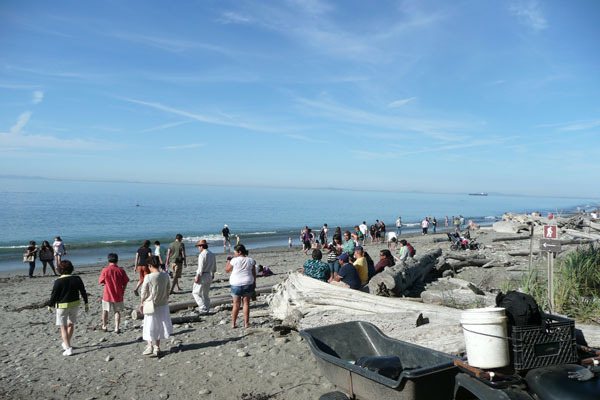
Those same Congressional acts also allow non-threatening forms of human recreation. You can visit and enjoy Dungeness Spit. Unlike some refuges, it is not closed to the public.
What can you do on your visit? A lot! You can walk the forest trails and wander out along the ocean side of the spit. If you are feeling energetic, you even can hike the 5.5 miles out to the lighthouse and back. (Just be sure to check the tides before you start.)
When you get to the lighthouse, volunteers staying there will be glad to give you tours from 9 a.m.-5 p.m.
Be sure to bring your camera or sketchbook and your binoculars. Just be aware that as you watch the birds and animals, they are watching you. That seal sticking its head up out of the water is scoping you out, trying to decide if you are safe. The birds are keeping an eye on you for the same reason. Please try not to disturb them. Walk quietly and gently, respecting their privacy and need to feel safe. Also, please respect the closed areas of the spit.
On your walk be sure to take some time just to sit on the sand or a driftwood log and listen to the waves and the calls of the birds. Let the spit’s beauty fill you with its peace and know that the birds and other wildlife are thanking you for protecting them.
Finally …
In celebration of the 100th anniversary of Dungeness NWR, you can join volunteers from Olympic Peninsula Audubon on a winter bird walk on Feb. 21.
The walk leaves from the refuge entrance at 9 a.m. If you are interested in this and future centennial events, visit www.Dungeness100.com.
John Maxwell is historian for the Dungeness National Wildlife Refuge.


Best of Olympic Peninsula