Understanding steelhead
Published 12:30 pm Wednesday, May 6, 2015
What would Sequim be without the river?
That’s the question Chris Burns, a natural resources technician for the Jamestown S’Klallam Tribe asked when probed about the importance of studying fish in the Dungeness River — something he’s devoted much of his professional and personal time toward.
To expand their understanding of the river, the resources it supports, like steelhead, its overall health and improve fisheries management, Burns and his colleagues Aaron Brooks, fisheries management biologist for the Jamestown S’Klallam Tribe, and tribal citizen Casey Allen are pursuing unprecedented DNA analysis of steelhead in the Dungeness River and nearby creeks.
“I think steelhead are the shinning star of the Dungeness … it’s the perfect river for them,” Burns said.
Although the Dungeness River is intrinsically ideal for steelhead, the numbers of steelhead returning to spawn remain below the goal established by the Washington Department of Fish and Wildlife, Burns said. The escapement (portion of an anadromous fish population that return to freshwater spawning grounds) goal for steelhead in the Dungeness River is 1,034.
“We’re just below that,” he said. “Part of the problem with the Dungeness is it’s impaired.”
For example, construction of levees, removal of large woody debris and irrigating from the river have caused changes to its natural behavior.
“Everything we do has an impact,” Burns said.
Valued resource
Concerns about impacts on the Dungeness River and with the Olympic Peninsula’s overall water supply are in a heightened state after the region was drought declared by Gov. Jay Inslee in mid-March.
The anticipated drought spurred Department of Ecology to fund a drought year leasing program administered by Washington Water. The voluntary program is partially aimed at ensuring surface flows remain conducive for fish passage during the final month of the irrigation season.
The onset of a drought in the midst of the 120th Irrigation Festival — a community celebration centered on irrigation — reflects the varying reliances on water.
Irrigation from the Dungeness River has proven essential to agricultural undertakings since May 1895 when the first headgate on the river was lifted, according to “Jimmy Come Lately: History of Clallam County,” a symposium published by Clallam County Historical Society.
The Dungeness Valley is one of, if not the largest, area to rely on irrigation and surface water in Western Washington, Amanda Cronin, Washington Water Trust project manager said. Within the valley an estimated 5,700 irrigated acres are under the Dungeness Water Users Association.
Although local irrigation is seemingly an age-old tradition, since its existence the Dungeness River has acted as an ecological artery of sorts.
“Every fish is an important component of a river system,” Brooks said.
Unlike other salmonids, steelhead have the potential to spawn multiple times. Each time salmon and steelhead return from the saltwater to a freshwater system to spawn they bring nutrients and provide an essential food source for many species, Brooks explained.
Beyond their biological role, salmonids are deeply woven into the culture of the Jamestown S’Klallam Tribe. But, Brooks noted steelhead fishing for both subsistence and sport has become more challenging with dwindling numbers.
Puget Sound steelhead made the federal Endangered Species List in 2007.
DNA study
To begin to pinpoint the status of the population, understand migration patterns of steelhead and evolve fisheries management, Burns and Brooks aim to create a genetic baseline for steelhead within the local waterways.
“The main goal is to better our management abilities,” Brooks said.
Knowing the genetic make-up of the local steelhead runs, like those already known for many of the other salmonids, will help researchers and scientists understand the species that has long been a part of the overall river system.
“What I want to see come from this (research) is the whole resident and anadromous connection,” Burns said.
Because steelhead are an ocean-going trout, true rainbow trout are “resident” meaning they don’t travel to the ocean, but still can spawn with steelhead.
In addition to studying the genetic impact of rainbow trout, which can provide genetic diversity to anadromous steelhead, Burns said, they’re also looking for the possibility of a remnant population of summer run steelhead which the National Oceanic and Atmospheric Administration has labeled “status unknown.”
“Summer run genetics can be found through DNA analysis,” Burns said.
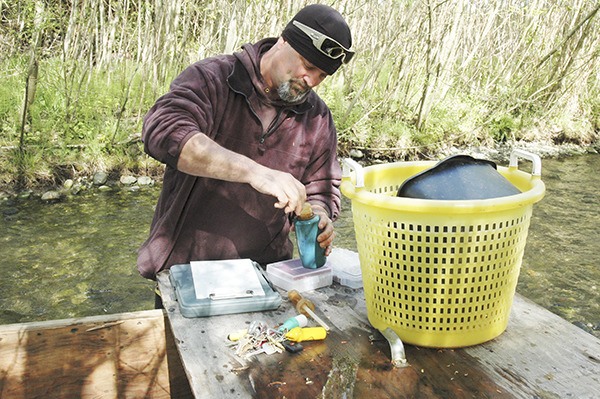
To create a genetic baseline, Burns and Allen are collecting DNA samples by taking fin clippings from adult and juvenile steelhead. The method doesn’t harm the fish and the small portion of the fin regenerates, Burns said. In the field, they also document the size of the steelhead and take scales for age analysis.
Because steelhead don’t travel in large numbers, Burns is gathering the majority of the DNA data via a rod and reel permit; thus requiring him to catch and release each fish.
“I would like to get 100 adult samples from the Dungeness River,” Burns said.
Since last year and the beginning of the steelhead DNA project, Burns and Allen have collected about 60 steelhead DNA samples.
Other methods
Although the tribe’s varying methods of assessment, from spawning surveys and smolt traps to DNA analysis are separate, they’re all part of fisheries management puzzle, Brooks said.
Occasionally, they’re able to collect DNA data from adult steelhead stopped by the weirs placed across streams to study production levels by funneling smolt into a box for documentation before they continue onto the ocean.
Natural resources officials with Jamestown S’Klallam Tribe also are assessing coho and cutthroat at the smolt traps, Brooks said.
Coinciding with the DNA research, the little to no snowpack may allow Burns and Allen to survey the Dungeness River for the entirety of the wild steelhead season.
“Steelhead spawning surveys have gone on for years, but the timing of the season is a problem,” Brooks said.
Researchers attempt to do steelhead spawning surveys, but because it entails walking the river and counting fish and redds, they’re typically unable to survey a whole steelhead season because of high river conditions due to snowmelt in the spring.
“We’ve never been able to survey an entire season on the Dungeness,” Brooks said.
Working around the seasonal challenge of surveying steelhead, Burns has used timing curves from rivers similar to the Dungeness River, such as the Nooksack River.
The DNA research coupled with the development of a reliable method to calculate steelhead escapement, Brooks and Burns seek to better understand the status of the local steelhead populations — something not thoroughly understood on a local level.
“There’s a lot we don’t know, but status ‘unknown’ just isn’t good enough for me,” Burns said.
Reach Alana Linderoth at alinderoth@sequimgazette.com.



Best of Olympic Peninsula