A day in the life of a refuge inspector
Published 4:43 pm Tuesday, June 9, 2015
by John Maxwell
For the Sequim Gazette
Editor’s note: This is the fifth in a monthly series about the Dungeness National Wildlife Refuge, past and present. — MD
Researching history is like a treasure hunt; you never know what you may find or if you will find anything.
For example, over the years an anonymous person at the Port Angeles branch of the North Olympic Library System collected a file relating to Dungeness Spit. There I found a report written in early 1915 by refuge inspector George Cantwell. I only have Page 2 of the report, but it told me a lot. Let me tell it to you as a story:
You are George Cantwell, an employee of the Bureau of Biological Survey of the U.S. Department of Agriculture. Your office is in Puyallup but your actual territory is rather vague, since at this time the bureau is not divided into geographic areas. It is January 1915 and you have just received word from your boss Henry W. Henshaw in Washington, D.C., that President Woodrow Wilson has added to your responsibility as refuge inspector two new wild bird reservations: Ediz Hook near Port Angeles and Dungeness Spit to the east.
Why are you in Puyallup and not Tacoma or Seattle? At this time the Puyallup Valley is a rich farming area, renowned for its hops, berries and vegetables. (A century later it is paved over with warehouses, high-tech factories and freeways.) It is thus a natural location for an office of the Department of Agriculture.
Part of your job is to advise farmers on both domestic and game birds, as well as keeping track of fish and other wildlife in the region. You already are responsible for three wild bird reservations out on the Washington coast: Flattery Rocks, Quillayute Needles and Copalis. President Theodore Roosevelt established them in 1907 to protect nesting sea birds.
Your immediate task is to post notice on the two spits and inform the local people, a rather thankless job, since you assume there will be some opposition.
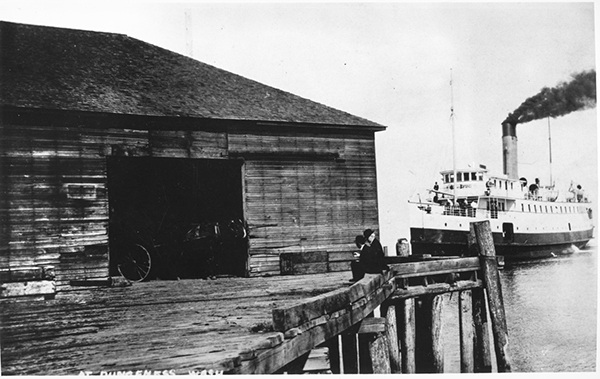
You get signs and circulars printed. In the morning you take the interurban train to Seattle, getting off just a short walk from the ferry dock. There you board a ferry. Five different steamships ran between Seattle, Port Townsend, Dungeness and Port Angeles. You ride the ferry first to Dungeness and then to Port Angeles.
At Dungeness you signal the lighthouse keeper to take you out to the spit in his boat. There the two of you post signs saying this is now a Federal Wild Bird Reservation and that hunting is not allowed (but people may still fish, crab and dig clams on the tide flats). The two of you are careful to stay half a mile out from the base of the spit, since that is private land and not part of the reservation.
Back on the mainland, you post circulars at the hotels and post offices in Dungeness and Sequim, and give a circular to the local newspaper, The Sequim Press. It appears in the Feb. 20, 1915, edition. You hunt up the local state game warden and notify him. He probably is happy about what you are doing and glad to do whatever he can to help.
Back on the ferry, you head west to Port Angeles, where you repeat the notification process, careful to include all the local newspapers and leaders. While some people are glad to see the reservations established, some are definitely not happy. Perhaps some tell you so in person or maybe they just mutter behind your back. After all, both spits have been popular locations for hunting waterfowl.
You also learn that Ediz Hook already is being eyed for industrial development now that Mr. Aldwell’s dam is complete and sending electrical power to the area.
You probably travel on out to the coast to check on the three reservations there. Then it’s the long trip back home to Puyallup where you write up your report, dated March 5, 1915.
Pecking away at a big, clunky manual typewriter you write, “Both this reservation (Ediz Hook) and that of Dungeness Spit, well posted with the Departments notices, and at both Dungeness and Port Angelus notice was given out to the newspapers and local game wardens, and copies left with the hotels and post offices … Left Port Angelus March 2nd. Noon. Arrived Seattle Wn. 6. pm. and arrived home in Puyallup Wash. that evening at 8:30.” (Note: all typos are his.)
You include in your report a list of waterfowl you observed around Ediz Hook.
Negative reaction was not long in arriving in the form of an angry editorial by Sequim Press publisher George O’Brien in the March 15, 1915, edition. He complains that the federal government is taking yet another “whack” at Clallam County, adding more reservations to the ones already existing, including military reservations, a quarantine station at Port Williams, forest reserves and a national monument (Mount Olympus). He gibes that “the Dungeness and Port Angeles sand spits are henceforth and forevermore reserved as a roosting place for sea gulls.”
He closes by writing that “The government started in over fifty years ago and reserved a townsite at Port Angeles and it seems the Washington officials have had it in for us ever since.”
You let out a mighty sigh and then get on with your job.
John Maxwell is a historian for the Dungeness National Wildlife Refuge.
Dungeness Refuge’s ‘Kids Day’ fun for whole family
Sequim Gazette staff
Celebrate the Dungeness National Wildlife Refuge’s Centennial at a free day of fun educational activities for the whole family, set for 10 a.m.-3 p.m. Saturday, June 20, at the Dungeness National Wildlife Refuge on Voice of America Road.
The first 200 youths who join the fun get a Kids Day Passport that guides them on a journey to learn about wildlife and habitats of the Olympic Peninsula and Washington coast while gathering cool souvenirs to help them explore nature with their families.
Climb inside a giant migrating salmon, see a miniature replica of the New Dungeness Lighthouse, create your own shell castings, examine insects, bones, shells and historical beach artifacts, create wildlife arts and crafts and more. Participants even may have a rare encounter with the elusive Bigfoot.
Join the Friends of Dungeness National Wildlife Refuge, Leave No Trace Center for Outdoor Ethics, New Dungeness Light Station Association, Olympic Coast National Marine Sanctuary, Olympic National Park, Quilcene National Fish Hatchery and others in this unique event and learn how Dungeness National Wildlife Refuge has been working for wildlife since 1915.
The event is free and open to the public. For more information, call the refuge office at 457-8451 or send an e-mail to david_falzetti@fws.gov.
Best of Olympic Peninsula