Finding ways to bring back the purple martin
Published 11:53 am Wednesday, August 26, 2015
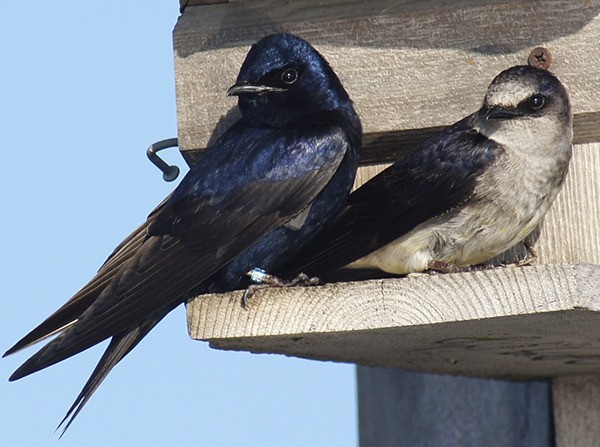
The most northern population of purple martins has come to rely on human help and remnants of the Dungeness dock near 3 Crabs.
The creosote soaked pilings, teetering about 15- to 18-feet into the sky and supporting 16 nesting boxes for purple martins are owned by the Port of Port Angeles and a target for future removal — leaving the largest of the swallow species without a place to nest.
“Eventually those pilings will be pulled out,” Ken Wiersema, president of the Olympic Peninsula Audubon Society. “Once they come out we could lose the entire colony.”
Wiersema is among the Olympic Peninsula Audubon Society members that have devoted much of their time and energy toward helping the purple martin population recover after fewer than 1,000 breeding pairs were documented to exist in Washington in the 1970s and 1980s.
For about 20 years Wiersema has witnessed the purple martin population at 3 Crabs rise and fall, but the overall trend has suggested populations both locally and statewide are increasing.
Despite their low numbers in comparison to historical records, without fail, a western migration of purple martins travel from near Panama, along the west coast of California and up to 3 Crabs to annually lay four to six eggs. Once arriving in mid-May, the purple martins stay until August. This year, 37 adults were documented to return, which is up from the 3-5 documented in 1999 and the years prior.
From those adults, 65 fledged birds were counted — setting a record since the Olympic Peninsula Audubon Society members began monitoring purple martins.
“When dealing with any natural system, you expect peaks and valleys,” Wiersema said. “It’s going to take a few years to know if we’re looking at a trend or just an extraordinary year… we’re guardedly optimistic.”
Climate change also may play a role in how purple martins migrate in the coming years and the birds’ success.
“Depending on climate change, it could push the whole migration of these birds north,” Wiersema said.
This year, the purple martins arrived about seven to 10 days earlier than normal — a likely indicator that winged insects also were more plentiful earlier in the season.
Like every type of swallow, purple martins need to live and nest near freshwater as they feed on insects, such as dragonflies. Although the abandoned pilings at
3 Crabs are within the salty waters near Dungeness Bay, there’s enough freshwater nearby to provide an active prey base. The location of the pilings are key to the local purple martin population, however,
as neither European starlings or house sparrows (both non-native species) aren’t comfortable nesting over water like purple martins.
But, similar to purple martins, European starlings and house sparrows prefer to nest in cavities and thus compete with one another for nesting areas.
Additionally, Wiersema explained how early forestry practices, such as clear cutting, the depletion of old growth and with it the dynamic structure of mature forests that once provided ample habitat for cavity-nesting birds also has negatively impacted the purple martin populations.
“Depleting old-growth forests were devastating to a lot of birds,” he said. “Purple martins are a bird that probably wouldn’t be coming back to this area if it weren’t for some human effort and protection.”
As a precautionary measure for when the Dungeness dock pilings are removed and in hopes of maintaining biodiversity, Wiersema is working to find nearby areas to install environmentally friendly pilings to transition the nesting boxes onto.
“There’s a saying that, ‘you want to keep common birds common,’” he said. “Essentially, you don’t want to wait until you have very few birds to begin taking steps toward maintaining them because, among other things, it becomes costly.”
Ideally, Wiersema and others assisting with monitoring the purple martin population would like to see the birds and surrounding habitat to recover enough to allow them to nest in natural cavities again.
“I think it’s an achievable goal, but it’s going to take a lot of cooperation,” Wiersema said.
Along with the growing effort at 3 Crabs to foster the purple martin populations, Wiersema also monitors five nesting boxes installed on Protection Island in collaboration with the US Fish and Wildlife Service.
Worldwide, 83 swallow species are known. Of those, 10 are documented to be found within the United States. Seven species are found within Washington and six different species, including purple martins are recorded in Clallam County.
For information about the Olympic Peninsula Audubon Society, visit olympicpeninsulaaudubon.org.
Reach Alana Linderoth at alinderoth@sequimgazette.com.