Get It Growing: Master Gardeners’ regrets
Published 1:30 am Wednesday, October 15, 2025

Even the most experienced gardeners make mistakes in their plant choices. Whether it’s an invasive spreader, a high-maintenance diva, or a plant that attracts more pests than pollinators, some plants just don’t play nice.
Plants that grow aggressively can quickly outcompete their neighbors, taking up space and resources. Most people know to avoid planting bamboo at all costs. It spreads through underground runners (rhizomes) and can quickly take over the yard. Add mint, English ivy, and Vinca (periwinkle) to that list. Without proper barriers, all these plants can and will become invasive.
Of course, not everyone agrees about what plants are “mistakes.” One gardener’s nightmare plant might be another’s favorite specimen. Take Crocosmia, for example; some love its fiery blooms, while others find it spreads too aggressively and is nearly impossible to remove. Forget-Me-Nots may look charming in spring, but for those who battle their endless self-seeding, they can quickly become a weedy frustration.
To help local gardeners avoid some regrets, several Master Gardeners (MGs) were asked, “What plants have you grown in your yard that you wouldn’t grow again?”
Talk about not agreeing! In fact, there was a lot of good-hearted disagreement amongst the Master Gardener group over what to list. In no special order, here are just a few of the plants MGs wouldn’t plant again and why.
English Laurel
It’s unanimous. MGs don’t recommend ever planting an English Laurel (Prunus laurocerasus) hedge. They are enticing because they are evergreen and grow fast. In fact, so fast they can quickly reach 12’ high and 8’ wide, and that is just the beginning. The mature size can be 18’ high and 20’ wide. That is way too much laurel hedge for just about anyone. They are also poisonous to dogs and the sap is an irritant.
Myrtle Spurge
Most, but not all, agree to avoid myrtle spurge (Euphorbia myrsinites); it grows and grows and crowds out neighboring plants. Sticky white sap can be a skin irritant, and it’s possibly poisonous to animals. If allowed to go to seed, it will become invasive with a capital I.
Mexican Feather Grass
Granted, this is a very pretty grass (which is also known as Stipa/Nassella tenuissima), but it is highly invasive! If you’re not an avid fan of ornamental grass, don’t plant it! It will come up everywhere, even compacted gravel walkways, and you will be pulling its fuzzy little babies endlessly.
Shasta Daisy
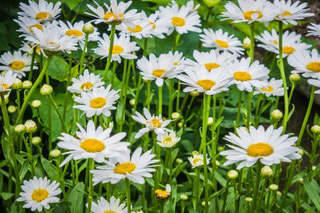
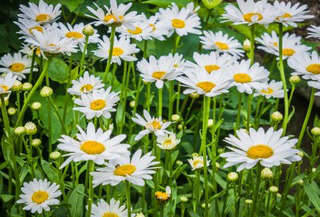
The opinions were divided on this daisy, also known as Leucanthemum x superbum. They are lovely if you have a lot of space, but what starts as a small clump gets really big after a couple of years (they spread by underground rhizomes). Eventually, you will be digging and dividing every year (don’t give them away to good friends). Also, many people don’t realize they are stinky; certainly, don’t plant this daisy under a window.
Borage
Again, a split decision from the MGs. Also called Borago officinalis, this is a great pollinator plant that, according to some, turns into a bully. It is also an abundant re-seeder; once planted, you may have borage for life. Some say its attraction to pollinators and lovely edible blue flowers outweighs the bully factor. So, we advise, if you do plant it, deadhead voraciously.
Perennial Bachelor Button
Yes, the flower (Centaurea montana) is a lovely blue, but they are so invasive – ugh. The roots always break when you pull or dig them up, and that little bit of root left in the ground is enough for them to come back. Add in the re-seeding, and it’s a real nuisance. We have been fighting this flower for years at the Woodcock Demonstration Garden.
Lady’s Mantle
MGs love Alchemilla mollis. But don’t plant it in your yard unless you dedicate yourself to deadheading to keep it from spreading everywhere. It will happily sprout and grow in gravel without any soil, nutrients, or water in sight.
Creeping Jenny
Two schools of thought on Lysimachia nummularia. One is that Creeping Jenny is great as a trailer in patio planters, bright green with lovely yellow flowers. The other is that it will eventually escape and make your life miserable. The name creeping is an understatement. If it escapes from a pot, there is no stopping it. How invasive can it be? Let’s just say it belongs on the list with ivy, mint, and periwinkle!
Lily of the Valley
Sorry, Lily of the Valley (convallaria majalis) lovers. This ground cover will choke out anything and everything around it. When it runs out of room in one garden bed, it will move to another without blinking an eye. The roots can travel from one garden to the next, even under concrete. Add the fact that this plant is very poisonous, and this delicate shade plant easily makes the “regrets” list.
Pearly Everlasting (Anaphalis margaritacea)
Planting native plants is encouraged, but doing the right thing in the case of Pearly Everlasting (anaphalis margaritacea) may be a bad move. It’s called “everlasting” for a reason: it will take over and spread like wildfire. It’s rumored that the seeds can survive in the soil for eons (or at least forever).
Before adding a new plant to your garden, research its growth habits and potential impact. Sometimes, a plant that seems like a great choice can become your biggest garden regret. When the description says “can be invasive,” believe it.
_____________________
Susan Kalmar is a WSU Clallam County Master Gardener and a volunteer at the Master Gardener Woodcock Demonstration Garden in Sequim.