Connectedness for the Ageless Generation: A 55-year history of serving seniors, having fun
Published 2:30 am Wednesday, February 25, 2026







By Michael Smith
Imagine two high school seniors with long hair and tie-dyed T-shirts riding skateboards down Washington Street sidewalks in the spring of 1971. A “senior center” was probably the furthest thing from their 17-year-old minds, and yet this year those carefree teens will be 72 years old.
Like our skateboarders of yesteryear, today you can come and enjoy Sequim’s senior center. Today we are able to provide vital services and fun activities as Shipley Center, because folks in our wonderful Sequim community invested time and treasure and planned ahead, over half a century ago.
It was May 27, 1971 when an intrepid group of Sequim pioneers signed the articles of incorporation and named the organization the Senior Citizens Center of Sequim. As we will see, the group changed their name a few times along the way, but where did it all start? The Center began life in the basement of the old Sequim Presbyterian Church. Many of its first members came from “The Leisure Hours Club” started by the church in the 1950’s in Sequim.
The first board included English teacher and poet Hart Smith as president, Cecil Miller as secretary/treasurer, and board directors Everett Lindaas, Rev. Floyd Torrence, Earl Morrell and Rhea Sherman. The first executive director was Bill Cooper.
In 1972 the Center moved from the church to its second location, the old 1913 Sequim “Town Hall” building east of the old fire station on Cedar Street. Later, that building became the city’s Public Works Department for a number of years before being sold and moved to 170 W. Bell St., where it can be seen today.
After a few more years, in about 1976, the City of Sequim asked the Sequim Senior Citizens, as the group called themselves, if they’d like to move to a larger city building. Jumping at the chance, the seniors moved a few doors down into the wood-framed “Community Center,” formerly the Adventist Church, on the corner of Second and Cedar where today’s Transit Center is. This third home for the center was rent free, but the seniors needed to raise a bit of money to pay the utilities each month, and shared the building with the City of Sequim. Senior activities had to end by 4 p.m. each day, and seniors could not use it on weekends. The building had one main room for activities and one room for a pool table, plus a small office.
In the late 1970’s the membership, numbering over 100, decided an expansion/remodel was in order, and with the city’s permission, greatly improved and expanded their operations into additional parts of the building, including a kitchen, two bathrooms, and more. The labor was provided by the men and women of the then-named Sequim Senior Center, all volunteers working together with much of the building material donated by Sequim merchants.
Bingo, cards, pool, checkers, chess, and other games were played, and there were sing-alongs, potlucks, and socializing. This worked fine until the mid-1980s when the need for even more space became obvious. The group dreamed of a bigger building to hold more people and activities.
In 1987 Sequim Senior Center obtained its official nonprofit status from the IRS, changing its corporate name to Sequim Senior Task Force. An odd name, but there was a “task” to be done, and they were focused on it. The fast-growing group was dreaming of a home of their own to buy or build, and donors wanted to be able to deduct their gifts to the cause.
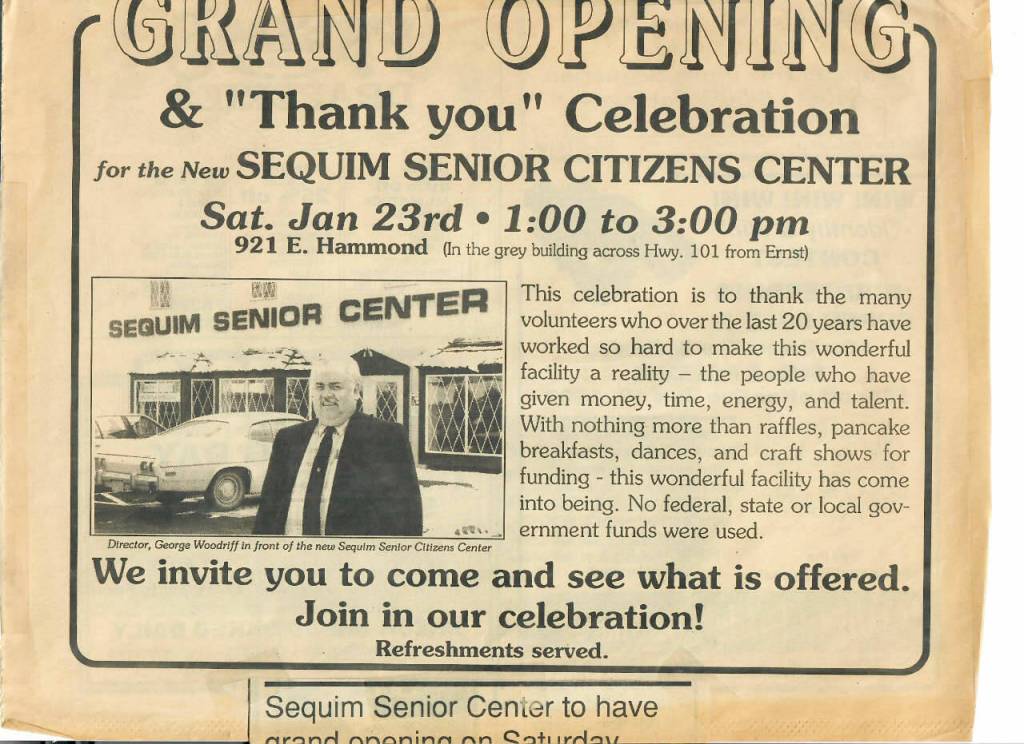
In 1989, Executive Director George Woodriff was hired and tasked by the board with finding a building or a building site and most importantly, funds to accomplish the goal. Fundraisers were held over the years, including pancake breakfasts, raffles, rummage sales, auctions, car washes and “most any other kind of fundraiser” that could be thought of to give what was then known as Sequim Senior Center new and larger digs.
Finally, enough money was raised and bequeathed to the organization, and in August 1992 Woodriff succeeded in finding a large “pole barn” building at 921 E. Hammond St. for sale at the right price, and arranged for its immediate purchase.
The building the center is in today was originally built and owned by local Sequim dairy farmers Willie and Florence Belfield. Shipley Center member Mary Bell tells us that Willie had built the barn to store construction materials, trucks, and equipment. Later, when they built the housing development on Blair and Belfield Avenues, south of the Center, Willie and his business partner used the building as construction headquarters and named their new neighborhood Flora’s Acres in honor of his wife.
The address 921 E Hammond has seen many other uses over the years, and has been owned by two different mayors of Sequim. The Belfields sold to former Sequim mayor Bill Thomas and his wife Carol, who turned the building into a health club, with racquetball courts. The Thomases later sold it to Sequim Mayor Ed Beggs and his wife Dorothea, who were Senior Center members. The couple created an antiques mall, with vendors selling their wares throughout. On the sale to Sequim Senior Center in 1992, it was said that the building had “found its true calling.”
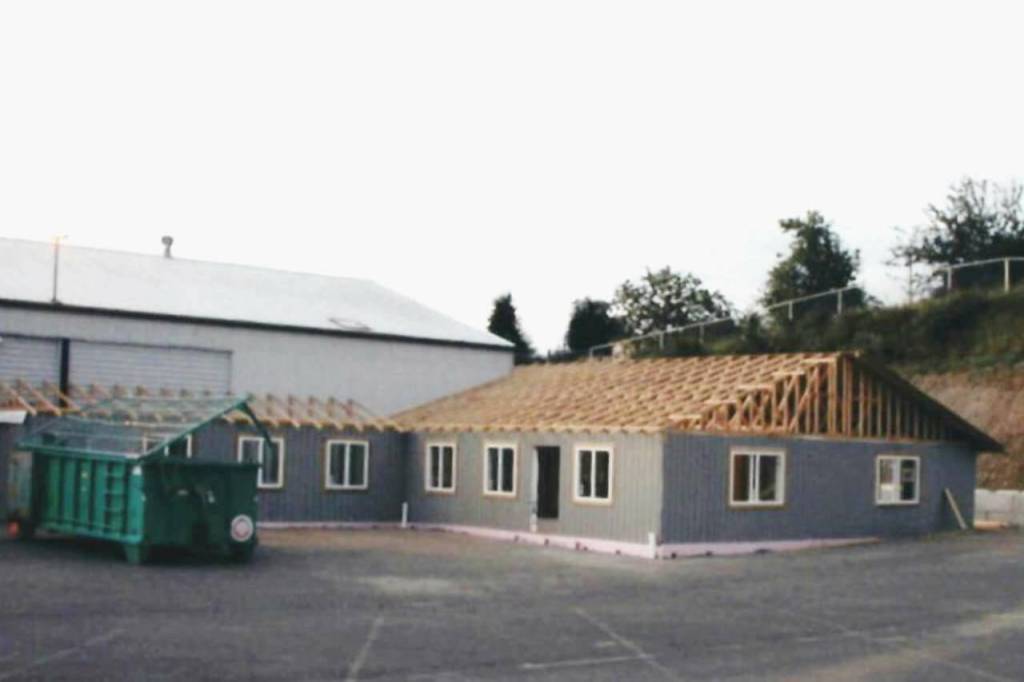
Renovation of the old pole barn started right away, with Woodriff and 100 senior volunteers adding walls, renovating restrooms, hanging drywall, painting, installing light fixtures, flooring, and more. Some volunteers had building experience and taught the novices what to do. There was great pride in the 1,350 senior members finally owning their own “home” that they moved into in January 1993.
Shortly afterwards, the new “Trips Department” was created and money was raised for a bus for seniors to enjoy trips all over Western Washington.
More members, more space
Almost exactly 10 years after the purchase of 921 E. Hammond, on August 27, 2002, Sequim’s indomitable seniors broke ground on a 3,885 square foot addition to their digs. Three sides of the building were added onto, creating a larger main room, a brightly lit art room, a computer classroom, a multi-purpose classroom, a health services room, storage areas, new restrooms, a Café dining room, a director’s office and a new front-desk lobby.
Generous donors and volunteer workers had a vision and made it happen, but it came with a cost; a 20-year bank loan. In 2013, the members of Sequim Senior Activity Center, encouraged by longtime member and volunteer Judy Priest, resolved to get their Center out of debt. A successful $135,000 “Burn the Mortgage!” campaign was completed in about 100 days, and the Center has not carried any debt since.
In 2005 the legal name of the nonprofit corporation was changed to its current name, Sequim Senior Services, and right after that yours truly was hired as the new executive director. In 2007, it began “doing business as” Sequim Senior Activity Center. Today, the “doing business as” name is Shipley Center, in honor of longtime member and benefactor extraordinaire R. Leo Shipley. (More about Leo’s story and his impact on Sequim and the Center that bears his name in a future column.)
Those teen skateboarders from 1971 are still having fun today at Shipley Center — not focused on age, but on life and living it to the fullest. As we move forward with our current project, the re-purposing of the former JCPenney to be Shipley Center’s new home, please join us. Today’s seniors and tomorrow’s, thank you.