Olympic Psychiatric Care marks 10 years of meeting rural mental health care needs
Published 4:30 am Wednesday, July 29, 2026
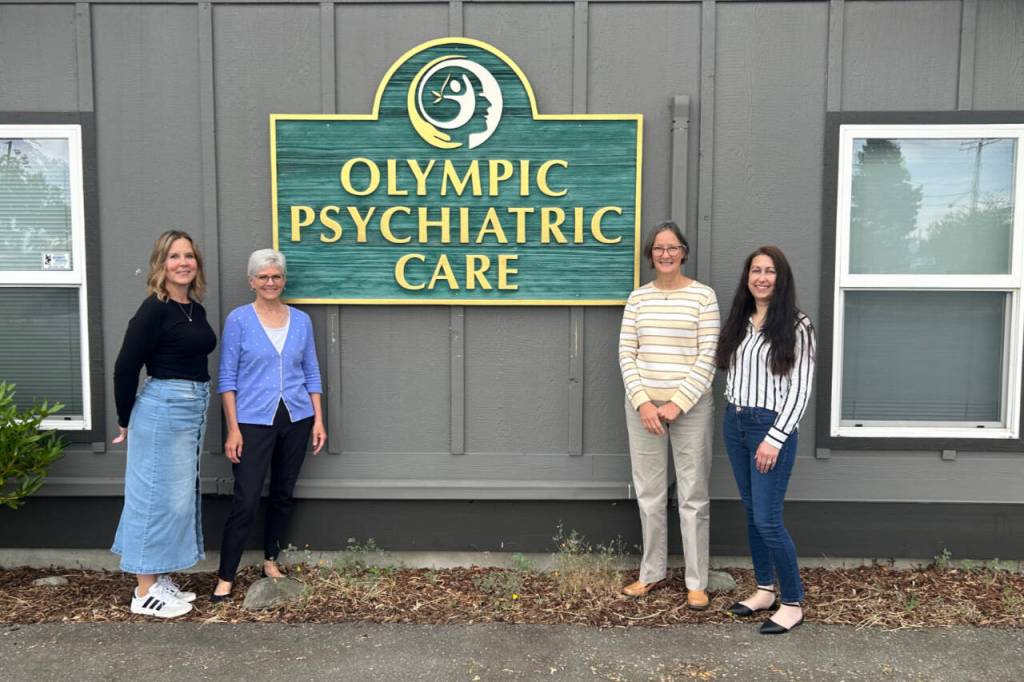
If one were to write a book about Becky Godby’s late-in-life career as a mental health professional, it could be titled “The Reluctant Entrepreneur.”
She had never seen herself as someone who could run her own business, but her struggle to find a job changed that. Ten years later, her business, Olympic Psychiatric Care, is going strong.
Godby had spent years as a women’s health nurse practitioner in the Midwest. She and her husband Lewis moved to the North Olympic Peninsula after their daughter married and settled in the region.
“We’d never even heard of Sequim,” Godby said. “Our daughter got married out here, and we said, ‘Hey, we’ve got one good move left in us,’ and we moved out here sight unseen.”
Once here, Godby discovered that local employers weren’t looking for more providers in her specialty. Psychiatric nurse practitioners, though, were in short supply.
“There is a nationwide shortage of psychiatric care, and it’s particularly hard in rural areas,” she said. “We don’t have a psychiatric hospital here, so you’re kind of out here just doing the best you can.”
Encouraged by her husband, Godby went back to school in her late 40s to earn a post-master’s certificate in psychiatric care. Eventually, she was recruited by Peninsula Behavioral Health and began working with primary care clinics across the area to help manage patients’ psychiatric needs. The need was substantial, but so was the strain.
“I was going to four different clinics, and after a year, I was just worn out,” Godby said.
Still, starting her own practice wasn’t an idea that appealed to her.
“I did not want to open my own practice because I’m not an entrepreneur,” she said. “Running a business doesn’t appeal to me in the slightest. I’m just patient care. The thought of running a business actually scares me.”
Lewis, though, had a knack for business, so Godby compromised: She would lean on him for help in handling the business side while she would focus solely on patients.
But literally on the day Olympic Psychiatric Care opened, Lewis accepted a pastorate position, leaving Godby with a new clinic — and no business manager to help run it.
Godby hired a woman through a temp agency to help with front office tasks. In 2019, she hired Tricia Vandiver, also through a temp agency, to help with an increasing workload. In 2021, after months of challenges brought on by the COVID-19 pandemic, the first woman quit. Vandiver stepped up to fill the void.
“I said, ‘Hey, you need to run my front office,’” Godby said. “She’d never done any of this. I told her, don’t bug me, don’t ask me questions, you figure it out — and she did.”
Vandiver taught herself medical billing, electronic forms, and the myriad administrative details that keep a small healthcare office afloat.
“She could talk an 80-year-old through how to do electronic forms over the telephone,” Godby said. “She did what I could never have done.”
Running the front office takes important skills, but Godby also needed other providers. She quickly discovered that recruiting other psychiatric providers to Sequim was, as she put it, “mission impossible.”
For seven years, she tried everything: asking colleagues in the Midwest to relocate, precepting students in hopes they would fall in love with the area, even hiring a headhunter.
“We paid her $2,000 and she said, ‘I always find people,’” Godby recalled. “After a year, she said, ‘You can give up — there’s nothing.’ And it was true. You just couldn’t get anybody out here.”
Godby eventually decided she was done trying to find help unless a psychiatric nurse practitioner walked through the door.
That is exactly what ended up happening. In late 2024, Natalie Caudle, an Advanced Practice Registered Nurse (APRN), walked through the door.
“She said, ‘Hey, are you Becky Godby?’” Godby recounted. “I said yes. And she said, ‘Hi, I’m a psychiatric nurse practitioner. I live in Sequim.’ Tricia and I just looked at each other like, ‘Are you kidding me?’”
That nurse practitioner had grown up in Port Angeles and returned to the area after 20 years as a military spouse.
Soon afterward, another psychiatric nurse practitioner called, and then a psychiatric physician formerly with Olympic Medical Center.
“What we have now is this little row of four providers,” Godby said, referring to the offices along Olympic Psychiatric Care’s hallway. “In the last two years, this has just come about, and we’re all just having a fun time.”
Today, in addition to Godby, Vandiver and Caudle, the Olympic Psychiatric Care team consists of Leah Fegan, MD; receptionist Jinna Zitting; and TMS technician Duane Grego. Jacqueline Welborn, APRN, has been renting space in OPC’s suite of offices and has been onboarding this summer with plans to officially join the team in September.
“It just all came together, and everybody’s living their best life – which is what’s so beautiful,” Godby said.
Advanced depression treatment
One of the most distinctive elements of Olympic Psychiatric Care is its transcranial magnetic stimulation (TMS) machine. TMS, FDA-approved since 2008, uses magnetic pulses targeted at the brain’s left dorsolateral prefrontal cortex — an area associated with mood — to treat severe depression that has not responded to medications or therapy.
“Medications help change the chemical environment,” Godby explained. “This helps change the electrical environment.”
The treatment is intensive: typically five days a week for seven weeks, based on the original protocol most widely covered by insurance. Patients undergo an initial “mapping” session to determine the correct placement and strength of the magnetic pulses, a process informed by decades of research dating back to the 1980s.
It is not a comfortable experience.
“One person said it’s like rubber bands being snapped on the inside of your head,” Godby said. “Another said it’s like my brain is being jabbed. Another told me it was like touching an electric fence.”
Still, patient commitment has been strong, especially among those who have tried multiple medications without meaningful relief.
“The efficacy is 60 to 80 percent, and our clinic’s experience has been closer to 88 percent,” she said. “I tell people I can’t guarantee you’ll get better, but the odds are pretty darn good.”
In four years, Olympic Psychiatric Care has treated more than 60 people with TMS. According to Godby, it remains the only TMS machine in Clallam County.
One of Godby’s most memorable patients was a 74-year-old man who had reached the end of his emotional reserves.
“When he came in, he was like, ‘If I die tomorrow, who the heck cares?’” Godby said.
He later described the TMS treatment as “transformative.”
“When he left, he had a smile on his face,” Godby said. “He said, ‘I’m on a journey, and it’s not over yet.’”
Time-intensive care
Godby’s approach to psychiatric care is deliberately time-intensive. New patients spend two hours with her during an initial intake.
“Diagnosis directs treatment, and I want to get your story straight,” she said. “Sometimes nobody has listened well enough or asked the right questions to really get to the bottom of what’s going on.”
That extended time, she believes, builds trust and keeps patients engaged through the often-frustrating trial-and-error of medication management.
“Psychiatric medications are not wonderful,” she said. “It’s not like an antibiotic — you take it for seven days and you’re better. They have side effects. Sometimes the first medication doesn’t work. By the time you’ve tried about three, people are sick of it.”
Alongside medications and referrals for therapy, Godby constantly returns to what she calls five major contributors to mental health: sleep, exercise, diet, relationships, and substance use. A person’s life is significantly affected if any of those things is “out of whack.”
Godby sees that play out across age groups in the region: older adults whose health is declining and who are increasingly isolated; caregivers straining under the weight of 24/7 responsibility; younger adults unable to afford housing or start families; and people of all ages wrestling with substance use.
“I tell them, it’s not just take a pill and be better,” she said. “You’ve got to work to get toward your best life, and we’ve got to talk about how to get there.”
“I went from fear to real joy,” she said. “Patients teach me so much. Their bravery for keeping trying is commendable. I tell them a lot of times, I’m your biggest cheerleader — confetti and balloons — because look at what you did.”
Over the course of a decade, the reluctant entrepreneur’s business has become a lifeline for North Olympic Peninsula residents navigating depression, anxiety, and other mental health challenges. For Godby, it was a calling that arrived late — but was a calling nonetheless.
Olympic Psychiatric Care is located at 502 S. Still Road, Suite 102 in Sequim. For more information or to schedule an appointment, call 360-683-2344, email info@olympicpsych.com, or visit olympicpsych.com.



Best of Olympic Peninsula