Ask a Master Gardener: What to know about Indian pipe, also known as ghost plant
Published 3:30 am Wednesday, October 1, 2025
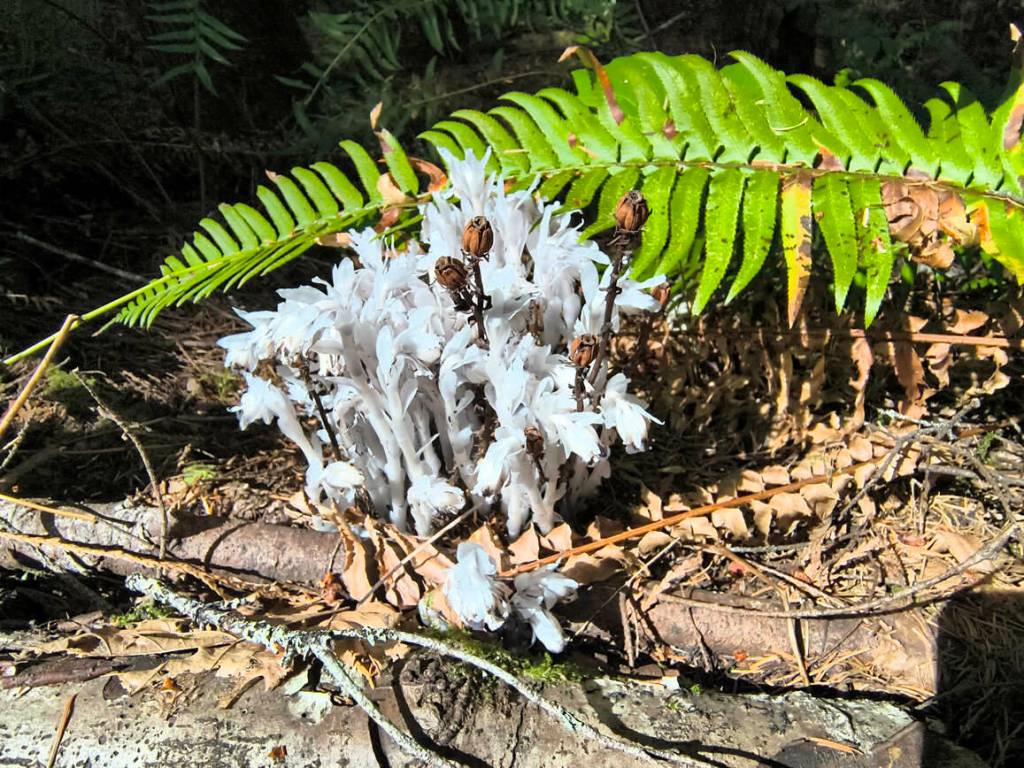
My friend and I saw this otherworldly organism on a hike in Olympic National Park. She said it is a plant, but it isn’t green. If it is a plant, do you think I can grow it in my garden?
The organism you stumbled upon is a plant called Monotropa uniflora (common name: Indian pipe or ghost plant). It grows in shady, damp woods rich in decaying matter and is recognizable by its translucent waxy white stems and scale-like leaves. The plant grows from four to 12 inches high.
Each stem bears a single, nodding flower — also a translucent white — that produces a seed capsule after pollination. As the seed pod ripens, the stem and capsule dry out, turning dark brown or black with a brittle texture. (You can see last year’s seed pods at the center of the photo.)
The Indian pipe is lacking in chlorophyll, the pigment that gives plants their green color, and cannot photosynthesize. For many years scientists thought that it was a “saprophytic plant,” meaning that it lived off decomposed or decaying organic material.
Studies in the late 20th century, however, established that the Indian pipe is a parasite. It taps into a symbiotic relationship between soilborne mycorrhizal fungi and certain trees in which the fungi provide nutrients and water to the trees in exchange for sugars that the trees produce through photosynthesis. The Indian pipe steals the sugars from the fungi without providing anything in return, making it a parasite.
The Indian pipe’s ability to obtain sugars from mycorrhizal fungi allows it to thrive in dark forest environments where sunlight is scarce.
Why is the Indian pipe considered a plant?
Since we think of photosynthesis — the ability to capture energy from sunlight and convert it to food — as a key characteristic of plants, why is the Indian pipe considered a plant?
Organisms categorized as “plants” share a variety of characteristics in addition to the ability to photosynthesize. Here are just a few of their common features:
• They are multicellular and have a membrane around their genetic material.
• They have large vacuoles inside their cells that hold water and help them maintain an upright position.
• They have rigid cell walls made of cellulose that confer additional structural support.
• They are rooted in one place and not as mobile as animals.
Not all organisms labelled as plants demonstrate each of these characteristics. They have enough of these traits, however, to lead scientists to categorize them as plants.
It is believed that the Indian pipe evolved from a green, photosynthesizing plant that first developed a symbiotic relationship with mycorrhizal fungi. In this relationship, the Indian pipe ancestor provided the fungi sugars in exchange for water and nutrients.
At some point, however, the Indian pipe ancestor developed the ability to not only give sugars to but take sugars from the mycorrhizal fungi. As the ancestor plant evolved to become more efficient at taking sugars it no longer had a need to photosynthesize and lost its own chlorophyll.
Can you grow an Indian pipe in your garden?
Replicating the precise conditions required for the Indian pipe to survive would be extremely difficult. The mycorrhizal fungi and mature host trees would need to be present and to have already developed a symbiotic relationship whereby they share water, nutrients and sugars.
If you try to transplant an Indian pipe from the forest, you will sever its connections with the mycorrhizal fungi it feeds off, leading to the rapid decline and eventual death of the Indian pipe.
The bottom line: Enjoy the Indian pipe on your hikes through the woods. You will not be able to grow it in your garden.
_____________________
Jeanette Stehr-Green is a WSU-certified Clallam County Master Gardener. She and her husband, Paul, love hiking in the Olympic National Park and Olympic National Forest and learning about native flora and fauna.



Best of Olympic Peninsula