Sequim students shine at state science and engineering fair
Published 10:39 pm Tuesday, April 21, 2015
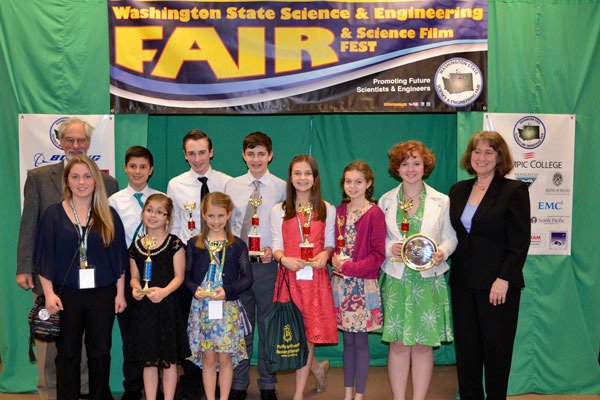
Fifteen Sequim students participated in the 58th Washington State Science and Engineering Fair in Bremerton from March 27-28, earning a total of 13 first-place awards at two award ceremonies.
They competed with 675 students in grades 1-12 who submitted 600 projects for more than 200 awards totaling $1.8 million. An estimated 3,000 students, judges, volunteers, teachers, family and community members attended the fair.
Two Sequim students were selected as the best in their category and a third was selected as a finalist for judging in grades 9-12 to represent Washington State at the International Science and Engineering Fair.
Sequim High School senior Ashley Baltrusitis submitted a project on the removal of dissolved toxic metals from contaminated fresh and seawater environments. For this project Baltrusitis was awarded first place in her category of Environmental Engineering and was selected as a finalist in the state for selecting which five students would attend the International Science and Engineering Fair. She also was awarded several other special awards, including a $20,000 per year renewable scholarship to Ohio Wesleyan University for Outstanding Achievement in Science.
Sean Weber, an eighth-grader at Sequim Middle School, submitted an engineering project on the design of a relatively inexpensive portable luminosity meter to detect toxic levels of metals in seawater using chemical compounds from bioluminescent organisms. Weber was not only awarded first place and the best project in his eighth-grade category, also the C.J. Croswaite Washington State Science Student of the Year. This award recognizes an exceptional student of science in grades 7-8 demonstrating ambition and an ability beyond their peers in their grade levels. In addition, Weber was selected to compete in the National Broadcom MASTERS competition for middle school students and awarded $150 from the International Society for Optics and Photonics.
Isabelle “Iz” MacMurchie, a seventh-grade middle school student, submitted a project that modeled a spider web, then calculated the maximum wind speed it could withstand before breaking. She was awarded first place and the best project in her seventh-grade category. She also was selected to compete in the National Broadcom MASTERS competition for middle school students.
Sequim competitors (by school, grade, project name, award)
Helen Haller Elementary School
Reagan Howe, grade 2 — “How Much Does the Different Temperature of Water Effect the Crystals?” (third place)
Julia Jack, grade 4 — “Does Temperature Affect the Rate of Butterfly Development?” (First Place and Special Awards from the Pacific Science Center)
Alliyah Weber, grade 4 — “Variables Which Affect Tooth Enamel Erosion” (First Place and Special Awards from the Pacific Science Center and the Washington Oral Health Foundation)
Sequim Middle School
Elizabeth (Grace) Bennett, grade 7 — “Simulated Lunar Dust Filtration” (First Place and Special Awards from the American Institute of Aeronautics & Astronautics PNW for Excellence in Aeronautics and Astronautics)
Nicholas Charters, grade 7 — “Testing Different Materials for Impact Variations” (First Place)
Connor Gosset, grade 7 — “RF Radiation In Microwaves” (Third Place)
Brianna Jack, grade 7 — “Utilization of Euglena as a Bio Filter for Nitrates” (First Place and Special Awards from the Broadcom MASTERS, Graphic Design and the USDA Forest Service Pacific Northwest Research Stations Outstanding Natural Resource Science Project)
Isabelle MacMurchie, grade 7 — “Breaking a Spider Web by Subjecting It to Wind Using a Mathematical Model” (First Place, Best of 7th Grade Category, and Special Awards from the Broadcom MASTERS and the Pacific Science Center Outstanding Grade 7 Project)
Vita Olson, grade 7 — “The Effect of Water Velocity on the Bank Erosion of McDonald Creek” (First Place and Special Awards from the Pacific Science Center – Project of Merit and the Association for Women Geoscientists – PNW Chapter – Award of Excellence)
Bailey Cauffman, grade 8 — “The Math Behind Making A Basket” (First Place)
Brenden Jack, grade 8 — “Designing a Sailplane with Solar Panels to Fly Continuously During Daylight Hours” (First Place and Special Awards from the Bonneville Power Administration (BPA) and the Museum of Flight “Sight of Flight”)
Aaron Jackson, grade 8 — “It’s Not Rocket Science … Wait, It Is” (First Place)
Sean Weber, grade 8 — “Designing a Luminosity Meter to Detect Toxins Using Bioluminescence” (First Place, Best of 8th Grade Category, and Special Awards from the Broadcom MASTERS, Pacific Science Center – Project of Merit, SPIE – The International Society for Optics and Photonics and the C.J. Croswaite Washington State Science Student of the Year — Grades 7-8)
Sequim High School
Nicholas Howe, grade 11 — “Light Bulb Efficiency” (First Place and Special Awards from the International Society for Optics and Photonics — SPIE, Wolfram Research, Inc. Mathematica Software and the Ohio Wesleyan University Outstanding Achievement in Science Scholarship)
Ashley Baltrusitis, grade 12 — “Removal of Metals from Aquatic Ecosystems Using Zeolites” (First Place and Special Awards from the American Chemical Society, Ricoh Americas Corporation Sustainable Development, Water Environment Federation U.S. Regional Stockholm Junior Water Prize, Marine Sciences for Outstanding Research, Washington NASA Space Grant Consortium for a Project in Engineering Discipline, Wolfram Research, Inc. Mathematica Software and the Ohio Wesleyan University Outstanding Achievement in Science Scholarship).


Best of Olympic Peninsula