
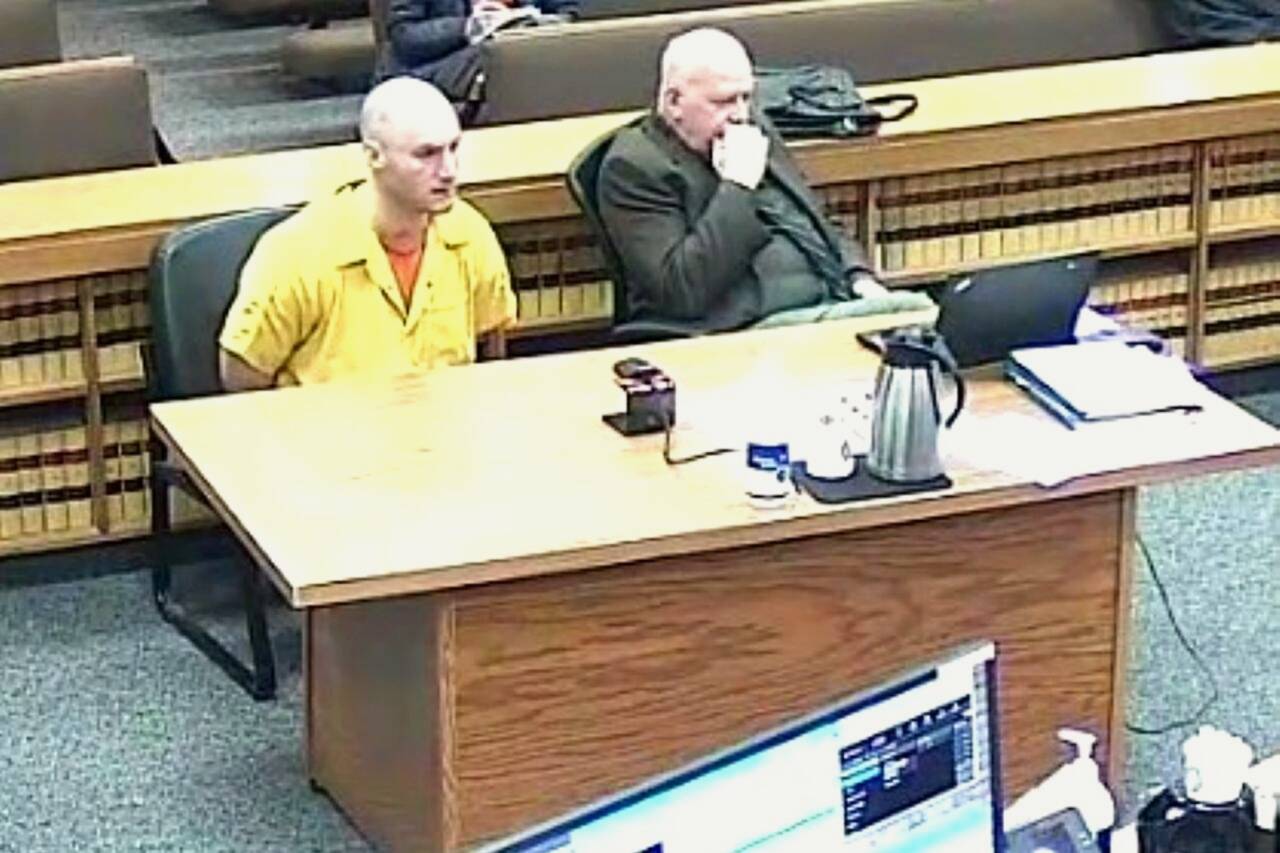
Sequim man Bret Allen Kenney, 37, has once again been recommended for civil commitment at Western State Hospital after a forensic examiner opined that he could not assist in his own defense due to his current state.
Kenney was facing a first degree premeditated murder charge for allegedly killing his mother and a second-degree attempted murder charge involving a Sequim police officer, both in May 2022. However, Judge Brent Basden agreed on Jan. 30 to dismiss the charges without prejudice, and ordered a civil commitment evaluation within 120 hours (or by Feb. 5) at Western State Hospital.
The Jan. 28 “Competency Evaluation Report” states that Kenney was diagnosed with schizophrenia, he lacks capacity to proceed with assisting in his own defense, and that restoration was not recommended.
Defense attorney John Hayden had requested Kenney’s evaluation on Jan. 8 with Clallam County Chief Criminal Deputy Prosecuting Attorney Michele Devlin in agreement.
Devlin wrote in an email reply that the civil commitment process will be the same as when Kenney’s charges were dismissed without prejudice on June 7, 2023. With the charges dismissed without prejudice, they can be refiled in court if his competency to stand trial is restored. Kenney’s latest arraignment was set for Jan. 8 until Hayden requested the evaluation.
Two other charges of first-degree assault and disarming a law enforcement officer were dismissed on Jan. 5 of this year as the statute of limitations had expired. Devlin previously said in court that the murder and assault charges do not expire.
Kenney was accused of the first-degree premeditated murder of his 53-year-old mother, Teri Ward of Sequim, who was found dead in her home from multiple sharp-force injuries on May 19, 2022.
He’s also accused of attempted second-degree murder of Sequim Police Officer Daniel Martinez during a traffic stop on May 19, 2022 in downtown Sequim where Kenney allegedly tackled Martinez, and wrestled for Martinez’s gun, which discharged, court documents state.
Following Basden’s Jan. 30, 2026 order for Kenney’s evaluation, he was referred to Attorney General Nick Brown’s office, which handles civil commitment cases.
A spokesperson for Brown’s office said in early January that state law prohibits them from providing the name of the facility a patient is in unless they are pending transfer to another facility, releasing to a less restrictive alternative placement, or discharging from commitment with notice provided to law enforcement and prosecutors.
Department of Social and Health Services (DSHS) doctors evaluate patients for potential civil commitment and, if appropriate, file a petition asking the court to civilly commit the defendant, the spokesperson said. Commitments are renewed every 180 days.
Dr. Sydnee Erickson, forensic evaluator for Western State Hospital, wrote in her Jan. 28 examination that Kenney is considered to be at a significantly elevated risk for re-offending and dangerous behavior when compared to the general population, and that his risk for both future dangerousness and re-offending would likely further increase if he were to become non-adherent to psychotropic medication.
Erickson wrote that since Kenney’s last restoration treatment ended around May 2023, he has been taking a medication considered the gold standard for treatment-resistant schizophrenia, but “despite adherence to (it) for over two years, Mr. Kenney continues to present with rigid delusional ideation, auditory hallucinations, and limited insight.”
She wrote that they have attempted specialized psychotherapeutic techniques with minimal change. Erickson wrote that Kenney is eligible for competency restoration but “his responsivity to treatment has declined in more recent years (i.e. remaining symptomatic despite adherence to extensive regiments of medications with increased doses across time).”
Kenney’s doctors observed him to have paranoid delusions, ongoing hallucinations, and fluctuating anger and depression despite compliance with medications.
Court documents state that he has had various criminal convictions since 2007 as an adult, and he began receiving mental health treatment in 2006.