A love of journalism — and those who keep our lights on
Published 1:30 am Wednesday, February 11, 2026




One day last month, an idea hit me: With Valentine’s Day approaching, what if we found out who are the longest subscribers to the Sequim Gazette and then randomly pick one of them to win a free Valentine’s Day dinner at a local restaurant willing to partner with us?
Immediately, Marie Dickinson, owner of Mariner Cafe, was on board.
I was provided a list of the Gazette’s top 10 longtime subscribers, though the person who compiled the list was unable to determine exactly how long each had been a subscriber due to a software change. If I’d had that information, my first call would have been to the person I knew had the longest-running subscription. But with that information not available, I started with Robert and Jean Blaurock. They were third on the list, but, as joint subscribers, they were clearly a couple. As such, they might appreciate a free Valentine’s Day dinner.
But when I called, Jean Blaurock told me that unfortunately she would not be able to accept the offer. Her husband had passed away, she said, and her own health issues prevented an outing to a restaurant. Before hanging up, Mrs. Blaurock told me that she has been a subscriber to the Sequim Gazette since 1986 — some 40 years.
Next I called Larry Barnes, who was actually the first person on the list. Turns out, Barnes is married — to Linda Haabala. He said he has been a subscriber to the Gazette for 20 or more years.
Although Barnes and Haabala already had plans for Valentine’s Day, they happily accepted a chance to dine pre-Valentine’s Day at Mariner Cafe. It is one of their favorite restaurants, Barnes told me, and they know Dickinson, the owner.
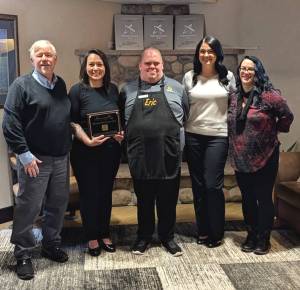
The result was a photo that represents the lifeblood of any newspaper: an advertiser (Dickinson) and a subscriber (Barnes, along with his wife).
As we approach the holiday when we tell those who are special to us how much we love and appreciate them, it seems appropriate that we here at the Gazette tell our readers how much we appreciate their loyalty and support.
This seems especially relevant in light of what happened last week at The Washington Post, a stalwart of journalism that came under the ownership of billionaire Jeff Bezos in 2013. In last week’s blood-letting, 300 jobs were cut — one-third of the newspaper’s staff. Foreign correspondent Lizzie Johnson posted on X that she was “devastated” after having been fired while she was literally in the middle of a war zone.
But it’s no secret that newspapers across the country have been struggling for some time now. As someone who has been in this business a long time, I have watched the down-slide with sadness. The rise of social media and seemingly relentles attacks on journalists had a lot to do with it.
When layoffs began happening at a large newspaper in the southwest where I had once worked, I was shocked when some of those who were let go were award-winning reporters and photographers. Once I thought about it, I realized why: their accomplishments and experience meant that they were among the highest paid. Investigative journalists whose work had led to significant, meaningful change found themselves out of work or forced to take a buy-out. In essence, they were punished for having done good work.
Here in Washington, a March 2025 study by Washington State University found that newsrooms in the state are widely described as under-resourced, gutted, and in crisis, with repeated layoffs and shrinking staffs severely limiting coverage of civic affairs.
The Gazette doesn’t have the number of staff members it had back in the day, before my time here, but thanks to longtime reporter and Associate Editor Matt Nash, city council meetings, school board meetings and court hearings are still being covered, and they’re being covered regularly. We’re not perfect, and we don’t have the bandwidth to cover everything, but we’re doing our best. To us — and to many still working in the journalism trenches — the mission still matters.
Investigative journalist Bob Woodward, who, along with fellow Post reporter Carl Bernstein exposed the Watergate scandal that led to the resignation of President Richard Nixon in 1974, popularized the phrase “Democracy dies in darkness.” Ironically, the phrase was adopted as The Washington Post’s slogan in 2017 under Bezos’ ownership.
While it might seem that covering city council meetings, school board gatherings and other local news might not be all that important in the grand scheme of things, it is indeed important. A number of studies have associated news deserts with lower voter turnout and the increased spread of misinformation. News deserts are spreading across the country as, one after another, community newspapers are forced to turn out the lights and lock their doors.
Before moving to the Olympic Peninsula two-and-a-half years ago, I worked at a newspaper that had its own press. The wall that separated the press room from the newsroom had large windows. At times I would stand at those windows and feel a chill as the press guys cranked up the press and yelled instructions to each other over the roar of machinery. I watched with pride as the papers began rolling down the conveyor belt, one after another.
Corny, I know. But to me it symbolized informing the public about things it needed to know, whether it was the city council’s consideration of a proposed major development or an elected official whose actions had led to a federal lawsuit that left county taxpayers on the hook. The news, whatever it was, mattered. It did then, and it does now.
If the presses ever go silent, if the lights are ever turned off, democracy will die. Thank you for helping us keep the lights on.