Olympic Home Share gains traction in Clallam County
Published 4:30 am Wednesday, August 5, 2026
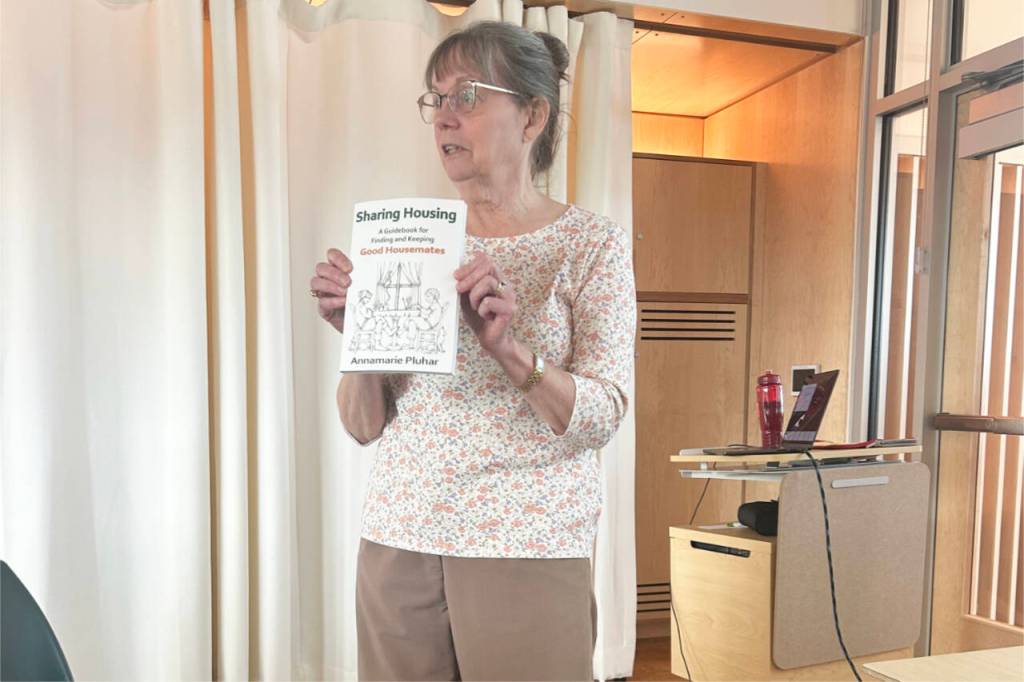
Dr. Nancy Stephanz hopes a new home-sharing program on the North Olympic Peninsula will help renters find affordable housing and homeowners find companionship along with a bit of extra money each month.
Olympic Home Share, operated locally in partnership with the for-profit company Nesterly, matches homeowners with extra space to renters who need an affordable room. The program was touted by Stephanz, a retired physician who moved to Port Angeles 10 years ago, as a way to address the lack of affordable housing in the area. The program launched in Clallam County earlier this year and has already produced six thus-far successful matches in less than six months, she said.
A half dozen people attended an evening presentation by Stephanz at the Sequim Library on Wednesday, July 29.
“This is temporary assistance to try to get people back on their feet in terms of the guests, and it’s assistance for the home share hosts for their lifestyle,” Stephanz told the attendees.
Stephanz emphasized that Nesterly is built around thorough vetting and hands-on support, aimed at preventing the “bad tenant” scenarios that often scare homeowners away from renting a room.
To enter the system, both hosts and guests must provide two letters of reference, which Nesterly verifies, and pass multi-level background checks, including criminal records, sex offender registries, and patterns of frequent address changes.
If they pass, Nesterly’s social worker staff help craft a written agreement between host and guest.
“They start with the homeowner, and they say, ‘What are your house rules going to be?’” Stephanz explained. That includes quiet hours, expectations around pets and children, rules for overnight visitors, and even specifics like musical instrument practice.
Nesterly staff then remain involved. Paid social workers call each client monthly to check how the arrangement is going, and they are available during business hours to help resolve any issues. They don’t provide legal representation but function as a real-time dispute resolution resource.
Fees, rent and ‘task exchanges’
The cost structure is designed to be modest and predictable for both sides. Once a match is made, there is a one-time fee to both host and guest that depends on lease length:
About $95 each for leases three months or shorter
About $195 each for a full year
Regardless of the length of the lease, either party can end the arrangement at any time with 30 days notice.
Nesterly also retains 2.5% of the monthly rent, which Stephanz said likely goes largely to the digital payment processor, which she assumes may be Stripe. One of the program’s most valued features, she said, is that hosts never have to ask for the rent: the digital payment processor automatically withdraws funds from the guest’s account three days before the end of the month, routes Nesterly’s portion, and deposits the rest into the host’s account on the first of the month.
Unlike many rentals in the current market, Nesterly does not require first and last month’s rent or a security deposit. If a host insists on deposits, they must arrange and collect those themselves.
The program also encourages what it calls “task exchanges”: reduced rent in exchange for help around the home. Hosts have used this for yard work, pet care, plant watering, and other routine tasks.
Stephanz detailed an example of a couple who described their property as a goat farm initially and listed a full floor of their home for $1,200 a month. After negotiating a task exchange with a pregnant veteran who now helps with chores, they agreed on $700 a month.
“She’ll have adoptive grandparents when that baby comes,” Stephanz said.
Data and long-term impact
Stephanz cited 2025 data from HomeShare Vermont, a 43-year-old program on which Nesterly, founded in 2017, modeled its approach. In that year, between 100 and 125 hosts participated, and a total of around 300 people benefited when household members were included.
Hosts there saved more than half a million dollars because guests contributed an estimated 38,000 hours of assistance. Guests, meanwhile, saved over $880,000 in housing costs compared with market-rate rents.
The model, Stephanz said, can give renters enough breathing room to pay down debts, secure childcare, or save for their own housing.
“If you can give someone low rent for just a few months, they can save up enough money to get their own place, or pay off their car loan, or pay off their student debt, or pay for daycare,” she said.
Surveys from the Vermont program also show quality-of-life gains for hosts:
80% report feeling happier
79% feel safer and less lonely
71% say they enjoy their home more
44% call family less often for help
Homeowners and tenants do not have to start out as strangers. They can already know each other, and even be friends.
“You can actually set up your own match outside of Nesterly,” Stephanz said, “and then they will facilitate it for you.”
Funding, expansion
Bringing Nesterly to Clallam County required a local contract with a partner agency. The Port Angeles Chamber of Commerce, led by Executive Director Marc Abshire, agreed to sign on behalf of the community.
There was a one-time onboarding fee of $5,000, followed by a monthly charge of $2,895, bringing the first year’s cost to just under $40,000 for the entire county, Stephanz said. The City of Port Angeles contributed $9,000, the Clallam County Economic Development Council added $10,000, and Stephanz herself, along with several other supporters, covered the remainder.
Going forward, as long as there is no gap in service that would trigger re-onboarding, the annual operating cost is expected to drop to under $35,000. In Stephanz’s view, it is the most cost-effective way to add affordable housing in the county.
The program is branded locally as Olympic Home Share to reflect ambitions beyond Clallam County. Organizers hope that Jefferson, Grays Harbor, and Kitsap counties will eventually join, extending the service area across more of the Olympic Peninsula.
In the meantime, Stephanz is focused on spreading the word.
“I will talk anywhere anybody will let me talk,” she said, listing libraries, senior centers, civic clubs, and churches.
“Please think about your friends,” she urged those who attended her presentation at the Sequim Library, noting that if a friend is rarely able to meet for lunch, that might be an indication they are struggling to pay rent.
“We need to think of new ways to help each other, because nobody else is going to help us.”
Find out more about Nesterly and Olympic Home Share on the Port Angeles chamber’s website, portangeles.org, or on the website of United Way of Clallam County, unitedwayclallam.org.




Best of Olympic Peninsula