Get It Growing: Warming up to extending the growing season
Published 1:31 am Wednesday, October 5, 2016
Residents of the North Olympic Peninsula are fortunate that there is rarely a time when the soil freezes (except for those living at higher elevations). As a result, local gardeners can keep fresh vegetables growing in their garden during most months of the year.
As temperatures dip below 40 degrees, however, vegetable plants begin to slow their respiration and photosynthesis, decreasing overall growth rates substantially. A successful winter vegetable garden, therefore, requires a few extra steps to ensure that plants are kept warm on cooler days. Increasing the air temperature around plants by just 4-5 degrees can result in significant benefits to the health and growth rate of vegetables.
To warm the air around winter vegetables, several methods can be used.
Cloches
Cloches are a popular method to warm individual plants. Materials such as plastic soda bottles, plastic milk cartons and glass jars with an open end can be slid over small seedlings and individual plants to protect them from the cold.
If using a cloche, the plants may warm up significantly on sunny days. Therefore, cloches may either need to be removed or vented to allow better circulation during the daytime hours.
Cold frames
Cold frames are greenhouse-like structures used to not only keep winter vegetables warm, but protect seedlings and cold-sensitive plants throughout the year.
Cold frames are rectangular structures usually made of wood or cinder-blocks that are partially sunk into the ground and covered with a transparent window on the top. This window can be made out of materials such as glass, fiberglass or plastic. Light is transmitted through the window to the plants inside the cold frame. These windows also should be able to slide or lift open to allow ventilation during warm or sunny days.
Low tunnels
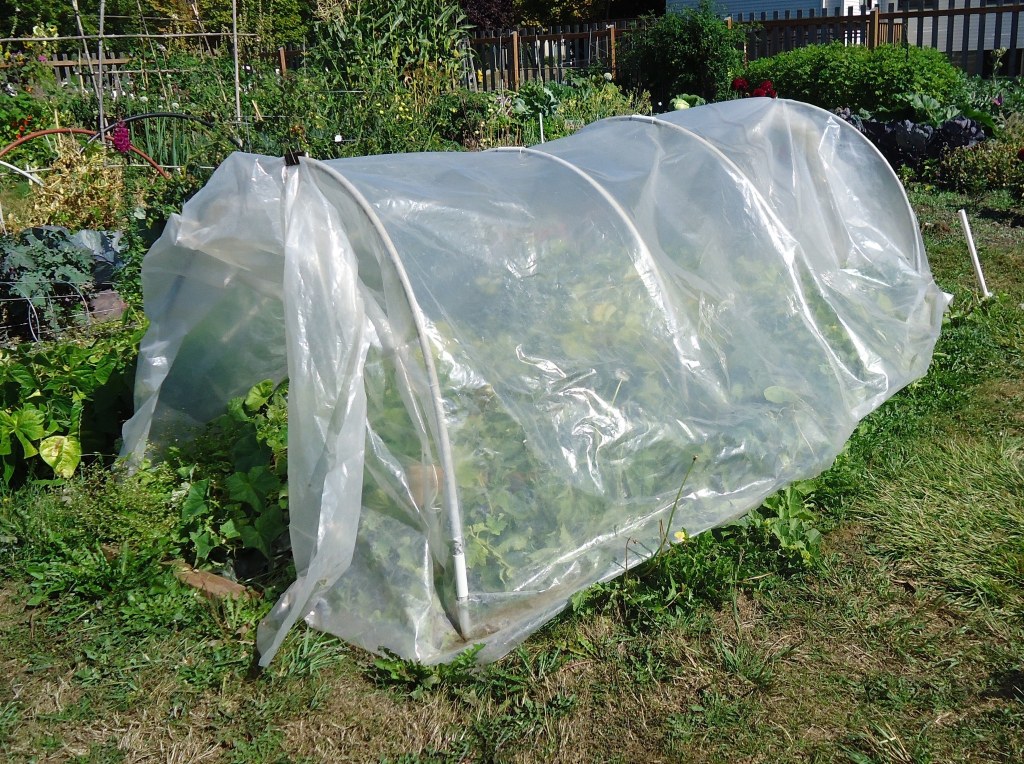
A low tunnel is a structure made out of hoops which is covered during the cooler months to provide extra insulation to plants.
The key to a low tunnel is to have strong structural supports. PVC tubing commonly is used to make hoops that are either attached to the frame of a raised bed or slid over rebar that has been driven into the ground. Hoops should be erected no more than 5 feet apart; they can be connected by a cross-bar at the peak of the hoops for added support.
The hoops are then covered with clear plastic (preferably 6 mil thick) or row cover such as Reemay® or Agribon®. Row covers can be purchased in various thicknesses. Choose one that allows good light transmission, but also traps an adequate amount of heat for the conditions.
Once covered, the material then needs to be securely fastened to the ground. Instead of putting your garden to bed after the last summer vegetable is harvested, consider ways to extend the growing season. Protecting your plants from cool temperatures, by using cloches, cold frames or low tunnels, is one of the best ways to ensure that you and your family can continue to enjoy fresh produce well into the winter months.
Pearl of wisdom
One of the easiest ways to protect plants is to remove the base from clean plastic gallon or half gallon milk jugs and place the jugs over individual plants that need protection. Remove the lids from the milk jugs during the day for ventilation; close the lids on cold nights to protect plants from frost.
For more
Get free gardening help by visiting local Master Gardener plant clinics, held on Saturdays through Oct. 8 at the Demonstration Garden, 2711 Woodcock Road in Sequim, and Mondays through Oct. 24 at the Clallam County Courthouse, 223 E. Fourth St., Port Angeles. All clinics run from 9 a.m.-1 p.m. Bring your gardening questions, samples from problem plants and garden pests.
Lorrie Hamilton is the Clallam County Master Gardener Program Coordinator.



Best of Olympic Peninsula