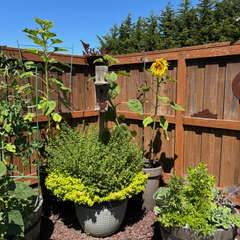
Do limited time, space, or gardening knowledge keep you from growing your own food? Container gardening may be the perfect solution.
While it’s often used to overcome space limitations, pest problems, or poor soil, it also offers benefits like better time management, accessibility for people with disabilities, and a fun, manageable hobby for beginners.
Let’s think inside the box and explore how container gardening might work for you.
Start with location
Your first decision is where to place your containers. This will depend on what you want to grow. Ideally, find a spot that gets 6-8 hours of sunlight daily, but many ornamentals and some vegetables can thrive with less. Also consider practical factors: Is there easy access to water? Is it convenient? Does the area offer some wind protection?
If you’re using containers or creating elevated raised beds for accessibility, be sure the area has smooth paths and enough room to accommodate mobility devices.
Pick your plants
Start with what you like to eat or look at! Research plant varieties suited to container growing. Seed packets, plant tags, and nursery staff are great resources for figuring out what will do well in your space and climate. Consider starting with plant starts for faster results.
Choose containers
You can grow plants in just about anything that holds soil, drains well, and won’t leach harmful substances. Beautiful ceramic pots, fabric grow bags, lined milk crates, and even a claw-footed bathtub are all great options. Let your imagination run. If you’re handy, you can build your own containers — simple wooden box designs can be modified for height or size to fit your needs.
Get the right soil
Container soil must be well-draining, clean, moisture-retentive, and light enough to avoid compaction. For most small to medium projects, a high-quality commercial potting (soilless) mix is a smart and easy choice.
Watering basics
Containers dry out more quickly than in-ground gardens. In the heat of the summer, you may need to water daily. Just like regular garden beds, its a great idea to mulch your containers to conserve moisture.
Fertilizing
Both organic and synthetic fertilizers work well in containers, as long as they’re labeled for what you are growing. Choose a complete fertilizer with nitrogen (N), phosphorus (P), and potassium (K). Using a slow release fertilizer when planting is a great time saver.
Organic options, which support a healthier soil, are a good choice, especially for edibles.
The fine print
Many plants do well in containers, even some varieties of tomatoes, hydrangea or berries. The trick is picking the right variety and understanding their requirements. For example, tomatoes need deep soil and staking and blueberries require very acidic soil.
With a little research and planning, so many things can be grown successfully — just be aware of their specific needs.
Learn more
A great resource for container gardening is the Washington State University Extension website: gardening.wsu.edu. It offers a wealth of easy-to-read, research-based publications for gardeners of all levels.
If you are interested in learning more about container gardening, don’t miss the next Digging Deeper Saturdays series. The topic on Aug. 16 will be “Container Gardening — Vegetables, Fruit and Flowers.”
The free event will take place from 10:30 a.m. to noon at the Woodcock Demonstration Garden, 2711 Woodcock Road in Sequim.
Also that day, at the same location, Master Gardeners will host a Plant Clinic from 9:30 a.m. to 12:30 p.m.
Bring your questions, samples and photos, and Master Gardeners will research the problem.
____________
Soilless potting mix is a growing medium made from organic and inorganic materials that contains no natural soil (dirt). It is designed to support plant growth by providing moisture retention, aeration and nutrient delivery. Common ingredients include peat moss, coco coir, perlite, vermiculite, and well composted bark. This type of medium, or potting mix, is commonly used in containers, greenhouses, and seed starting because it’s lightweight, sterile (free of weed seeds and pathogens), and can be formulated for different plant needs.
____________
Susan Kalmar is a WSU Clallam County Master Gardener.