Guest Column: The Next Chapter
Published 1:30 am Wednesday, February 5, 2025

I grew up on an island in a small town pretty much like Sequim. In such a place everyone knows everyone else and their kids, or if you don’t, you eventually meet them at a school function, the post office, or at the one movie house in town. You can walk to the market, the school, the church and the hospital without breaking a sweat. When I close my eyes, I can be back under the dark skies and the bright stars of that place, and I can smell the fresh, salty air of the sea.
My siblings and I played on a farm or near a mangrove swamp and filled our time hunting for fiddler crabs during low tides. We were never far from the sea, and when the monsoon season brought wind and heavy rains, we were on the lookout for whatever strange creatures the waves might wash ashore behind my grandfather’s house. Occasionally, the sea brought us a Pacific man o’ war, which looks like a giant jellyfish the size of a wash basin. Some memorable storms pushed saltwater to the stairs to our home. It was life as we knew it; the sea was a familiar presence, and we lived and breathed it. When my family left the island and moved to the big city, I bid goodbye to the dark, starry skies, but the scent of the sea remained with me.
When I left my family’s home for the first time, I moved to the central Anatolian region of Turkey. The closest body of water was the Black Sea, 125 miles away. We do learn much about a city from the smells that permeate it. This one smelled of cheap cigarettes, freshly brewed coffee, fresh breads, and mouth watering kebabs. In wintertime, the air was redolent of the cow dung burned for heating and the roasted chestnuts sold by street vendors. For the first time, it felt suffocating to live so far from the water.
Some time later, given an opportunity to move to Istanbul, my husband and I leaped at the chance. We landed in a sparsely furnished apartment on the European side of the city with two suitcases, two cats, and not much else. We were just a few steps from the sparkling blue waters of the Bosporus Strait, and I was happy.
Over the years, we moved houses more times than I could count. I started gardens that were never completed. I planted banana and guava trees that began fruiting just as we were packing out. I planted Arabian jasmine shrubs next to the dining room windows for their fragrant flowers that we never got to enjoy. I recognized my “placelessness” in the scheme of things. I got married in one continent, and gave birth in another; my father died the same year as my husband’s mother, in opposite parts of the world. My ancestral home now exists only in memory. I’ve come to envy people who live in one place, one neighborhood, all their lives. To see the trees you planted as saplings grow to maturity seems like a dream.
Noted author of the American west Wallace Stegner once wrote about “placed” people — “lovers of known earth, known weathers, and known neighbors both human and nonhuman,” and their opposite, a species that is non-territorial, a person — “acquainted with many places … rooted in none.” Stegner writes, “whatever their relation to it,” a place is “made a place only by slow accrual, like a coral reef.”
Knowing a place as Stegner writes about it is something you can’t find on Google Maps. It is the kind of knowing that comes from the physical presence and smell of the place, from the memory of having lived in the place, and from the known history of the people and creatures who shared it with you. Here, I became acquainted with the weather, with the eagles nesting nearby, with the lavender fields and the coyotes howling at night. I became familiar with the high, gauzy cirrocumulus clouds in the morning, the dramatic layers of altocumulus at sunset, the occasional rainbows, the winds from the west and off the northern shore that turn the fields of grass into rippling waves of green. I got to know the people who shared the same space with me and their stories. Perhaps, as in Stegner’s words, I have learned to “be quiet part of the time, and acquire the sense not of ownership but of belonging.”
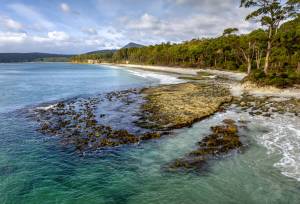
Coming back to Sequim after traveling elsewhere now brings a sense of comfort. Some days, I stop at the edge of the water flowing into the Pacific Ocean and imagine myself sending a signal to the old island — we are connected still, but I’m slowly accruing memories here, like a coral reef.
___________
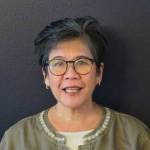
Ruby E. Carlino is a published writer with over a decade of blogging experience and a background as a technology analyst. She has lived in Sequim since 2018, after spending years in Asia, Central America, Europe, and the Washington, D.C. area during her husband’s diplomatic assignments. She can be reached at nextchaptercolumn@proton.me.