Global Running Day: Jogging my memory about lessons learned from my running days
Published 1:30 am Wednesday, June 3, 2026
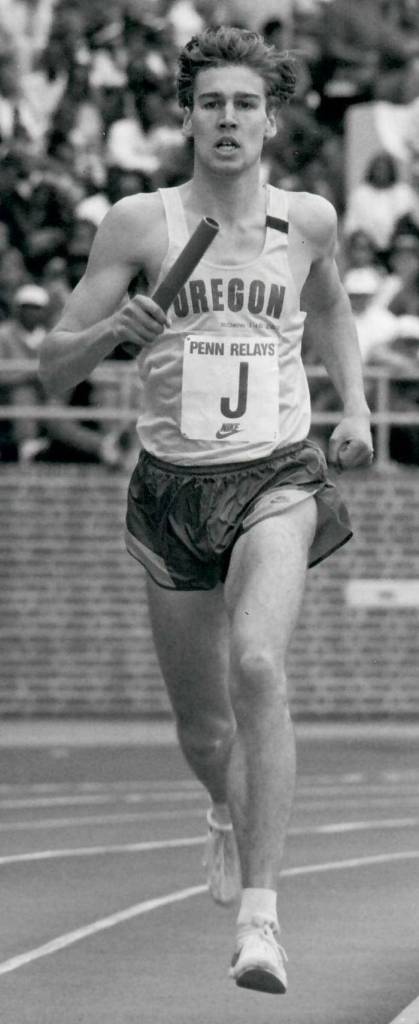
By Tracy Hollister
For the Sequim Gazette
During the late 1960’s, my father Geoff Hollister was a distance runner on the University of Oregon track team under head coach Bill Bowerman, the most impactful man in my father’s life. Bowerman had recently coined the term “jogging.” He wrote a book called “Jogging,” and promoted the health benefits for people of all ages.
Jogging classes for the public were taught mostly by his athletes, by guys like my dad. Running was the tool with which Bowerman forged boys into men, and he created a legacy of champions that continues to funnel out of Eugene, Oregon to this day. The shoes Bill Bowerman cobbled for his athletes became Nike. My dad was there, selling the first Nike running shoes out of the back of his VW bus with Steve Prefontaine, the first person to win a race with Nike shoes on his feet.
Global Running Day 2026 is the first Wednesday in June. Millions of people from 177 countries are pledging to go for a run for the health of it.
My dad, coach Bowerman, and “Pre” would be proud to see jogging celebrated around the world, for it was their innovation, their lionhearted struggle, and their dedication to human betterment and wellbeing that sparked the awareness and participation 60 years ago.
Since then, it has been observed that running regularly improves cardio-vascular health, bone density, muscle development, joint health, mood, and overall longevity — meaning it helps prevent heart attack, heart disease, arthritis, Alzheimer’s, cancer, and makes you live longer and live better.
It’s not the most fun thing to do, I know. After a few weeks of easy regular running, it becomes routine and something happens — you want more, more of the good hurt. Your body is literally asking for it. There are plenty of days when your lazy brain doesn’t want to go run, and you make yourself go. No more procrastinating, no more complacency, you lace up the trainers and begrudgingly get out the door.
Within five minutes, the endorphins are starting to flow, your body is thanking you with dopamine, you are glad you are putting in some miles and getting a sweat on. As human beings, we are born to run. We are human, we have more endurance traits than most land mammals, and we can even outrun a horse, given enough time!
A healthy habit of running is a series of small accomplishments that create confidence. Each run is a building block that boosts fitness and puts a certain tenacity into everything else you do during your day. The mindset of a runner is very much in the moment. This is where the brain is most productive and at ease. It’s also the most difficult time perspective to maintain. Our minds are often worried about the future, or regretful of the past. Both are out of our control, and both cause fatigue and disease.
Feeling your footfalls on a forest path and seeing your hot breath hit the cool air, there is no other time than the present. You will never run this run again. Make it count. You are in the now. It becomes practice, ritual — a healthy order in life.
Importance of moderation
A word of caution regarding running becoming additive. Without moderation in your training regime, you will run yourself into the ground and experience lethargy and injury. Moderation, another critical lesson in life taught to me the hard way by running without brains.
Embrace the rest days — they are just as important as the hard effort days in a training cycle — and never increase your weekly mileage by more than 15%. As a high school athlete, I obeyed the rules. There was constant expert oversight from my coaches and my dad. As a senior I performed well, capturing the Oregon cross country championship, and the fastest 1500 meters in the state in 1991, placing me in the top five nationwide. Those two performances earned me a full scholarship to the University of Oregon.
I mention this for the young runners. There are more than health benefits for a person who enjoys running — there is money. Intending to elevate the success I achieved in high school competition to the NCAA division 1 did not go as planned. There was less oversight, and I was free to run too hard. I thought more mileage was better, and I broke the training principles which led to lackluster performance on race day, and three permanent injuries before my senior year at Oregon was complete.
Had I honored the rest days, and the principle of moderation, my college running career would have been much brighter. But as Coach Bowerman once told me, “You are enrolled at the university to get an education.”