Get It Growing: Get the dirt on soil testing
Published 3:30 am Wednesday, October 22, 2025


By Dale Dalaman
As the end of the growing season is approaching, it is a good time to take stock and reflect on the season.
What went well in the garden? What didn’t go so well? What could be changed or done differently?
These answers help formulate a game plan or strategy for the next growing season.
While it may be too soon to start planting a spring garden, now is the perfect time to take a major step in preparing for the new season.
That step is soil testing.
All plants, like humans, require nutrition and water to live and thrive.
Like humans, not every plant requires the same soil composition or nutrients to thrive.
Blueberries, for example, like highly acidic soils, while brassicas (such as cabbage, broccoli, and kale) do best in more alkaline soil.
And then of course, there is the ever-present N-P-K requirements.
N-P-K refers to the three essential primary macronutrients that plants need to grow: Nitrogen (N), Phosphorus (P), and K (Potassium). Nitrogen promotes leafy green growth, phosphorus is vital for root development and flowering, and potassium supports overall plant health and disease resistance.
How do we know what N-P-K levels currently exist if the soil is not tested? Too much or too little of these nutrients can impact the garden and possibly the environment.
There are three primary reasons to get a soil test:
• To achieve a healthy garden and/or lawn. (Not everyone wants a lawn, but for those that do, a soil test will identify specific nutrient needs and pH levels required to keep it looking nice.)
• To avoid over fertilization. The test results received will identify and recommend how much and what type of fertilizer to use, preventing over-application that can harm the garden and pollute local waterways.
• To save money by buying only those products that are needed.
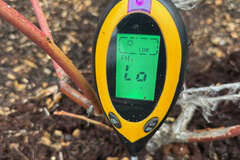
Soil testing provides key information about nutrient levels, soil pH, and organic matter.
This information can help the gardener make changes to improve crop productivity, reduce fertilizer waste, and support sustainable land management practices.
Tailored fertilization helps prevent nutrient runoff, ultimately benefiting the homeowners’ production and the environment.
The Clallam County Conservation District conducts soil testing for residents of the community for a fee of $35 per test.
The county requires a three-pound sample.
This is equivalent to about a one-gallon zip-lock bag. A full bag may be required to meet the weight requirement if it is a light soil or potting mix.
They will ask you to identify what has been growing in the sample area as well as what you plan on growing there next season.
It doesn’t need to be specific varieties, but a general idea is helpful so they can provide more specific recommendations.
For example, vegetables, ornamentals, berries, fruit orchards, etc., are good categories to provide them.
The Clallam Conservation District website page at https://clallamcd.org/soil-testing provides comprehensive instructions on how to gather and submit soil samples.
It’s crucial to thoroughly read all the directions provided.
The soil report will include recommended applications to correct your soil for the plants or crops you plan to grow.
The Conservation District or the Clallam County Master Gardeners can help answer any questions you may have about those results.
It may sound like a little extra work and money, but it will save you both in the longrun.
If you are interested in learning more about soil testing, the Washington State University extension publication “A Home Gardener’s Guide to Soil and Fertilizers” is available at pubs.extension.wsu.edu. Search for EM063E, or by title.
Happy growing, and may all your plants grow and thrive.
And remember, a soil test helps achieve that goal.
________
Dale Dalaman is a WSU Clallam County Master Gardener intern.


Best of Olympic Peninsula